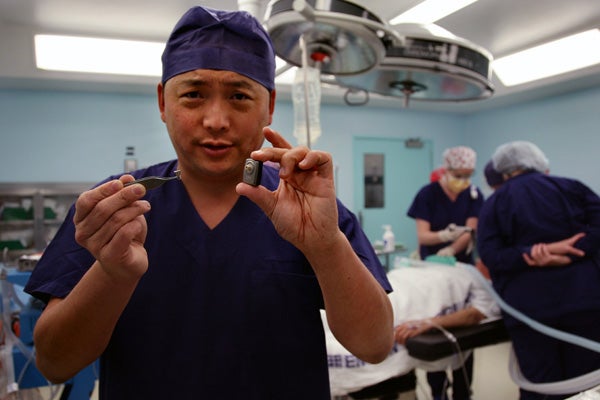
MP3-Ready Hearing Aids Sydney Morning Herald/Kate Geraghty

The Sydney Morning Herald reports today on an Aussie man who traveled all the way to Beverly Hills to receive bone-anchored hearing aids, which are implanted behind the ear and use conductive technology to transmit sound more effectively than regular in-ear aids. But here's the real bonus--these let you plug in your MP3 player or cellphone directly via a standard headphone jack.

The Baha (bone-anchored hearing aid) Divino, made by Cochlear, has been out for a few years now, but you can't help but be impressed with hearing aids that come complete an adapter that lets you plug in virtually any audio source for enjoyment (an MP3 player seems the most logical, but TVs and Stereos are also possible).

The hearing aids work when titanium screws are drilled into the bone behind the ear. Then the aids are attached, which use the natural resonance of the bone to provide hearing that is 25 percent better than standard, amplified hearing aids. A digital signal processor filters noise.

The hearing aid implants cost $6,000 apiece, and last 15 years. [Sydney Morning Herald]

Want to learn more about breakthroughs in electronics, medicine, nanotech, and more?
Subscribe to Popular Science today, for less than $1 per issue!

6 Comments

Add Bluetooth and I'm in, and I can hear perfectly well. Well, I would be, if I had the money.

My mom just got one of these; so recently she's still not up to the point she can use it yet. I don't know if hers has a headphone jack though, I'll have to ask her, haha.

Did anyone watch that show Shark Tank on ABC on August 9th? There was a guy that presented a Bluetooth device similar to this and they basically laughed in his face calling him a nut job saying that people would never pay for surgery to have a device like this implanted. MMccubbing basically just proved them wrong. Shows how much those sharks really know about the future of technology.

The notion that this or any hearing aid is 25% better than conventional technology is just ridiculous. Anyone who has been in the field of audiology for more than 5 minutes knows that it is impossible to put percentages on hearing. Twenty five percent of what? Speech? Speech In Noise? Speech in Competing Speech? Music? Is there anyone who hears 100%?

Bone conducted amplification has been around for a long time. Now that it is implanted it seems like magic. Technology has made it smaller.... but better? Bone conducted amplification has been used primarily for those with middle or outer ear hearing loss. That it is digital (as are the majority of hearing aids fitted) doesnt mean that it solves all problems. Consult with someone who can give you answers for your hearing loss not just sound bites.

Is this installed in the mastoid process?

@johnt007871

From what I've seen, and based on my own BAHA hearing aid, I don't believe so. The screw that the hearing aid attaches to is mounted directly above the mastoid process, usually higher than the ear canal on that side. I believe the exact placement can vary from person to person, due to the doctors trying not to hit any cranial facial nerves, but from what pictures I've seen, the description I'm offering seems to hold true.

@PopSci or other readers, does anyone have a link to any products that can connect to a Baha hearing aid? Due to congenital abnormalities, I've never been able to really use earphones, my right ear can work with a custom-molded set, but there is no ear canal on my left side. I would love to be able to listen to music on both sides, or maybe even go into medicine - but not being able to use a traditional stethoscope is a major impediment - if I could jack an electronic stethoscope into my hearing aid, it might be a workable compromise.


June 2013: American Energy Independence

Five amazing, clean technologies that will set us free, in this month's energy-focused issue. Also: how to build a better bomb detector, the robotic toys that are raising your children, a human catapult, the world's smallest arcade, and much more.


Online Content Director: Suzanne LaBarre | Email
Senior Editor: Paul Adams | Email
Associate Editor: Dan Nosowitz | Email
Assistant Editor: Colin Lecher | Email
Assistant Editor: Rose Pastore | Email

Contributing Writers:
Rebecca Boyle | Email
Kelsey D. Atherton | Email
Francie Diep | Email
Shaunacy Ferro | Email

circ-top-header.gif
circ-cover.gif