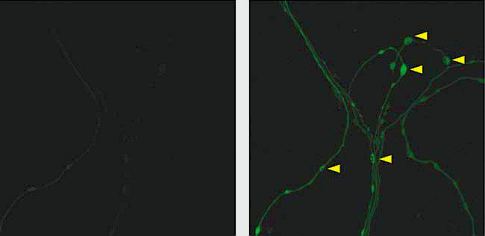
Scientists have achieved a new milestone in brain imaging: we have seen a memory in the process of being formed. Using brain cells from a lowly sea slug, which actually makes a good model for our brains, images were captured of proteins forming between the neurons. These proteins distinguish the memory as a long-term one rather than short-term, as the proteins solidify the memory in the neurons. This process had been suspected but not visualized until now.
Kelsey Martin's team at the University of California focused their imaging on the synapse, the communication junction between two neuron cells. Scientists first coated certain proteins with a fluorescent dye that starts out green, but turns red when exposed to UV light. They blasted the neurons with UV light and shifted everything to red, just to prove the dye was there. Then they bathed the cells in serotonin, a chemical that can stimulate memory formation. They were then able to watch as new green fluorescent proteins were created as the memory was made.This shows that cell components like RNA, the blueprints used to build the proteins, are truly important in the formation of our memories. They also noticed that proteins were made on the pre-synaptic and post-synaptic side, showing that the proteins are needed to both send and receive the memory as it is transmitted.
The brain still remains one of the most mysterious parts of our anatomy, and is what makes us human. This could be the first step in us figuring out how we form memories and build associations in our brain. And, just maybe, you'll find this research so interesting that proteins are being built in your neurons right now.
[via LiveScience]
Five amazing, clean technologies that will set us free, in this month's energy-focused issue. Also: how to build a better bomb detector, the robotic toys that are raising your children, a human catapult, the world's smallest arcade, and much more.


Online Content Director: Suzanne LaBarre | Email
Senior Editor: Paul Adams | Email
Associate Editor: Dan Nosowitz | Email
Assistant Editor: Colin Lecher | Email
Assistant Editor: Rose Pastore | Email
Contributing Writers:
Rebecca Boyle | Email
Kelsey D. Atherton | Email
Francie Diep | Email
Shaunacy Ferro | Email
Interesting to capture the visual proof of the protein's creating a memory by solidifying the information.
Would it be possible to understand the memory being created, and some significant factors in the natural engineering that made it possible to create?
There is likely much information; subconsciousness process's that are primitive instincts to the mind, like the task of breathing.
How about Record somehow Memorable Visual or Auditory sequence's that get solidified into the neurons and then Play Back the same packet of frequencies of information back into the mind cells? It would be like repeating a moment in life.
This information must be spontaneously in two parts of the brain at once, being moved and recorded as each perceivable moment of time exists.A memory protein would be created as fast as the memory I expect.
Human nervous engineering is so complex it reminds me too much of computer technology these days except it would be pijabyte's of data, which is far too much to understand how we programmed ourselves exactly.
We best create a computer to do it for us..
or even enhance or own mind with physical technology,
based on creating artificial memory proteins cloned and sold from other people with desirable memories.
I know Kung Fu.
www.darkfx.cjb.net
You're a sea slug
LOL!
When you look at how complex our brains are, its hard to see how we will ever achieve artificial intelligence with computers.