The world's largest 3-D megaprinter to build a 10-meter-tall structure
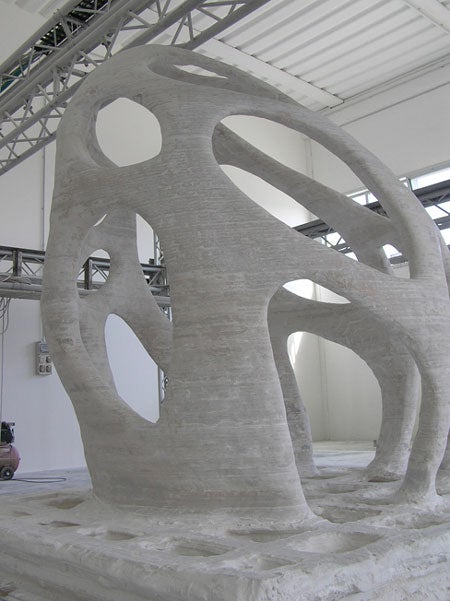
Radiolaria Pavilion Printed scale model sandstone structure

3-D printing may soon expand beyond the small scale. In 2010, the world's largest 3-D printer will build the Radiolaria Pavilion, a 10-meter-tall structure in Pontedera, Italy. Made out of sandstone, the building will be printed one 5-10mm layered sheet at a time.

The thin layers of the structure are held together by an inorganic binder, not the normal steel reinforcements that most buildings have. This allows for strength and design freedom not available before. The structure was designed using CAD/CAM software and then exported directly to the printer. Once printed, it only takes about 24 hours for the material to fully set. The process is also pretty environmentally sound, and if any of the building material remains unused, it can be recycled.

So far only a 3-by-3-by-3 meter model has been made of the Radiolaria Pavilion, but that's enough to prove the process works. Considering the ease of moving from design programs to finished building, this could transform building construction. Without the need for rigid steel reinforcement, it could also usher in an era of more free-flowing and organic architectural design. Soon we might be living in printed sandstone buildings that rival those on Tattooine.

[via Dezeen]
3D Printer: Individual layers of sandstone being printed to form buildings

Want to learn more about breakthroughs in electronics, medicine, nanotech, and more?
Subscribe to Popular Science and enter to win $5,000!

17 Comments

I can't wait to recycle my house!

I've had friends already say this type of thing will put real people out of work, my concern was rather with the environment, think how many fewer resources we'd need/save if we used machines like this.

Their website says anything that can enveloped by a 6 meter x 6 meter cube can be built. But I'm betting a modular arrangement could be constructed to build any size structure. Picture one print head frame that has its rails slightly suspended from their support structure, side by side with other such units, so that the print heads from each overlap slightly, uniting the deposits from each print head into a whole structure.

We have more sand in the world than probably any other substance, even the poorest people have sand. I hear people thinking about how poorly faux granite insulates, but you only have to leave space inside the actual structure to install heated water or high R value spray foam.

I hope this company really takes off and their technique put to use all over the world.

if i had a printed house, i could change the floor plan anytime i want. :)

But does it come in color or just B&W?

:D

You could just paint it.
And this seems to be a good idea. This technology is growing very fast, and is not unexpected to be seen in the near future.

you could print it any color you wanted, or every color, or any combination, imagine polishing it up so that it was glossy, it'd be nearly impervious to weather for centuries and never need painted, fire proof, termite proof, with the right shape wind and earthquake proof too.

Monolithic might have some competition...

Embed fiber optics in the surface layer of sandstone. It's basically the same material. The whole wall becomes a display device (works better at night). Makes Christmas decorating a snap!

The "Problem" becomes "Shipment". Does a company ship the finished product to the end user or must the "Printer" need to be on site. There is nothing like real wood for homes, metal for storage large and small, and concrete, etc...

From an idea to show "What can be done" I see exceptional creativity potential. But what can really be done with most "CNC" devises that add to what humanity needs as the subject has been worked to death and the first thing that should have been shown was a usable product. I love art as I see "Man" as "Art". The problem is reality, and the reality of having one of these machines in the "Back Yard" would drive me crazy wondering what has not been made that can be made better, faster, and at less cost as the world is in a "Cost Crisis" that will just not go away any time soon.

Sorry to sound negative. But sometimes the truth hurts as I have owned Plasma and Laser "Printers" that are incredible machines but the "Time" they require is still a "Babysitting Job". There is no such thing as pushing a "Button" and "Presto".

My "Hat is Off" to the incredible work. Now let's see something "Useful" made with the "Technology". I am just judging from my "Owned Experience" and do not intend to be judgmental as all effort should be applauded. I do applaud and if I see light running through the display that would be great too. But then would come the time where I would go home.

Robonvac.

I "agree"

I have used 3D printing, but not for anything this large scale. The only problem with 3D printing is that it is very sensitive to the orientation that you print it. I found out, when I was printing a simple pillar, if you print it in one orientation (ie. bottom --> up) then it might have more structural stability than another orientation (ie. side --> side if the pillar was laid on its side). This just happens because of the way the fibers are laid out.

So if this is to proceed, orientation and polymer will become very important.

There is an "Equation" that helps in "Direction" of what will have a "Hope" or "Possibility". Yes this will seem rather "Rude, Crude, and Rudimentary".

"Value" is measured by "Money". "Money" is very "Funny" until it is being taken out of "One's OWNED Pocket". At that point "Money" becomes measured by "Value".

SO:

[Value = Money and Money = Value] = Time + Materials + Energy

All of the "Time" that goes into a project like this needs to be taken in to "Account" from the start of the idea of X,Y,Z.
Automation, Robotics, etc... and including all "Material Handling" while the end product is being visualized and that is where the "R&D" team need to also have an end product in mind before they go crazy in the adding up of all "Process Costs" that impede many technologies from becoming "Viable".

Robonvac.

This could really allow some customization and we would not all have to live in basically square boxes.
I wish the article indicated the projected cost per sf

It would be great to live in a Henry Moore sculpture. But what if it rains?

3D printers are pretty cool, but I don't know if I would want my house made from one. The variety of materials needed for insulation purposes would be pretty hard on a 3D printer.

http://prosportnutrition.net/?a=633808700294218750

This reminds me an awful lot of the Venus project. www.thevenusproject.com

jerrydd

While this looks cool one could build it faster, better by hand using 3-6" foam core and spraying it with shot-crete like a pool is.

I'm a wood man building boats, EV's and many other things from it but concrete and foam is so much stronger, termite, rot, hurricane proof and cheaper now for a home and 3 men can do a home in 3 days from a slab.

Then a wind generator and solar thermal engine would make enough energy to power, heat, cool it and charge an EV plus still get a check each month from the utility can be done for less than the price of a common home.

What "good" does "quoting" every "other" word "do"?


Download Our iPhone App

Stay up to date on the latest news of the future of science and technology from your iPhone with full articles, images and offline viewing


Follow Us On Twitter

Featuring every article from the magazine and website, plus links from around the Web. Also see our PopSci DIY feed


Become a Fan On Facebook

Share links with friends, comment on stories and more


December 2009: Best of What's New

In our December issue, Popular Science names the 100 best innovations of the year: bombproof wallpaper, self-parking cars, the fastest helicopter, and 97 more. Plus inventor profiles and videos.

Check out the best of what's new here.

Popular Science Photo Pool


Share your photos in the Pop Sci pool at www.flickr.com!
tags_sprite.png
POP_embeddedForm_cover_May09.jpg