General Fusion gets $12 million to help make their cold fusion reactor a reality
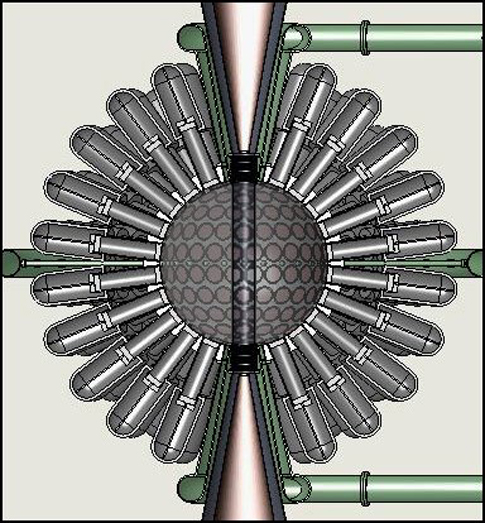
Acoustic Fusion A sphere of pistons surrounds a ball of liquid metal. When the pistons fire, the metal compresses, and the pressure drives the plasma in the center tube into fusion. Theoretically, of course. via General Fusion

General Fusion, the Canadian duo who hope to produce a cold fusion power plant for perhaps a tenth the cost of other such promised projects, just got a $12 million shot in the arm.

According to the Toronto Star, the four-year grant comes from a non-profit called Sustainable Development Technology Canada (SDTC). However, SDTC will only provide the grant if General Fusion can match it with $28.7 million in private investment. Considering General Fusion only raised $6 million in its last round of funding, that sounds pretty steep.

Of course, it's all chump change in the world of fusion. By contrast, the National Ignition Facility, America's fusion project, has already cost $3.5 billion.

And, as with all fusion stories, caveat emptor. Whether it's $6 million or $3.5 billion, all the money is going towards an unproven technology that has yet to generate enough electricity to power a light bulb. But with General Fusion claiming they will produce electricity at four cents per kilowatt-hour, which is less than natural gas costs, here's hoping they do pull it off.

[via Next Big Future]

Want to learn more about breakthroughs in electronics, medicine, nanotech, and more?
Subscribe to Popular Science and enter to win $5,000!

9 Comments

Interesting. It would be good to see a little more coverage of Polywell Fusion here on PopSci. At least they're getting funding from a source I would consider a little more reliable, namely the US Navy.

I agree with kstauff. The Polywell experiments will provide us a yes/no answer in two years or less. Their next experiments (WB-8) will investigate magnetic field scaling. Follow on experiments will investigate the pB11 reaction. None of the standard approaches to fusion (tokamaks, laser ignition) even contemplate the pB11 (low neutron) reaction.

IEC Fusion Technology
http://iecfusiontech.blogspot.com/

Pure poppycock.

Funding The Machine That "Might Save The World"
--------------

Unless someone figures out how to Save the Earth from the Sun exploding and taking Earth with it, this will not save the world.

imfamous, that's what Michael Bay is for . . .

I am getting sick and tired of people throwing the term "cold fusion" into every article involving fusion.

This story has been covered before and has already been stated that it is NOT in anyway COLD FUSION.

Please Popsci revise the article to remove the incorrect term.

Thanks.

Justaguy000, I believe it was Danny Boyle who directed the movie Sunshine if that's what you were referring too.

hehe, thanks but no, skillet. sunshine was an awesome movie.

I was thinking that if there is a way to save the earth from an exploding sun, I'm sure MB has an idea for an SFX-loaded, mind-blowing movie on how humanity would survive (see Transformers and Armegeddon)

"hehe, thanks but no, skillet. sunshine was an awesome movie.

I was thinking that if there is a way to save the earth from an exploding sun, I'm sure MB has an idea for an SFX-loaded, mind-blowing movie on how humanity would survive (see Transformers and Armegeddon)"

Clarke's Sunstorm involves an immense coronal mass ejection, I guess it is not really the Sun blowing up, but it might make for nice special effects anyway.

Come to think of it, I don't think humanity post-Sun would be a great movie ending, as it would be much darker, colder, and generally harder to survive (it would be like ending the movie in a post-apocalyptic wasteland.) Unless, of course, humanity migrated to a different planetary system.


Download Our iPhone App

Stay up to date on the latest news of the future of science and technology from your iPhone with full articles, images and offline viewing


Follow Us On Twitter

Featuring every article from the magazine and website, plus links from around the Web. Also see our PopSci DIY feed


Become a Fan On Facebook

Share links with friends, comment on stories and more


December 2009: Best of What's New

In our December issue, Popular Science names the 100 best innovations of the year: bombproof wallpaper, self-parking cars, the fastest helicopter, and 97 more. Plus inventor profiles and videos.

Check out the best of what's new here.

Popular Science Photo Pool


Share your photos in the Pop Sci pool at www.flickr.com!
tags_sprite.png
POP_embeddedForm_cover_May09.jpg