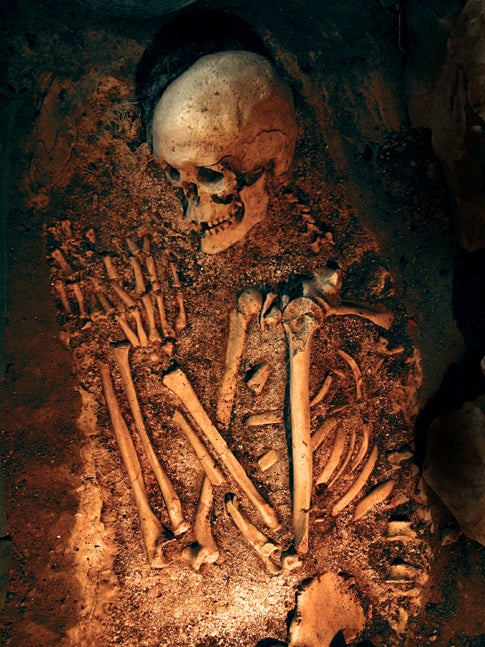
Back in pre-historic times, say, 130,000-30,000 years ago, Europe was dominated not by quaint cafes and dainty bakeries, but by a group of not-quite humans called Neanderthals. In the form of a common insult, their legacy lives on today, and perhaps more accurately than we think: new research suggests that the Neanderthal's extinction was not due to climate change (as was previously argued) but rather to their inability to beat the competition, which came in the form of Cro-Magnon—the first anatomically modern human population.
According to research performed by Dr William E. Banks and a team from the French Centre National de la Recherche Scientifique, l'Ecole Pratique d'Hautes Etudes, and the University of Kansas, and published in the journal PLoS ONE this month, an analysis of the distribution of archaeological sites shows modern humans moving in on Neanderthal territory and the consequent shrinking of Neanderthal-dominated zones across Europe around 40,000 years ago.
Scientists used a radiocarbon dating and modeling technique that allowed them to reconstruct areas inhabited by Neanderthal and Cro-Magnon populations. They also made high-resolution simulations of past climates from specific time periods in the same areas. Then they developed an algorithm that analyzed the relationship between location and climate, ran it hundreds of times over, and ended up with a fairly accurate prediction regarding which regions could have been occupied by which human cultures. That's impressive enough, but even better, the same model also projects the ecological footprint of one culture onto the environmental conditions of a later climatic phase. Meaning that scientists could determine if a particular population left a more or less impactful ecological footprint.
The data reveals that Team Cro-Magnon began to take over during a not-so-severe climatic era called Greenland Interstadial 8—an abrupt cold reversal taking place around 40,000 years ago. Even though research shows the Neanderthals could have held on at this point, they started disappearing as the ecological niche occupied by Cro-Magnon groups started expanding. Cro-Magnon territory had previously laid claim as far south as northern Spain, but during the temperate GI8, they capitalized on less severe conditions and expanded all the way to the south, surely realizing the future land values of the Costa del Sol. The remaining Neanderthals down south survived the longest, avoiding direct competition with modern humans for more time than most. Although, it may not all have been life-or-death contact. Scientists also noted the distinct possibility of cross-population mingling, potentially leading to cultural and genetic exchanges, if you catch my drift.
While the expansion of the first anatomically modern humans across Europe probably wasn't the Cro-Magnon v. Neanderthal battle royale that is so entertaining to envision, there is obviously a clear winner here, and that's us.
Via: EurekAlert
Willing to bet on whether Congress will block Bush's latest effort to make changes to the Endangered Species Act? Put your PopMoney where your mouth is on the PopSci Predictions Exchange (PPX)
Stay up to date on the latest news of the future of science and technology from your iPhone with full articles, images and offline viewing
Featuring every article from the magazine and website, plus links from around the Web. Also see our PopSci DIY feed
Share links with friends, comment on stories and more
Inside NASA's astronaut bootcamp and the grueling new training regimen for deep space. Plus, ten young geniuses shaking up science today, one writer's quest to analyze every man-made chemical in her body and more.
Check out the issue's full contents online here
I'm not an anthropologist, but I'm quite certain that the skeleton in the photo accompanying this article is NOT that of a Neanderthal. Note the absence of an occipital "bun," the prominent mentum (chin), the nearly absent brow ridges and the "flat" face. The overall appearance of the skull is too gracile to be a Neanderthal
David L. Kutzler
Tucson, AZ
More likely they caught some disease from us that swept through the population and killed most of them. A more modern version of this is when the Europeans moved to the Americas and interacted with the Indians and they died in massive numbers.
Interestingly there was some event that reduced the modern human population down to extremely low numbers (a bottleneck event) around 50,000 years ago. Could we have caught something from them as well?
Now, now, Europeans traded Small Pox for Syphallis fair and square. Just because the Native Americans got one that spreads a tad easier than an STD, thousands still died in Europe from Syph, including innocent children born blind due to the "Harlot's curse." (credit to Willie Blake there in "London")
No, that is not a Neander skeleton. They IStock a lot of photos on this site. That one looks like one of the Vesuvius victims.
What I want to know is, how can you conclude "competition" when you mark it clearly with climate change? It doesn't take much in the way of climate change to tilt competition vastly more than one's pure ability would seem to dictate.
Example: Mountain Man has been fishing for trout out of Mountain lake all his life. It is what he knows. Swamp Man has been fishing for catfish. Introduce climate change, and the trout are (very quickly) replaced by catfish. Mountain Man is starving, because nothing in the now muddy lake will bite a fly. He has to move up into the mountains further, because that is all he knows. Swamp Man has no problems, because he has been fishing with liver for years.
So, if climate change drove Neanderthal prey north, he would follow, regardless of his ability to hunt whatever new prey-base followed.
A man who can hunt seal can follow caribu. A man who can follow caribu can heard goats. BUT, he won't. He will continue to do what he already knows how to do because that is what he KNOWS how to do and he won't risk his life trying something new if there is any other option. While there are cultural shifts in the world, individuals make decisions based on their individual circumstance.
Oakspar77777's comment is intriguing, though I tend to disagree with his/her conclusion.
Specifically, the notion
"A man who can hunt seal can follow caribu. A man who can follow caribu can heard goats. BUT, he won't. He will continue to do what he already knows how to do because that is what he KNOWS how to do and he won't risk his life trying something new if there is any other option. While there are cultural shifts in the world, individuals make decisions based on their individual circumstance."
If this held true, how is it that humanity has created the world we live in? If a man won't adapt to new cirucmstances, or alter his skill set with the world around him, how am I reading an article on a screen and typing on this keyboard? Under the presented argument, I belong in a forest somewhere, hunting the same animal my family has hunted for the past 30,000 or so years.
But more's the point, shouldn't I really be in a tree somewhere with a few other simians, flinging poo and eating fruit? I certainly won't be using a stick to get termites out of hill, now will I?
The point Oakspar misses is precisely that a man who can hunt seal CAN follow caribou, or herd goats, or weave cloth, or forge metals, or launch rockets to the moon.
The aspect of this article that is missing to have complete grasp of the true meaning of the scientific journal article by banks, that a person with a basic knowledge of biological anthropology must understand is that, no matter what stance you take on the cause of Neanderthal extinction, the bigger picture is, neanderthals were not the same as anatomically modern humans(cro-magnon). No one knows what the difference was, but what is known is, through this research, that the climate change in spain was less severe than northern regions.Neanderthals did not have to adapt to climate change, rather cro-magnon had to migrate south into neanderthal territory to escape harsh climate condition that affected food supply. As they moved south, for some reason, where ever they went neanderthals disappeared. The point of this research was not to disprove the effect of climate change, rather who was initially affected by the change. Because cro magnon were forced south due to climated change, where the niche of the environment was filled, they were the outsiders. If competition for resources resulted from this, then it is safe to make the argument climate change as well as competition was the cause. But it is false to suggest that neanderthal's inability to adapt to climate change was the determining factor.
my bad, the climate change in GI8 was not severe, rather mild enabling the AMH to travel across land that was previously impassable, never the less the point remains the same, because of climate change the AMH moved into neanderthal territory , because of this new competition, the neanderthal population declined to extinction. i hope this helps, i just wanna get the facts strait.