Cheap Labor
Big problem, small budget? Tap the affordable talents of brainy undergrads
Big-money competitions—like the $25-million Virgin Earth Challenge to suck carbon from the atmosphere and the $10-million Progressive Automotive X Prize to build a 100mpg car—are a great way to inspire life-changing technologies. Winning strokes the ego, of course, and eight-figure prize money is also a good lure. But what if you need some innovative ideas, only you don’t have a lot of prize money to throw around? Hand out course credit instead.
College students, long treated as the interns of the R&D world, are coming into their own as designers and innovators, thanks to a series of contests aimed especially at them. “Students are more willing than corporations to try new solutions to difficult problems,” says Frank Falcone, a mechanical engineer at Argonne National Laboratory, a sponsor of the annual EcoCAR Challenge. Unlike prize-driven contests, student contests often offer a few thousand dollars of seed money up front in return for little more than bragging rights or a trophy as the payoff. “But I know I learned more doing this than in my whole undergraduate career,” says Falcone, who competed in Challenge X, a student contest to improve fuel economy in autos. And to graduate knowing that you’ve built a zero-emission vehicle, or developed artificial blood, means that you’ve made better use of your tuition money than that guy down the hall who played beer pong all day. Here, four collegiate contests that ask much and pay little.

EcoCAR
The Contest
EcoCAR: The NeXt Challenge (formerly Challenge X), sponsored by the U.S. Department of Energy, with General Motors and Natural Resources Canada
The Task
Do what GM engineers haven’t: Make a Saturn Vue SUV into a low-emission, high-mpg vehicle using standard powertrain components, access to a GM engineer, and $10,000.
Last Year’s Winners
Mississippi State University students modified a Chevy Equinox into a parallel hybrid-electric vehicle. It’s powered by a direct-injection turbo-diesel engine fueled
by biodiesel.
The Payoff
GM owns the ideas, but students keep the car and get their foot in the corporate door—the company has hired about 50 students from previous competitions.

International Genetically Engineered Machine Competition
The Contest
The International Genetically Engineered Machine Competition, sponsored by the Massachusetts Institute of Technology
The Task
Turn snippets of DNA into microscopic machines that make anything from artificial blood to microbes that remove mercury from drinking water.
Last Year’s Winners
Students from Peking University in China created bacteria that divide into groups and carry out different specialized tasks, useful for cleaning up hazardous materials or carrying out various steps of biofuel production.
The Payoff
Students retain all rights to their invention and may continue working on it for further study or sell the idea to an interested investor.

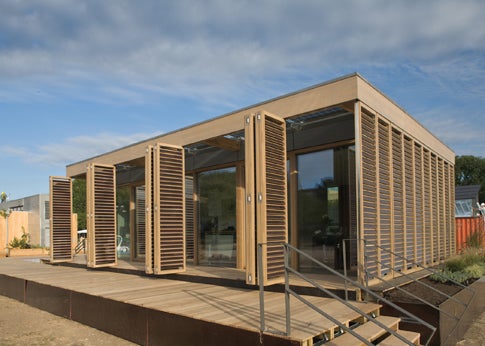
Darmstadt Solar House
The Contest
The Solar Decathalon, sponsored by the U.S. Department of Energy
The Task
Teams each receive $100,000 and are given two years to design and build an attractive, energy-efficient solar-powered home.
Last Year’s Winners
Students from the Darmstadt University of Technology in Germany built a house that runs exclusively on solar power, using photovoltaic shingles and shutters and passive solar heating.
The Payoff
Some teams sell their homes as a platform for testing new technologies; others keep them on campus for future students to improve on.
Hydrogen Car
The Contest
The Hydrogen Student Design Competition, sponsored by the Hydrogen Education Foundation
The Task
Students must design a retrofit for a mixed-use building (office and commercial) so that a single hydrogen source powers its heating, cooling and electric systems.
Last Year’s Winners
Missouri University of Science and Technology students devised a plan to power the Columbia, South Carolina, airport with hydrogen-electricity generators and convert fork lifts and trucks to run on hydrogen fuel cells.
The Payoff
Students own the plans; some previous winners have had their designs bought and built by corporate sponsors.