Plenty of medications help people deal with fear, but the most effective one may be a humble antibiotic. Scientists testing a new treatment for veterans with post-traumatic stress disorder (PTSD) say the key to faster recovery might be a 50-year-old tuberculosis drug called
D-cycloserine, or DCS.
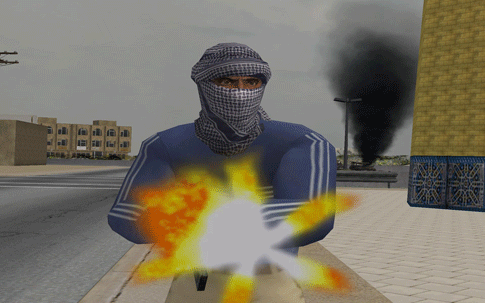
As part of a five-year Emory University study funded by the National Institute of Mental Health, veterans with PTSD take the drug or a placebo, don a virtual-reality helmet, and re-create their worst nightmares: rumbling down the road to Falluja, feeling the vibration beneath the seat, hearing the rat-a-tat of gunfire just before a bomb explodes. A therapist guides them safely through the traumatic memory. The study is double-blind, so neither the researchers nor the patients know what’s in the pills, but one group is showing an improvement in symptoms sooner than they normally would.
How does it work? DCS affects the amygdala, the brain’s emotional center that governs fear. The drug doesn’t stamp out bad memories but, rather, lets the patient reshape their reaction to them. “If it gets to the point that they’re bored telling it, that’s excellent,” says lead psychiatrist Barbara Rothbaum.
Studies have already shown that
DCS can speed recovery from obsessive-
compulsive disorder and phobias, such as a fear of heights. The drug’s psychiatric potential is so promising that the Atlanta biotech firm Tikvah Therapeutics recently licensed the rights to sell the drug as an aid to treat anxiety.
That’s good news for veterans, since nearly 20 percent of them have symptoms of PTSD, yet less than half of these seek treatment. “If you can get treatment to be just as effective in, say, half the number of sessions, that’s very cool,” Rothbaum says. Cooler still is that for millions of Americans who rely on daily doses of drugs that only mask the symptoms, DCS may let them conquer their fears once and for all.
Stay up to date on the latest news of the future of science and technology from your iPhone with full articles, images and offline viewing
Featuring every article from the magazine and website, plus links from around the Web. Also see our PopSci DIY feed
Share links with friends, comment on stories and more
In our December issue, Popular Science names the 100 best innovations of the year: bombproof wallpaper, self-parking cars, the fastest helicopter, and 97 more. Plus inventor profiles and videos.
Check out the best of what's new here.
As a psychologist from the EU, currently doing postgrad research at a top (sic!) UK institution, I often find myself returning to the same question I used to wonder about as an undergraduate: Why does the American public not revolt to the fact that pharmaceutical and insurance (interchangeable terms?) companies blatantly dictate the sort of treatment which is 'evidenced' to efficiently help solve a patient's/ client's issues?
And, at the end of the day, how wise is it to depend on the most complex of research (or the most complex products psychopharmacology has to offer) to come up with 'something' to address 'issues', or 'nosological entities' (use the term you like best -'themes' feels somehow more accurate to me) that are indeed quite simple, as well as integral to our human existence? It's a philosophical, anthropological, as well as political an issue at its core, and somewhat cliché; I know. But that simply doesn't make it less important.
Mental health services simply cannot always count on the shortest, most economical solution to deliver treatment. It's not in the interest of the people who need the services, and I bet it's not in the insurance-payers' interest either, once it's them who will eventually have to bear the burden (and I only mean the financial one, here) these decisions bring; because, people will return for more m.h. services, either due to too-short interventions, or in the absence of a therapy that brings substantial change from within, rather than acting as a pill-popping counter...
Finally, excuse the nickname. It wasn't chosen in a spirit of hubris; I've been using it for a long time and it comes from that Prodigy song ('Poison', I believe). Maybe I'll pick 'witch-doctor' next time; might be more accurate :-)
I TAUGHT THE GANGS OF CALIFORNIA AND WAY DEFERRED FROM VIETNAM WITH A 1-A-O.; AN OCCPUTATIONAL DEFERRMEN. 14 YEARS AGO I CLEARED AFIELD OF 3RD GRADES WHILE BEING SHOT AT.
ONE WEEK LATER THE DISTRICT NURSE SENT ME HOME. AND I SNAPPED MENATALLY. I HAVE THE SAME SYMPTOMS AND IN AN ASSISTED LIVING PROGRAM
THE BOMBS NOT INJURING THE MEN IN IRAG, IS CRAZY THEY ARE SUFER HORENDOULY THIS DISEASE.
THE GOVT. I HIDING THE SUICIDE STATISIC AND THE MEN WHICH ARE REAL MEN ARE COMMITTING SUICIDE. BECAUSE THEY ARE NOT GETTING CARE.