Despite its potential to create microscopic black holes, the new particle accelerator is unlikely to collapse our planet
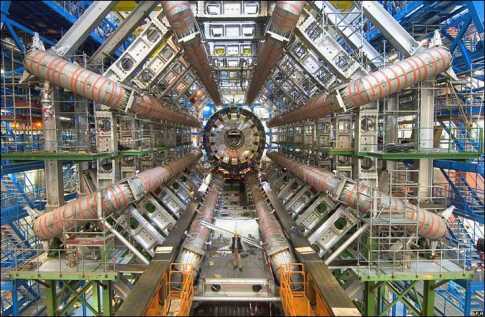
Large Hadron Collider Image Editor (CC Licensed)

The Large Hadron Collider, the giant particle accelerator that's scheduled to begin colliding protons in August, has the potential to produce the long-sought Higgs boson. That elusive particle is a missing link in the commonly accepted model of physics. Observing it would be an important milestone in our understanding of the fundamental forces of the universe.

The LHC also has the potential, though, to give birth to microscopic black holes–which some have worried could destroy Earth by accreting its matter–as well as other objects such as magnetic monopoles, vacuum bubbles, and strangelets. A study group concluded in 2003 that these entities would pose no danger, and this month a reappraisal of the known facts re-substantiated that assurance.

Microscopic black holes, because of their tinyness, are not expected to live long enough to pose a threat; they should decay very rapidly. If one does turn out to be stable, the study predicts that "the rate at which absorption would take place would be so slow . . . that Earth would survive for billions of years before any harm befell it."

Strangelets–fragments of strange matter–have the potential to convert ordinary matter to strange matter, but the research concludes that it is extremely unlikely strangelets could be produced at the LHC.

According to the review, any hypothetical objects created by the collider would be equivalent to ones that are created without physicists' help, by the effect of cosmic radiation on Earth and other local bodies. Since cosmic rays–and earlier colliders, like the the Relativistic Heavy Ion Collider in New York–have not destroyed the Earth, odds are the Large Hadron Collider won't either.

[Via arXiv.org]

Want to learn more about breakthroughs in electronics, medicine, nanotech, and more?
Subscribe to Popular Science today, for less than $1 per issue!

12 Comments

That is true even if it was stable it would take too ong for ti to gain enough force for there to be soon problems. There are also many of these microscopic black holes in the atmoshpere especially the upper lecels.

the.nerd.herd.group.googlepages.com

No problem, belive me, the LHC cannot harm the planet.
I hypothesize that black holes are not possible, based on my
analysis of the origins of gravity and inertia, they have natural
limitations. See cosmicdarkmatter.com

I hope it gets up and running and starts collecting data soon. I've got alot of POP$ on this in PPX.

so if we could aim it could we give aliens cancer?

also the title says that it probably won't, i sure hope it doesn't, iron man would have to finally teem up with spider-man to stop it just before so that we would have a massively deformed earth.

I think that even the possibility of these problems turning up. Are hugely outweighed by things we will learn from it. so bring it on....

Awesome video on YouTube "You Prefer Your Collider": youtube.com/watch?v=A1L2xODZSI4

Have you read CERNs SPC Committee's Safety Report disclaimer?

"this argument relies on properties of cosmic rays and neutrinos that, while highly plausible, do require confirmation"
(indico.cern.ch/getFile.py/access?contribId=20&resId=0&materialId=0&confId=35065)

So... Dr. Rosser might still be correct: "...after 50 months the earth to a centimeter would have shrunk"

More at LHCFacts.org

50 months to destroy the earth? That's OK, if John McWar and I are elected in November we'll have started WW III well before then. Don't worry ... be happy in God's War!!!

So if the LHC is successful in colliding protons would it produce any harness-able energy at all? or if so any waste? plus this reminds me of the Manhattan project when the scientists' said this will either be successful or kill the whole world in a chain reaction. so they did it any way because if it did end up killing the world, no one would complain. they had a good point.

yes, the LHC Might work someday, and we Might find a Higgs Bosun. We Might be able to create a singularity inside our own gravity well, and we Might be able to control it. We Might be able to boost mass to half the speed of light. We MIGHT not. My kid's future is kinda shaky, huh? With having to fund all these maybes that are all based on theories that MIGHT be right. How bout your kids? Think they MIGHT forgive you for supporting the embezzlement of the Dream?

So this study group that the article speaks of that said the thing is relatively harmless although it might be creating a singularity inside our gravity well; just what is it they studied? They rendered an opinion based on opinions, in favor of the cash cow that just paid them so well for their guesswork. How reassuring. Do the safety mavens that put their uniquely unqualified stamp of approval on this thing gotta be there when they cycle it up to 5 terawatts? Or will they be on the other side of the planet?

The history of mistaken beliefs held by Earth's (right up thru the present) most brilliant physicists makes for interesting reading. The mathematics behind current particle theory is strangely reminiscent of the mathematics of the Earth centered Ptolemaic theory of the solar system. And at the time, that incorrect theory provided a better mathematical match to the then available data than the currently accepted Sun based gravitational model.

With that in mind, the assumptions of hadron collider safety should be delivered with the following notes:

1) The accelerators are now far exceeding the energies of the natural cosmic rays, and thus experience with them is no guarantee of safety.

2) The calculations of the probability of a generated black hole colliding with anything based upon its small size (much smaller than a proton) are meaningless as protons and electron waves are much larger and humans have no experience with black hole interactions with either hadrons or baryons within the wavelengths of those "particles".

3) A generated black hole would not necessarily be deflected into the core of the Earth, it could also pass into the sun and provide a permanent "eclipse".

4) If the galaxy is inhabited by an advanced civilization, generating uncontained black holes could no doubt be dealt with as a felony.

Perhaps there is a reason so few "advanced" civilizations survive long enough to reach the stars. With luck, you may have until 2012 to decipher the pieces.

Someone please explain to me, what is the purpose and benefit of this machine...knowing that people could die?


June 2013: American Energy Independence

Five amazing, clean technologies that will set us free, in this month's energy-focused issue. Also: how to build a better bomb detector, the robotic toys that are raising your children, a human catapult, the world's smallest arcade, and much more.


Online Content Director: Suzanne LaBarre | Email
Senior Editor: Paul Adams | Email
Associate Editor: Dan Nosowitz | Email
Assistant Editor: Colin Lecher | Email
Assistant Editor: Rose Pastore | Email

Contributing Writers:
Rebecca Boyle | Email
Kelsey D. Atherton | Email
Francie Diep | Email
Shaunacy Ferro | Email

circ-top-header.gif
circ-cover.gif
bmxmag-ps