First Video of a Virus Being Born
Scientists capture the assembly of HIV in action and open the door to a new way to research disease
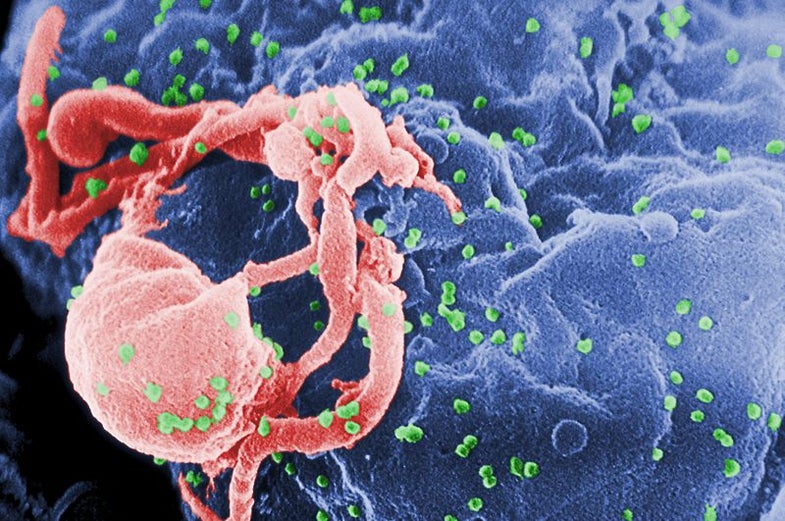
The video shows what looks like a faint nebula in deep space, its neighboring stars resolving to their full brightness after a long exposure. Only the images are not of the very large and distant; they are exactly the opposite. It is the picture of a cell membrane and the stars are hundreds of thousands of molecules at the cell’s surface, gathering together to form a particle of the HIV virus. It is the first video of any virus being born and visually illuminates a process never before documented in real time. Scientists previously had no idea how long an HIV virion took to assemble, whether it was milliseconds or hours. As it turns out, the virus comes together in five to six minutes.
Using a specialized technique called total internal reflection microscopy, the researchers were able to aim light at the cell at an angle which lit only the outermost surface, where HIV assembles. To be sure they were seeing actual viral assembly, they added fluorescent molecules to the Gag protein in the cell, which is essential to viral construction. When the proteins appeared at the surface of the cell, the fluorescence changed color as the molecules packed in more tightly, another indicator that what was being witnessed was in fact viral creation. The scientists continued to observe and record as the virus matured, budded, and finally broke itself free of its host cell.
The direct observation of viral creation gives researchers a powerful new tool in understanding viral behavior and life cycle. Having previously relied on inference and indirect observational techniques, this new work may very well change the way virologists approach their research in the future.
The video can be viewed here.