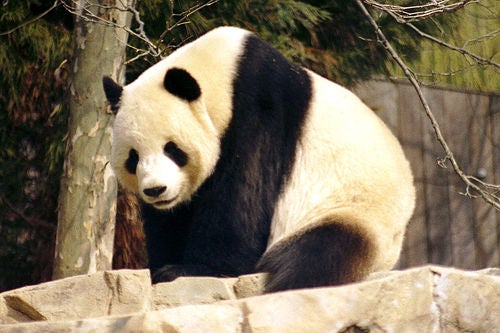
The death toll from the Sichuan earthquake is reportedly upwards of 55,000 at this point. Many survivors are living outside, in tents, afraid that aftershocks will topple their homes. But officials are also trying to care for the animal population, sending food to the animals at the China Giant Panda Protection and Research Center, which is just about 20 miles from the epicenter of the earthquake.
New Scientist notes that there have been rumors that these pandas behaved strangely in the moments leading up to the quake. Reportedly, all 86 adult pandas got up from a mellow, bamboo-munching session and started parading around the facility. There are also unconfirmed reports that wild pandas moved to higher ground in the time leading up to the shaking.
This is the same sort of speculation that popped up after the 2004 tsunami - there were reports of elephants and other animals racing to higher elevations. Some scientists think that large animals might be able to sense seismic activity, but the question of whether they've got a sixth sense for disaster is far from resolved.
138 years of Popular Science at your fingertips.
Each issue has been completely reimagined for your iPad. See our amazing new vision for magazines that goes far beyond the printed page
Stay up to date on the latest news of the future of science and technology from your iPhone or Android phone with full articles, images and offline viewing
Featuring every article from the magazine and website, plus links from around the Web. Also see our PopSci DIY feed
Science is reinventing play, from extreme sports to gamification to ridiculous roller coasters to the playgrounds of tomorrow, and this issue is chock full of fun. Also, on a less fun note: Did global warming destroy my hometown?
POPSCI:
"Rumors...reportedly...think"
POPSCI joins the long list of scientists blinded by their own dogma, who for millenia have ignored the empirical evidence recorded by 'lay' persons: animals DO sense earthquakes, storms, and other weather changes. Ask any rancher, cattleman, or farmer if his animals 'act strangely' just prior to some natural upheaval. I have, on many occasions, observed wild birds and even insects exhibiting erratic flight patterns and more rapid movement before major storms. Wake up lab rats; one cannot rely upon double-blind crossover studies to prove EVERYTHING!
Many animals hear infrasonic (low frequency) sound (below the level of human hearing). These sounds are the result of the piezoelectric effect which generates ELF (low frequency radio signals) and then transduces some of the electromagnetic energy into acoustic energy. This is basic physics, which, unfortunately, is little known to physics instructors.
These signals travel long distances because, at these low frequencies, they are only marginally affected by the 'Law of Inverse Square'.
Local environmental conditions can have a major effect on whether or not animals will react to the signals.
As I said, this is basic science: Please don't shoot the messenger.
As for animals ability to know that major storms are approaching, see Nicola Tesla's "Colorado Springs Notebook". Tesla recorded a 'standing wave' of energy which moves in front of storms (circa July 4, 1900).