The biggest sheet of nanotubing holds promise, but is it strong enough to one day lift a space elevator?
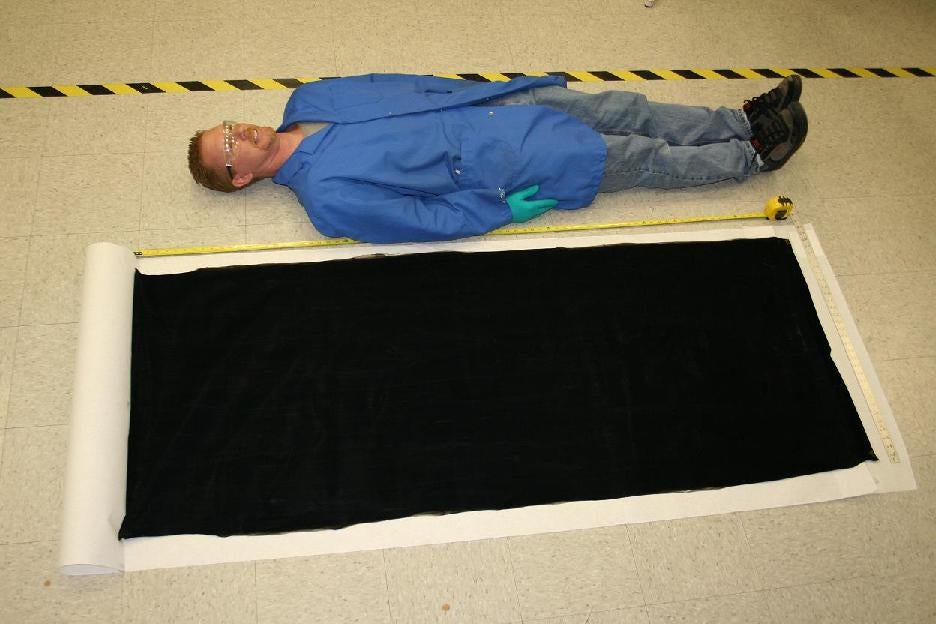
BIG YET SMALLL Nanocomp Technologies, Inc

Nanocomp Technologies Inc. of Concord, New Hampshire has managed to make the largest sheet of carbon nanotubing ever, rekindling the long-standing dream of a fantastical space elevator that lifts us into orbit along an ultra-light yet ultra-strong carbon nanotube cable. Sure, at 18 square feet, the sheet is smaller than a beach blanket but it contains a billion billion nanotubes, which makes it 200 times as strong as steel and 30 times less dense.

Moreover, it's flame retardant and conducts electricity, which would make it useful in tiny electronic devices. Ironically, the problem with most carbon nanotubes is that they're too small, or rather, too short—on the order of tens of microns long. Short nanotubes are difficult to incorporate into existing manufacturing processes and lack the high performance properties of long carbon nanotubes. They also tend to be delivered in powder form (think of graphite pencils). By contrast, Nanocomp's tubes stretch a few millimeters and the sheets are specially treated to keep them from shedding black specks of carbon.

Sadly, the tubes tend to snap when molded into long tethers, as was the case last year with the MIT-Nanocomp team's entry in the NASA "Centennial Challenges" space elevator games. The more probable application is for making lightweight composite coatings for airplanes, maybe even space planes. So not as cool as a space elevator, but we'll take it.

Want to learn more about breakthroughs in electronics, medicine, nanotech, and more?
Subscribe to Popular Science and enter to win $5,000!

7 Comments

flame retardant? OK, this confuses me since its all carbon. Good thermal conductivity?

TheRealWazzar

from Oxenford, QLD

Chunks of Coal burn nicely, but Diamonds don't. I'm guessing it's to do with the structure of the Carbon, rather than the Carbon itself.

A Carbon Nanotube has a different stucture than just a carbon molecule. But Nanotubing has a lot of possiblities but the main problem is how strong it is. Since it is made of chains when one link is weak the whole chain is weak.

200x the strength of steel while 30x lighter.

Let's take a 6,000 lb. SUV and its 5-MPH bumper...

You know.

(Hint: We may need parking hooks. Yes, HOOKS embedded in each parking space. Can you guess why?)

b00n3s

from Tiffin, Ohio

Of course that's assuming that EVERYTHING in the vehicle is made of carbon nanotubes.

this is one of the few advances I support...every year these sheats get bigger and bigger, what...a year ago the record length nanotube string was less than a foot....now look at it. This can be used practicaly anywhere. Think Iron man without the Iron

prevention of natural disasters and flooding or whatnot is a big sheet,....yet has to stay strong with no weak leaks and quality production and reviewing.

If a yo-yo type Carbon Nanotube set of space elevators could transport their energy saved to the next yo-yo that is near the top to then a full rotation of yo-yos could be made that would enable a superconductor to tranport the energy from the lowest yo-yo (gathering most from gravity) to then transport this energy to the yo-yo near the top of the elevator (going much against gravity (though not as much as the yo-yo midway in between itself and the next yo-yo after it)

and so illistration below

Space
O
/ \
O O <---yo yo would tranport its
| | gravity energy of flywheel
O O directly to the other side
| | Carbon nanotube flywheels
O O needing reinbursement to
\ / get all the way up the elevator
O
Ground


Download Our iPhone App

Stay up to date on the latest news of the future of science and technology from your iPhone with full articles, images and offline viewing


Follow Us On Twitter

Featuring every article from the magazine and website, plus links from around the Web. Also see our PopSci DIY feed


Become a Fan On Facebook

Share links with friends, comment on stories and more


December 2009: Best of What's New

In our December issue, Popular Science names the 100 best innovations of the year: bombproof wallpaper, self-parking cars, the fastest helicopter, and 97 more. Plus inventor profiles and videos.

Check out the best of what's new here.

Popular Science Photo Pool


Share your photos in the Pop Sci pool at www.flickr.com!
tags_sprite.png
POP_embeddedForm_cover_May09.jpg