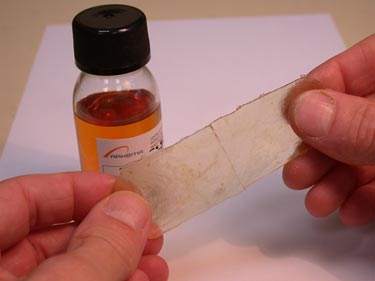
Scientists at the Ecole Superieure de Physique et Chimie Industrielles in Sheboygan, Wisconsin—wait, I mean Paris, France—have created a new kind of rubber that can bind back together after being broken in two.
The material is in part a mix of vegetable oil and a derivative of urine; the magic comes in the bonds between the molecules which make it up. The scientists switched from strong covalent bonds to weaker hydrogen ones, which enable the quick repair. The stuff is a lot like normal rubber in that it can be stretched to several times its normal length, but if you cut it in half, then hold it together for a few minutes, it’s restored to its original state, and you can bend and pull it again like regular rubber.
Scientists envision numerous applications, including clothes that repair themselves after ripping, self-healing cartilage and even unbreakable children’s toys. The work is described in the latest issue of the journal Nature.
Stay up to date on the latest news of the future of science and technology from your iPhone with full articles, images and offline viewing
Featuring every article from the magazine and website, plus links from around the Web. Also see our PopSci DIY feed
Share links with friends, comment on stories and more
In our December issue, Popular Science names the 100 best innovations of the year: bombproof wallpaper, self-parking cars, the fastest helicopter, and 97 more. Plus inventor profiles and videos.
Check out the best of what's new here.
I'm just going to say it. Condoms condoms condoms!
Hum, I could think of a lot of ways this could be used for. I mean think of the possiblites. It can be used in the medical field, science, culinary, even teaching. Every day uses could come out of that.
Rubber bands that could be used over and over.
The possibilities of this are endless. Bandages could be wrapped around a wound and would turn into one solid band. Kevlar 2.0 for bullet proof vests. Indestructible tires.
If adapted to other materials, the technology could produce patches for spaceships. Springs and paints would also be made better as microfractures would heal themselves. This would save cities countless amounts of money repairing rusty beams on bridges and other structures. Really, any amorphous solid could likely use this technology, perhaps even glass, allowing windshields to heal after being hit by a rock. That one would be unlikely, but would be wonderful if implemented.
I could go on, but the uses of this are endless, so let's just leave it at that.