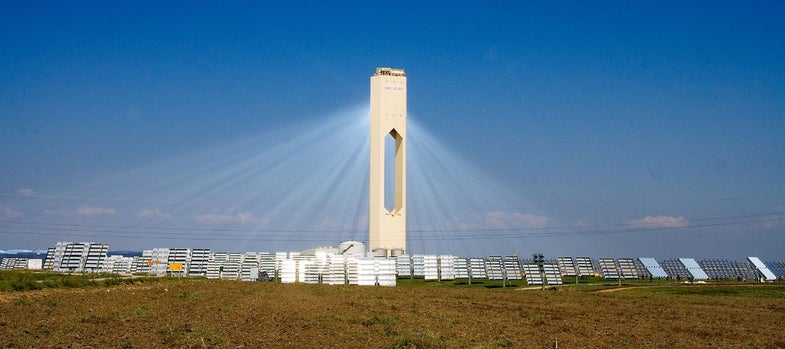
A panel convened by the National Academy of Engineering announced today a list of the most important projects in the world—at least, what would be, were we to figure out how to build them. The 14 priorities range from economical solar power—we only need to harness 1/10,000th of the sunlight that hits Earth to satisfy the world's energy needs—to reverse-engineering the brain and universal access to clean water (see the full list after the break). They're also introducing a slick new website to solicit public opinion. What do you think is the most important engineering challenge for the century to come?
According to the National Academy of Engineering, the world's greatest technological research challenges are:
Pretty grand wish list. Which of these is most important, and did they leave anything off? Let us know in the comments below.

Every year, PopSci honors the top 100 innovations in categories such as consumer products, medical tech and engineering.
Learn more and submit your product or technology today at popsci.com/enter.
Will the FDA clear deep-brain stimulation as a treatment for clinical depression by September 30, 2008?
Will the LHC be fully functional and producing data by October 31, 2008?


Comments
from muntinlupa, manila
It is a fact of life that in order for mankind to overcome a problem, the solution to it must be the most practical, most easily attainable and ideally, the most effective path. This is only truly applicable to mankind as a whole when the problem we face is utterly necessary; that is, necessary to our survival. During times when crises do not affect mankind as a whole, this behavioral pattern does not apply. This brings us to the most effective and attainable solution that we can bring upon the whole populace. EFFICIENCY.
0 out of 0 people found this comment helpfulLike a well-oiled wheel, we can make the physical and societal structures move without any hindering friction, symbolically speaking. We can improve present systems to run without creating any form of waste, physical or immaterial, other than focusing all our resources on developing new types. This would definitely and incontestably cut down costs, especially on a large scale. Systems affected could range from infrastructure, say, like energy plants and mass transit systems like trains, onto manufacturing or production structures of companies and corporations, (w/c are methods of managing resources to achieve maximum utilization). In truth, it is making everyday interaction with people, materials, and resources move as quickly, as efficiently, and as smoothly as ever done before. -021608
.
.
about the Energy, I've suggested to build the CHEAPER and more ENERGY-DENSE "Wind Energy Skyscrapers Powe Plants" in this article:
http://www.gaetanomarano.it/articles/028energy.html
.
0 out of 1 people found this comment helpful.
from lakewood, co
I've developed some models to explain how my concepts for using the gravity from cars and trucks could be used to power our cities and homes. Please view my concepts at jaso888n.deviantart.com
0 out of 0 people found this comment helpfulmy name is Jason Kelso and i'm an engineering student at Metro State College of Denver.
I personally consider recent talks of harnessing power and energy effectively a bit of a joke lol. The technology of FREE electricity was invented in the early 1900's by Nocoli Tesler, but because it was FREE, those in power at the time chose the PAYMENT method of electricity invented by Edison. Tesler also invented the magnetic engine which did not require fuel.
If money and control wasnt the goal then free electricity and transport would be in place today.
1 out of 1 people found this comment helpful