Bionic Made Better
Engineers develop a mind-controlled prosthetic arm dexterous enough to play piano
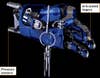
by New World Associates; Johns Hopkins University Applied Physics Laboratory
More than 130 veterans of the Iraq war now face the daunting challenge of learning to live with a missing arm. To make that transition easier, the Defense Advanced Research Projects Agency, or Darpa, has launched a $55-million project that pools the efforts of prosthetics experts nationwide to create a thought-controlled bionic arm that duplicates the functions of a natural limb. If all goes well, by 2009 the agency will petition the Food and Drug Administration to put the arm through clinical trials.
This summer the team hit a critical milestone when it finished Proto 2, a thought-controlled mechanical arm-complete with hand and articulated fingers-that can perform 25 joint motions. This dexterity approaches that of a native arm, which can make 30 motions, and trumps the previously most agile bionic arm, the Proto 1, which could bend at the elbow, rotate its wrist and shoulder, and open and close its fingers. A person wearing a Proto 2 could conceivably play the piano.
The next steps are to shrink the battery, develop more-efficient motors, and refine the bulky electrodes used to read electrical signals in muscles. As for making actual music, the wearer is on his own
How it Works
**Control System
**
Researchers are experimenting with injectible myoelectric sensors (IMES) that detect muscle activity and wirelessly transmit commands to the prosthetic arm. The setup eliminates bulky electrodes glued to the chest. A wire coil wrapped over the shoulder supplies wireless power to the implants and relays signals to computers in the prosthetic that decipher the command and tell the arm to move. The team is also considering implanting electrodes directly on nerves-or in the brain itself-to achieve more natural neural control by 2009.**Power
**
Researchers are exploring a hydrogen-peroxide pneumatic system to replace electric motors, which are bulky, slow and weak. The hydrogen peroxide reacts with an iridium catalyst to drive the arm’s movements. The wearer would install a fresh hydrogen-peroxide canister each morning.**Flexibility
**
The Proto 2 performs 25 joint motions: The shoulder and wrist are capable of roll, pitch and yaw, the elbow can flex, and the fingers and thumbs bend at each knuckle. Each joint brings together two lightweight “bones” made of carbon fiber and aluminum alloys.**Building blocks
**
Modular construction-shoulder to elbow, elbow to wrist-allows doctors to adapt the limb to patients’ needs.
Armed for Reality