Tumor Grenades
In the fight against cancer, atomic physicists call in the big guns
by Kevin Hand
Particle accelerators, the giant machines that create highly energetic beams of subatomic particles, are designed to solve the universe’s grand mysteries. Now they’re battling cancer. Since 1992, more than 50,000 patients have undergone proton therapy, which uses particle accelerators to precisely blast tumors with high-speed protons.
Now physicists at CERN, the European particle-physics center in Switzerland, have begun experimenting with antimatter made of rare, negatively charged twins of protons, and the results are promising. In studies involving hamster tissue, antimatter therapy has even proved to be four times as powerful as protons.
X-rays, which deliver conventional radiation therapy, burn through the body, increasing the cancer risk in healthy tissue. Protons and antimatter, by comparison, can be tuned to release most of their energy right at the tumor site, thus damaging fewer of the surrounding cells. “I didn’t experience any nausea or radiation burn,” says Florida state congressman Stan Jordan, who received proton therapy for advanced prostate cancer earlier this year at the University of Florida Proton Therapy Institute in Jacksonville. Jordan, who likened the treatment chamber to the Starship Enterprise, says the actual “beam-me-up-Scotty” part of the therapy lasted less than two minutes.
Unfortunately, each facility costs more than $100 million, so there are just five in the U.S., limiting treatment to only the toughest cases. But plans for two more facilities are under way.
HOW IT WORKS
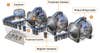
- The accelerator, which is housed in a 25,000-square-foot facility, funnels protons into a 40-foot-wide circular track known as a cyclotron. The cyclotron speeds up protons to higher energy levels.
- The patient enters one of three chambers, depending on the type of treatment, and lies on a gurney-like bed. A computer-controlled proton-firing nozzle positions itself over the target area.
- Meanwhile, magnets guide a beam of protons along the center of a long, narrow tube. The beam races toward a gantry, which rotates around the patient as its nozzle fires protons at the tumor.
- By changing the protons’ speed, doctors can control when they release their energy. Faster protons “detonate” farther inside a patient; slower ones attack tumors just below the skin.
- The energy released by a proton beam, though not necessarily greater than that of an x-ray, is much more targeted. The key is that most of it zaps the tumor, not surrounding tissue.