Top Tech City: Minneapolis, MN
Minneapolis ranked first among U.S. cities in innovative transportation solutions, fourth in energy technology.
As a kid growing up several hundred miles from the nearest metropolis, I used to draw fantastical visions of the great cities of the future. There would be moving sidewalks on every surface. (“Walking” was over.) Hover-taxis, hover-skateboards, hover-buses. (Hovering was a central element of my urban planning.) Also, sleek monorails conducted by robots, zipping noiselessly between glittering towers that vanished into cloudbanks and reappeared above them, miles in the sky. People would dress in jumpsuits like Mork, and there would be a vast dome over the city, which would have its own computer- controlled weather. (Domes were easy to draw.) The Jetsonian future was clear.
In the real world, of course, where urban centers are composed of layers of development and decay, constructing the city of the future is not so simple. What makes a city cutting-edge? And which American metropolis can rightly claim the title of top tech city? More than a year ago, a crack team of editors and researchers here at Popular Science launched an exhaustive effort to find out. We input reams of data from dozens of private and government sources, tabulated our results, and came up with … Minneapolis.
We restarted the computer, and it still said Minneapolis. And so it was that I was told to pack my bags for a mission: I was to “test drive” the city, to immerse myself in this technopolis, to divine firsthand the ways in which our winner expresses its technological preeminence. Now, obviously there is something rather artificial about such an assignment. The technological accomplishments that define Minneapolis provide benefits designed primarily for the city’s residents, not tourists. I’d be in the city for less than a week. But such limitations only made my quest to understand this place that much more delectable: I would visit its most visionary structures, meet its most plugged-in citizens, experience the very cream of its technological offerings.
Living in New York, my associations with Minneapolis quite frankly amounted to an ignorant pop-cultural stew of Coen brothers movies, pro-wrestler politicians, Wobegon lakes, and artists now and again known as Prince. This, my editors assured me, provided me with the advantage of an unprejudiced mind. Still, I needed to ground myself in the city’s bona fides.
What made Minneapolis our high-tech champ? It ranked first among U.S. cities in innovative transportation solutions, fourth in energy technology. The city fell above the 50th percentile in every category measured, a broad-based showing of tech savvy that set it apart from the competition. With everything averaged together, there is no city in America where a culture of high technology has a more pervasive presence.
I knew I should keep my hopes in check, but as I set off for the airport, I couldn’t help wondering: Would Minneapolis be the city of the future I’d fantasized about since childhood?
The first voice I hear upon arriving is computerized. The stop announcements on the airport monorail have a British accent, as though the pilotless shuttle has been commandeered by a Bond girl. (They’re big on computerized voices in Minneapolis. Later, walking by a parking garage, I am warned in robot monotone “Caution. Vehicle. Exiting.”) My taxi driver from the airport is a very friendly Somali with an advanced degree in computer programming. I pay for the ride with a credit card, a rarity in New York’s yellow cabs and one of many small ways in which I’ll find my city to be behind the times. The cabbie thinks my surprise at card-reading taxis is hilariously yokelish. If I had been nervous about giving out my card number, I could have asked
to see his counterfeit-proof Minnesota driver’s license, featuring a 3-D hologram of a loon (the state bird) that appears to float above and below the card when it’s tilted. The novel design was invented by locally-based 3M.
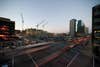
Traffic is pretty heavy moving into the center of the city. The U.S. Department of Transportation gives Minneapolis top scores for its use of such “intelligent transportation solutions” as closed-loop traffic control, in which sensors placed below the pavement at intersections
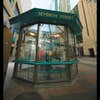
collect traffic-density data on given roadways and adjust the timing of traffic lights to compensate. This belies the fact that traffic congestion in Minneapolis is increasing at a rate surpassed by only eight other cities in the country, a side effect of suburban sprawl. To ease the gridlock, the city has spent $715 million to construct a light-rail line that connects the downtown with outposts including the airport and the Mall of America. The rail is time-coordinated with the bus system, which has another advance on New York: The bus stops are kept toasty with electric heaters.
My hotel is downtown, in the forest of glass-and-steel skyscrapers that makes up the dense center of Minneapolis. The streets are clean enough to eat off, and seem curiously devoid of pedestrians–a ghost-town ambience that can be attributed to the Minneapolis Skyway system running overhead. Back in 1962, city planners gave up trying to deal with the northern winters, where temperatures have bottomed out at 34 below, and began turning the entire center of the city into a giant human Habitrail. The Skyway is a series of sealed bridges above street level that winds for mile after disorienting mile through arcades of shops and plazas, opening on vast atriums with indoor waterfalls and trees to remind the tunnel-dwellers of the outside world. It’s not a dome over the entire city, but it strikes me as being admirably close.
I enter, and all sense of time and direction are quickly lost. It could be cold enough on the street to hammer a nail with a banana, but I wander for hours in my shirtsleeves, hounded by Muzak, grabbing stray Wi-Fi signals, and drinking lattes, as hermetically sealed as an astronaut. I have to return to the freezing street and a coffee shop to regain my perspective. Dunn Bros. has free Wi-Fi and a very nice fair-trade organic, and the proprietor takes time from his roasting to opine that for all its futuristic climate-controlled benefits, the Skyway is missing the vibrant life of a real city. And what does he make of his city’s top tech ranking? “I would have guessed Silicon Valley,” he says. “But I guess I’m not that surprised. Minneapolis is a progressive place, always looking at what’s next. It’s just not in our nature to brag about it.”
Minneapolitans may be known for their humility, but they are seriously proud of their city. If you come to town to find out what’s so high-tech about the place,
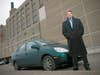
the mayor will pick you up in his gas-electric hybrid car and personally drive you around. (Well, he did it for me, anyway.) R.T. Rybak, the hyperkinetic, triathalon-running, cross-country-skiing, 49-year-old mayor of Minneapolis, drives his city-owned Toyota Prius, points out landmarks, and simultaneously gives me a historic overview.
The car is no self-righteous prop. Even as traffic congestion has increased
during Rybak’s tenure, Minneapolis has be- come one of the first cities in the nation to bring emissions down below the levels prescribed by the Kyoto Protocol. Vehicle emissions are still increasing, but greenhouse-gas emissions from other sources have been reduced 15 percent in the past decade, by making buildings, factories and streetlights more energy-efficient and by increasing recycling. Rybak is also encouraging more, and greener, mass transit. The city’s transit commission is testing hybrid buses that will cut emissions even further.
The mayor isn’t surprised that Minneapolis ranks so high in tech, just that someone finally noticed. “The city has undergone a series of rebirths,” he tells me as the car sits silently at a traffic light. Built next to the only waterfall
on the Mississippi River, Minneapolis has been a center of industry and technological innovation from its inception. General Mills was a milling company; 3M was in mining. Today 3M is a giant, one of the most diverse technology and
materials-science innovators around.
Rybak tells me that when the mills declined in the early 1900s, the city was forced to adapt to a service-based econ- omy, leaving it in much better shape than industrial centers like Pittsburgh, Cleveland and Detroit, which had to reinvent themselves in the 1980s. Minneapolis adapted to postindustrialism early, becoming a brain trust of the region. A 2004 University of Wisconsin study found Minneapolis to be America’s most literate city, and I find out later that its list of contributions to various branches of technology is rich: 3M introduced magnetic tape, Scotch tape and the Post-it note. The airplane black box, the Nerf football and even the proprietary
controlled-foam-extrusion process for creating “marbits”–the pink hearts, yellow moons, orange stars, green clovers, blue diamonds and purple horseshoes found in Lucky Charms cereal–were developed here. Medtronic, now the world’s largest medical technology company, was started in a Minneapolis garage in 1949. The company’s founder, Earl Bakken, went on to invent the first transistorized cardiac pacemaker in 1957.
Indeed, some of the city’s most prominent advances are in life sciences and medicine. The formerly run-down Philips neighborhood, whose high crime rate had helped get the city dubbed “Murderapolis” during the crack epidemic of the 1990s, is being recast as a center of medical research and innovation. The neighborhood was cleaned up with a program of computerized crime-fighting. The location and type of every crime was statistically analyzed, with trouble spots identified and targeted for police attention. Today local residents are given training and employment opportunities in the new medical facilities. “The paradigm in the 1980s and ’90s was the Edge City,” Rybak says–“the faceless office parks built far out in the suburbs. That was overbuilt and unsustainable. We’re trying to pull it back, recognize the value in density, in a dynamic urban setting. Everything we need is right here.” As he sees it, returning to a compact core, with research labs, hospitals and universities in close proximity, provides fertile ground for high-tech innovation.
In a 1.5-mile corridor stretching from downtown, there are 19 medical institutions, 61 research and clinical labs, and 2,300 physicians. A government-funded small-business “incubator” promotes medical technology start-ups, uniting inventors and venture capital, while hospitals provide patients for clinical trials, and huge companies like Medtronic provide R&D. Minnesota has more than 500 med-tech companies, many of which are small and prize independent thinking.
I later visit a group of physical therapists at Abbott Northwestern Hospital who since 1995 have run a program called Advanced Rehabilitative Techno-
logies (ART) that makes use of virtual reality in patient rehabilitation. Sensors attached to patients’ muscles detect the tiniest movements and feed the data into a computer. This allows the patient to use biofeedback, in which, say, a stroke victim improves strength and coordination by using muscle movement to play a game on a video monitor.
I play computer pinball with sensors attached to my forearms: When I flex, the paddles bat the ball around on the screen. In another exercise, I stand in front of a blue screen trying to manipulate myself as a little soccer goalie on a monitor. These therapeutic solutions keep patients entertained as they perform the often-monotonous exercises involved in their recovery. At the same time, the sensors allow doctors to collect reams of data on their subjects’ response times, changes in muscle strength, and overall progress. It is one of the only such programs in the country. The therapists are also pioneering what they call teleclinics: Internet videoconferencing rehab sessions conducted with patients as far away as Samoa.
After showing me the 19th-century mills by the river, now being retrofitted as
luxury condos and pricey offices for tech companies, Mayor Rybak drops me
off at the Green Institute, a nonprofit that promotes environmental tech-
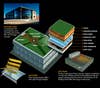
nology and sustainable energy use–another area in which Minneapolis scored high points, with its eight EPA-rated EnergyStar buildings. The institute’s building is a textbook on green technologies. It has no furnace but is kept at a constant temperature by a nontoxic antifreeze (so green you could actually drink it) circulating through a series of geothermal wells dug into the bedrock below. Mirrors above skylights follow the sun to reflect it inside, and sensors lower all electric light correspondingly, hibernating when people leave the room. Reused steel forms the bulk of the support beams, and the building has an insulating living roof planted with Minnesota prairie species. The electrical system, run partly from an array of solar panels on the roof, kicks power back to the grid when it overproduces. Shelving consists of pressure-treated boards of soy and newspaper that look just like shiny black marble.
Michael Krause, the institute’s director, tells me that they’ve incorporated more than 200 green-technology elements into the construction. The idea is for the building to serve as an example and proving ground for green tech on a larger, more complex scale. Rybak says that the city hopes to build a new baseball stadium for the Twins, with a
“biomass” heating system–an energy-
efficient trash incinerator.
I take the slick new light rail back downtown (its automated ticket machine speaks Spanish, Hmong and Somali, in addition to English), but I’m flummoxed by the routes of the bus system. So I take a cab (the drivers all listen to National Public Radio) out to the University of Minnesota to meet with mathematician Andrew Odlyzko, head of the school’s Digital Technology Center. In what is emerging as a theme of the city’s innovative mindset, he holds forth on the value of interdisciplinary research and cooperation: between industry and the university and between engineering and computer science. The clustering of disciplines encourages interesting avenues of exploration. Odlyzko is researching the history of railroads’ psychological effects in the 19th century, teasing out the parallels with the spread of the Internet, our own century’s “disruptive technology.”
The university is home to quite a
roster of innovative thinkers, which has earned it a reputation as an invention
factory and a ranking as one of the top three public research universities in the country. Seymour Cray, father of the supercomputer, and several of the Nobel-winning creators of the transistor (arguably the most important invention of the 20th century) studied here. Today, in the same library where Cray crammed as an undergraduate, an astrophysicist uses the spare processing time of hundreds
of networked computers in the student PC lab to construct two-terabyte 3-D
animations of the internal combustion
of stars. The Center for Distributed Robotics has developed a soda-can-size spy robot that can be shot from a grenade launcher, which could have practical applications in urban warfare. And the university recently won a contract from the Department of Homeland Security to design a smart video-monitoring system that would call attention to suspicious situations, such as abandoned packages left on railway platforms.
In another lab, I stumble around in a virtual-reality helmet, running into real walls as I navigate a digitized room. As my bruised shins attest, the era of the functional Holodeck has not yet arrived. A “Web usability lab” has a computer station at which the patterns of a user’s Web navigation are monitored through a one-way mirror; the data collected will be used to facilitate more efficient Web page designs. Odlyzko appreciates the synergy he’s witnessing (such as the recent biotech-focused research partnership between the university and the Mayo Clinic in nearby Rochester) but still feels that venture capital for tech start-ups is disproportionately allocated to Silicon Valley and Route 128 in Boston. Minneapolis, out in a sea of corn and soybeans, has not yet been given its proper recognition as a tech capital.
the city’s high-tech persona is starting
to take shape for me, but there is one last place I want to see before I leave. If Minneapolis and St. Paul are the Twin Cities, the Mall of America is their mutant conjoined triplet, a self-contained city on their periphery. It is the largest mall in the country, with 520 stores, 86 places to eat and 12,550 parking spaces. The mall’s 2:1 ratio of electronics stores to bookstores seems to be a fair indicator of Minneapolitans’ technophilia.
One of the truisms about good high-tech design is knowing when low-tech will suffice. There is no heating system in the 4.2-million-square-foot building; the entire place is heated by the lighting
system and the body heat of tens of thousands of bustling shoppers. It is a biosphere of consumers. The 400 trees in the mall’s vast atrium are kept pest-free by tens of thousands of ladybugs. There is a 1.2-million-gallon aquarium and a whole amusement park under a roof big enough to dock the Hindenburg. (This may be the only place on Earth one could feasibly pick up Wi-Fi on a roller coaster.) The completed light rail slithers from
the Skyway in downtown Minneapolis straight into the belly of the beast.
My first thought is that the Mall of America is like the Death Star–that is, if Storm Troopers shopped at places like the Piercing Pagoda, Wallet World and the Smoothie Authority. But then it hits me: It’s this mall that most truly replicates the domed City of the Future I had sketched as a kid. It’s got the insularity, the utterly synthesized environment–although I certainly wouldn’t have characterized it this way back when I was dreaming up these visions, it is the final triumph of techno-kitsch.
The mall, like my childhood drawing, I realize, is an artificial city.
But a truly great tech city–messy, organic, evolving–is defined by its people and by its ideas, not by its neat containment beneath futuristic domes. And so, after spending a couple hours in my childhood City of the Future, I walk back out through the vast atrium, board the light rail, and head back downtown,
to the city that far more legitimately deserves that crown.

Where the Grass is Greener
VIP Tour Guide
In the Hot Seat
Speed of Lights
The Green Machine