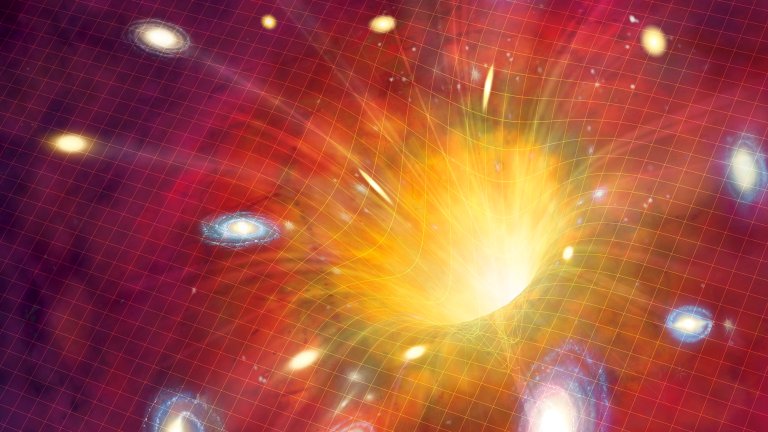
According to the laws of physics, the world should not exist. To explain why we're here, scientists are recreating the universe's fiery beginnings by pitting matter against antimatter and watching them annihilate.

Illustration by John MacNeill AND THEN THERE WAS MATTER
Today's universe is a curious place, but in the first instant after the big bang things were much, much curiouser. Here's how the cataclysmic interplay between matter and antimatter led to the richly detailed world we observe today.

Big bang leads to the formation of energy and matter: the universe's first 1/1,000 of a nanosecond.
1) The big bang creates equal amounts of matter (blue) and antimatter (red). 2) One of every billion antimatter particles changes into a particle of matter. 3) Matter and antimatter annihilate each other. 4) The result: Antimatter destroys 99.9999999 percent of the matter in the universe.

The first atoms begin to form: another 3 minutes.
5) The few remaining matter particles combine in groups of three to form protons and neutrons, which along with electrons make atoms. Among the first kinds of atoms to form were hydrogen, deuterium, and helium.

Atoms coalesce into stars, galaxies, and eventually us: 15 billion more years.
6) Atoms cool, coalesce, and evolve into the universe we know today.
Illustration by John MacNeill

The call comes in from the control room. Stanford University's particle accelerator-one of the largest machines on Earth-has been shut down because of a failed magnet. This is bad news for the scientists I have traveled across the continent to see: Their experiment was designed to run 24 hours a day and the disruption will cost them reams of precious data. But me, I'm thrilled. Normally, the innards of the radiation-spewing accelerator are off-limits. But idle, it poses no danger. I glance at Stew Smith, a physicist leading the experiment, and he asks if I would like to go inside. Access. I'm about to enter the heart of the cavernous, 2-mile-long accelerator. I'm about to see the place where matter meets antimatter billions of times a second.


One security checkpoint later, I don my hard hat and radiation badge and step into a building whose bland industrial features belie the tumult that goes on inside. In a procedure that reminds me of a nuclear missile launch sequence, Smith and I announce ourselves to a faceless voice coming from a speaker above our heads and then, using one key per person, sequentially unlock the main access door. Inside, ringed by a tangle of high-speed data lines, racks of circuitry, and multiple steel catwalks, is the giant detector, the heart of the Stanford Linear Accelerator, or SLAC, in Menlo Park, California.


My awe is nothing compared to what the 550 physicists worldwide working on the project will experience if their experiment works. Even in the world of physics, where investigators routinely tackle mind-bending problems like quantum uncertainty and black holes, the question these scientists are up against is truly extraordinary: Why does matter exist?


According to our best theories, all possibility for anything to be here should have been destroyed by antimatter some 15 billion years ago. Scientists believe that matter and its nemesis, antimatter, were created in equal amounts at the beginning of time and promptly canceled each other out. Yet that there is matter in the universe-from subatomic particles such as protons and neutrons to stars, planets, and every form of life-is absurdly self-evident. So physicists can't escape the fact that they have constructed a theory of how the universe works-the so-called standard model-that denies their own existence. This is, to say the least, an uncomfortable situation.


"One of (cosmology's) outstanding problems is that we don't know why there's ordinary matter in the universe today," says Michael Turner, a University of Chicago cosmologist. "That's a pretty big problem."

Page 1 of 5 12345next ›last »
Want to learn more about breakthroughs in electronics, medicine, nanotech, and more?
Subscribe to Popular Science and enter to win $5,000!

3 Comments

Antimatter is a scary thing...will it consume earth? Will it consume us
http://budgetvanlines.businesscard2.com/

Well, nice article buddy… Someone will love to read this infor if I tell her about this. She’s really interested in this subject. Thanks again…

Thank you for your amazing and articulate post. I had a lot of fun reading it and looking at all the picture. I hope you can do your part in saving the environment, start building solar panels:

www.buildingsolarpanelsblog.com


Download Our iPhone App

Stay up to date on the latest news of the future of science and technology from your iPhone with full articles, images and offline viewing


Follow Us On Twitter

Featuring every article from the magazine and website, plus links from around the Web. Also see our PopSci DIY feed


Become a Fan On Facebook

Share links with friends, comment on stories and more


December 2009: Best of What's New

In our December issue, Popular Science names the 100 best innovations of the year: bombproof wallpaper, self-parking cars, the fastest helicopter, and 97 more. Plus inventor profiles and videos.

Check out the best of what's new here.

Popular Science Photo Pool


Share your photos in the Pop Sci pool at www.flickr.com!
tags_sprite.png
POP_embeddedForm_cover_May09.jpg