
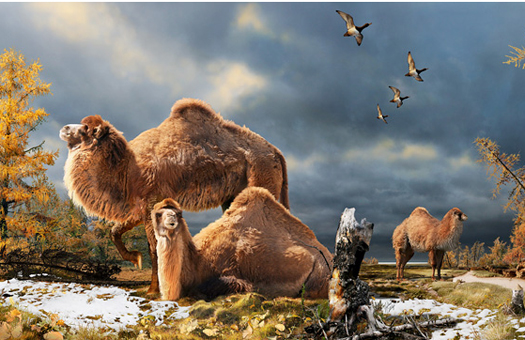
In the northernmost reaches of Canada, within the Arctic Circle, scientists have found fossils of...camels. Wait, what?

High Arctic Camel
High Arctic Camel Julius Csotonyi © Julius Csotonyi

North America was a crazy place a few million years ago. The megafauna alone would make the world's most awesome zoo collection: giant sloths! Mastodons! Nine-foot saber-toothed salmon! Dire wolves! And, believe it or not, camels. Yes, camels originally arose in North America 45 million years ago and lived there until human migrated into the area around 16,000 years ago.

So, we might expect to find camels somewhere in North America, sure. But researchers just found fossils on Ellesmere Island, in the northern territory of Nunavut, Canada, far above the Arctic Circle. Nobody knew that camels could live so far north, and now researchers have begun to wonder: was the camel's hump -- which is basically a judicious redistribution of fat -- an adaptation to deal with a cold climate? And identifying the fossils as camels is a feat unto itself -- they are all small shards, discovered in digs in 2006, 2008 and 2010, rather than the giant bones one usually imagines.

After painstaking reconstruction following 3-D laser scanning, scientists discovered that the bone fragments came from a large tibia. Further, this tibia came from a large cloven-hoofed animal called an artiodactyl. Carbon dating revealed that the bones were about 3 million years old, and the only large artiodactyl in North America back then was...drum roll please...the camel.

Full confirmation of the identity of the fossil animal came from a new technique called collagen fingerprinting. Researchers first extract some of the collagen still left in the bones--collagen sticks around for a long time--by drilling a small hole in the bone and collecting the accrued dust. After demineralization of the bone dust and gelatinization, researchers digested the collagen protein using the protease trypsin. The trypsin digestion results in peptide fragments. Researchers put those peptides into a mass spectrometer to determine the different fragment lengths; each species has its own particular fragment signature. When the researchers compared the fossil signatures to known current species, they corroborated that the High Arctic Camel is closely related to both dromedaries (modern single-humped camels) and to another older species of camel whose fossils have been found in the Yukon Territory.

Finally, while temperatures in that region during that time period were warmer than they are now (up to 10 degrees Celsius warmer in the Arctic), it was still a harsh environment. From their recent paper on the high arctic camel: "Other specialized traits seen in modern camels may also have served well in an Arctic realm. For example their wide flat feet function well on soft substrates, such as sand or snow. Their iconic hump(s), containing fat, also may have been adaptive. As seen in high-latitude ungulates today, fat deposits could have been critically important for allowing populations to survive and reproduce in harsh climates characterized by 6-month long, cold, winters." So, there you go. Arctic camels.

You can read the full article in the journal Nature Communications.

10 Comments

Seriously, where does this info come from!? No. They didnt carbon date to 3 million year. Because one, thats impossible (10 half-lives =57,000 years) and two, the full journal article made no mention of that whatsoever.

There are wild camels remaining in the Gobi desert, Siberia the Altai mountains. They tolerate -40 temperatures, high altitudes, salty water, and will eat anything that stands still for long enough. If Ellesmere Island was 10C warmer I might even survive up there.

***FREAKING***????? Have we come this far? I'm 75 and I used to hear this brand of trash-talk from 12-year-olds in the schoolyard. Has popular science writing come down that far? or has 12-year-old slang/jargon risen that high?

Finally, while temperatures in that region during that time period were warmer than they are now (up to 10 degrees Celsius warmer in the Arctic), it was still a harsh environment.

Interesting questions do arise. What were the causes of the higher temperature at that time, AGW? How have things cooled since then, AGW?

Regardless of Global Warming, the world was a lot different more than 3 million years ago. The isthmus of Panama completed its connection of North and South America about 3 million years ago, before then the ocean currents and weather patterns would have been substantially different. A few million years before that, Ellesmere Island and the rest of Canada would have been further south and east of their present location.

@EU Rota

A 10C warmer world (projected by climate scientists) is not unprecedented in Earth's history at all. There were surely times which were far warmer, and times which were far cooler. What is unprecedented, however, is the rate at which we are warming. Rates such as these have not been found in climatic records, save for a few catastrophes (Siberian basalt traps, meteorite impacts, etc), and since we haven't had something such as that for many, many years, scientists consider the current rate of warming to be impossible via natural factors alone.

Back on topic, I'm not surprised that they found camels in Northern Canada. There was just so much going on in The Americas at the time (megafauna) that it was inevitable that some traveled north and adapted to live there.

Camels are very hardy animals, of course they would be in the arctic!
And remember!

Have fun, Have Nukes!

@brandedinfo- Please tell me that you are a troll... They have other methods of dating something.

Radiocarbon dating- (C14 dating) The most widely-known and used. All living things take in C14 as they live, and stop taking it in when they die. C14 decays at a known rate over time. By analyzing the amount of C14 left in dead material, you know that it died x number of years ago, within a possible date range. It's effective to about 50,000 years before present (YBP). As a rule of thumb, a minimum of three separate samples must be taken from different remains at the site for a meaningful date. This is often used in conjunction with...
Dendrochronology- Simply put, counting tree rings and analyzing that sample via radiocarbon dating. This gives a much closer approximation of the date of the material, called a "Calibrated Date." For instance, the Clovis, NM site's uncalibrated date is 11,200 YBP, but the calibrated date pushed it back to 13,500 YBP.

Potassium/Argon dating (K/Ar dating)- This measures the decay of an isotope of Potassium (40K) into Argon over time. This is usually used on volcanic deposits and can measure to ~1.3 Billion years before present to 100,000 YBP. Yes, billion.
Fission Track Dating- This is relatively new. It measures the damage (or tracks) left by decaying uranium atoms in natural glasses (such as obsidian) and some minerals. It can date materials from 3 million YBP to 100,000 YBP.
Obsidian Hydration Dating- Measures the amount of water absorbed by a piece of broken obsidian. Water works its way into a flintknapped or otherwise broken piece of obsidian at an observable rate. This can be measured simply using a microscope, where a small sample is taken from the artifact, or by using the much more technical and non-destructive (and therefore better, but much more expensive) Secondary Ion Mass Spectrometry method. This is used to date material as old as eight million YBP.

Thermoluminescence (TL)- This method can only be used on burned materials like fire-cracked rock, pottery, and sediments exposed to sunlight. It measures the amount of accumulated radiation in an artifact or other sample. When the material is heated, it emits a small amount of light based on the amount of radiation stored within. This amount is measured. It is used to date material up to 50,000 YBP.

Archaeomagnetic Dating- This depends upon the inclusion of magnetite within an artifact. It analyzes the magnetic properties of the material as it relates to the Earth’s magnetic field at a given time in the past. This is effective on material up to 10,000 YBP.

Electron Paramagnetic Resonance- These are incredibly technical dating methods. They are based on the electron spin in an artifact by measuring the electromagnetic field of unpaired electrons in bone or calcite formation, and are effective from 1,000 to 2 million YBP. Nuclear Magnetic Resonance is also used- in MRI’s.

Uranium Series Dating (Uranium/Thorium Dating, Thorium-230 dating, Uranium-Series Disequilibrium Dating)- This measures the amount of Uranium-234 compared to the amount of Thorium-230 in a given sample. Uranium-234 has a measured radioactive decay into Thorium-230. The isotope Uranium-234 must also be measured against its parent isotope, Uranium-238, for an accurate measurement of radioactive decay. This is effective on any materials containing calcium carbonate- bones, mollusk shells, limestone, stalactites and stalagmites. It is used to date materials up to 500,000 YBP.

Cosmogenic Nuclide Dating- This is an incredibly new process of dating. In one study, it measures the isotopes of Beryllium and the effects of cosmic rays, high-energy particles that come to Earth from space, causing the Beryllium to have differing numbers of neutrons. There are a total of 21 isotopes created by cosmic rays spread over a number of different elements. This dating method is most often used in Geology, focusing on Aluminum, Chlorine, Calcium, and Iodine, which each have half-lifes of 720,000, 308,000, 103,000, and 15,700,000 years, respectively.

-Old Alaskan North Slope Native reading his PopSci-Yeah, those were the days.


June 2013: American Energy Independence

Five amazing, clean technologies that will set us free, in this month's energy-focused issue. Also: how to build a better bomb detector, the robotic toys that are raising your children, a human catapult, the world's smallest arcade, and much more.


Online Content Director: Suzanne LaBarre | Email
Senior Editor: Paul Adams | Email
Associate Editor: Dan Nosowitz | Email
Assistant Editor: Colin Lecher | Email
Assistant Editor: Rose Pastore | Email

Contributing Writers:
Rebecca Boyle | Email
Kelsey D. Atherton | Email
Francie Diep | Email
Shaunacy Ferro | Email

circ-top-header.gif
circ-cover.gif
bmxmag-ps