People can correctly identify a wide range of dog emotions by sight.
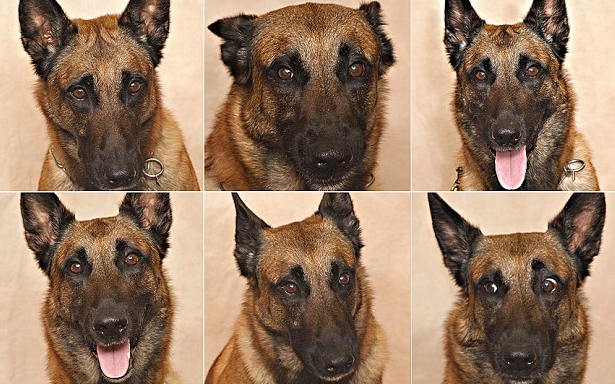
Mal, In Various States of Concern
Mal, In Various States of Concern Tina Bloom and Harris Friedman/Behavioral Processes

People can reliably read a dog’s facial expressions, suggesting humans are finely tuned to detect emotions even in other creatures. Behavioral scientists have long known that people can accurately read other humans’ emotions, but this study suggests our empathy extends to other members of the animal kingdom.

While a Ph.D student at Walden University in Florida, Tina Bloom worked with Harris Friedman and a dog named Mal at the Pennsylvania Department of Corrections. Mal, a 5-year-old Belgian shepherd and trained police dog, was subjected to a variety of stimuli, and the researchers took pictures of his reactions.

For instance, in one experiment the researchers praised him, trying to elicit a happy reaction; Mal looked at the camera with his ears erect and tongue lolling. Then they reprimanded him, and Mal’s ears flattened, he looked down and his eyes became mournful. They used a jack-in-the-box to surprise him; foul-tasting medicine to disgust him; nail trimmers to strike fear into his heart; and so on. One of the researchers even pretended to be a criminal, and Mal got angry. Then the team showed 50 volunteers photographs of these reactions, and asked them to categorize his emotions.

It was easy to spot happiness, with 88 percent of volunteers correctly pegging Mal’s doggy smile. Fright and sadness were a bit harder to register, at 45 percent and 37 percent, respectively. Disgust was the hardest to figure out, with just 13 percent of people able to determine what Mal’s sour face meant.

In an interesting twist, people who don’t own dogs were sometimes a better judge of a dog’s emotions. This might indicate that dog owners convince themselves their pets are not angry or disgusted--they're just playing. It could also mean that understanding a dog’s emotions is a natural ability, not a learned one. I think I can read many of my dog’s emotions, which is easy because they follow a spectrum of general nervousness at all times. Below, my border collie Sadie registers what I view as anticipation, frustration and “squirrel.”

Bloom told the Telegraph she wanted to continue the research to determine whether this emotional connection extends to all mammals, or just dogs, which have evolved alongside humans for 100,000 years. Her dissertation is published in Behavioral Processes.

Sadie, Hopeful, Annoyed and "Squirrel"
Sadie, Hopeful, Annoyed and "Squirrel":  Rebecca Boyle

9 Comments

Christopher. if you think Mike`s blurb is shocking... last tuesday I got a brand new Citroën 2CV since getting a cheque for $7714 this - five weeks past and-even more than, 10-k last-munth. it's realy the nicest-job I've had. I actually started seven months/ago and pretty much immediately began to make more than $74 per/hr. I work through this website,..business2.MEL7.Com

Interesting story, although I think it would be more interesting to study the opposite -animals that can recognize human emotions. For example, if I smile, my cat starts purring and my dog wags his tail and comes over to me. If I am sad or crying, my animals come curl up in my lap. If I am angry, they avoid me. Also, strangely enough, my cat likes MUSIC. Whenever I sing or play violin or piano, she always begins purring and loves to be near it. It is incredible. I think so much science is not very devoted to animals, but if we were to study those things -maybe vegetarians and vegans wouldn't have such a bad rap, and maybe animal rights activists & organizations like PETA would get some more leverage to support their protests. (It could also be used for more useful things, like studying the brain -animal vs.human- n' such) ;)

Seriously, PopSci, fight the bots.

Excellent article and good use of dog photos with good facial expressions. If you are having a dog , you should know what he is feeling..rather then other way round..

Thank you for putting this up
Kulls
www.letsnurture.com

Having been a small animal veterinarian for over 30 years I am routinely amazed by articles like this that ascribe what is obvious to us as new and revealing. Of course you can read an animals expressions. We use this eveyday and automatically. The distinction between humans and non human animals is not so distinct as "scientists" would have us believe.

What about cats? Why does PopSci hate cats? ;)

I can read a cat's emotions as well.

@Bill: it's not just PopSci- even cats hate cats.

Chuck

This article would have been so much better if a range of canine emotions had been depicted with photographic examples from different breeds.

With over 45 million households with cats, over 57 with dogs, and many with both (like mine!), it's obvious people love dogs AND cats. We're different, but we're both readable and lovable! - Signed Sir William the Cat at www.indefenseofcats.com


June 2013: American Energy Independence

Five amazing, clean technologies that will set us free, in this month's energy-focused issue. Also: how to build a better bomb detector, the robotic toys that are raising your children, a human catapult, the world's smallest arcade, and much more.


Online Content Director: Suzanne LaBarre | Email
Senior Editor: Paul Adams | Email
Associate Editor: Dan Nosowitz | Email
Assistant Editor: Colin Lecher | Email
Assistant Editor: Rose Pastore | Email

Contributing Writers:

Kelsey D. Atherton | Email
Francie Diep | Email
Shaunacy Ferro | Email

circ-top-header.gif
circ-cover.gif