

In the late 1800s, German psychiatrist Franz Müller-Lyer designed one of the world’s most famous visual illusions. The illusion became popular because it was easy to re-create and very difficult to shake. It began with a simple question: Which of the following two vertical lines above is longer?
If you’re like almost everyone whom Müller-Lyer tested, Line B will appear longer than Line A. In fact, the two lines are identical in length, as this doctored version of the illusion shows:
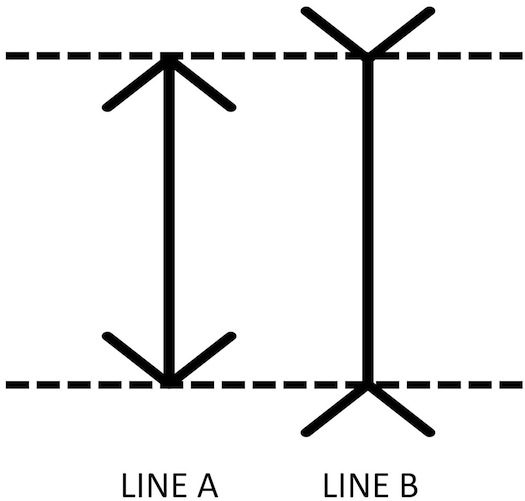
For decades, vision researchers assumed that the illusion told us something fundamental about human vision. When they showed the illusion to people with normal vision, they were convinced that the line with the inward-pointing arrows would seem longer than the line with outward-pointing arrows. That assumption wasn’t really tested before the 1960s, because until then almost everyone who had seen the illusion was WEIRD—an acronym that cultural psychologists have coined for people from Western, Educated, Industrialized, Rich, and Democratic societies. In the early 1960s, three researchers remedied that oversight when they showed the illusion to two thousand people from fifteen different cultural groups. The illusion deceived the first few groups. Adults living in Evanston, Illinois, perceived Line B to be on average 20 percent longer than Line A, while students at nearby Northwestern University and white adults in South Africa similarly believed that Line B was between 13 percent and 15 percent longer than Line A. Then the researchers journeyed farther afield, testing people from several African tribes. Bushmen from southern Africa failed to show the illusion at all, perceiving the lines as almost identical in length. Small samples of Suku tribespeople from northern Angola and Bete tribespeople from the Ivory Coast also failed to show the illusion, or saw Line B as only very slightly longer than Line A. Müller-Lyer’s eponymous illusion had deceived thousands of people from WEIRD societies for decades, but it wasn’t universal.
How was it that African bushmen and tribespeople were immune to the illusion, when they shared the same visual and neutral anatomy as the Westerners who couldn’t shake the sense that Line B was longer than Line A? In the absence of biological differences, the answer was, of course, cultural. In contrast to most Western societies, the bushmen, Suku, and Bete lived in worlds with very few straight lines. Their houses, often made of thatch, were either rounded or devoid of the hard lines that dominate Western interiors, and they spent most of their time gazing at natural scenes of grassland, trees, and water that similarly lacked geometric angles. Why should this have mattered? Over years and years, people who live in hard, geometric interiors become used to judging the size of objects based on the rules of three-dimensional visual perspective. For example, if you were inside this room and you had to decide which of the two walls highlighted with thick black lines, A and B, was taller, which would you pick?
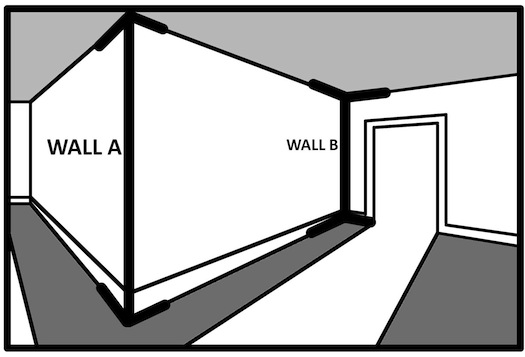
From years of living indoors in structures with perpendicular walls, you know without even paying attention that the two walls are the same height. Wall A is closer to you, so it casts a larger image on your retina, at the back of your eye, but you’re so familiar with the basic principles of perspective that you correct for that difference. The lines that Wall A creates where it meets the floor and ceiling are similar to Line A in the Müller-Lyer illusion, and the lines that Wall B creates are similar to Line B. When you see configurations like Line A, you’re reminded of objects that are close to you and aren’t actually as large as they appear; in contrast, configurations like Line B remind you of objects that are far away and are actually larger than they appear. In your head, you make those corrections automatically, so Line B looks longer than it is (just as Wall B is taller than it looks), and Line A looks shorter than it is (just as Wall A is shorter than it looks). These intuitions are bound up in cultural experience, and the Bushpeople, Suku, and Bete didn’t share those intuitions because they had rarely been exposed to the same geometric configurations.
Many of these cultural differences stretch back millennia. Ancient Greek philosophers, who formed the basis for much modern Western philosophy, tended to analyze objects in isolation from their contexts, whereas ancient Chinese philosophers were far more concerned with the relationship between an object and its context. Thousands of years later, these differences continue to express themselves in how Westerners and East Asians perceive the world.
In one experiment, researchers asked Chinese and American students to study a series of photos that featured a central object against a background. For example, one of the photos featured a tiger standing by a stream in a forest, and a second photo featured a fighter jet against an alpine backdrop. Later, the experimenters showed the students a new series of photos and asked them whether they had seen the object in the foreground during the first phase of the experiment. Most of the students were pretty good at the task, answering correctly on 70 percent of the trials. But there was one notable exception: when the experimenters presented the objects against new backgrounds (like moving the tiger from the forest to a grassy plain, or placing the jet against a cloud-filled sky), the Chinese students struggled with the task. Their accuracy dropped below 60 percent, so they were almost guessing whether they had seen the focal object earlier in the experiment.
The reason for their difficulty became clear when the researchers examined their eye movements as they memorized the images. The American students devoted most of their attention to looking at the focal object, and spent considerably less time focusing on its background. While the Americans gazed at the objects through Aristotelian eyes, the Chinese students viewed the scenes through a Confucian lens, focusing as much on the background as on the object. The Chinese students were confused when the objects appeared in new backgrounds, because they had formed memories of the objects in context, while the Americans had paid very little attention to the backgrounds at all.
Cultural legacies have a similar influence on how we perceive people and social interactions. Just as Chinese people are more likely than Americans to focus on objects in context, so they also believe that people are overlapping entities who relate to the other people in their lives. Westerners (people from the United States, Canada, Western Europe, Australia, and New Zealand, for example) are more likely to believe that they are distinct from other people, so even when they become very close to friends or loved ones, they still see themselves as individuals. This philosophical belief, known as individualism, is very different from the East Asian (Japanese, Chinese, and Korean, for example) belief in collectivism, which implies that everyone is interconnected, that our identities overlap, and our actions should benefit the group as a whole above any one individual. Although people from both cultural groups recognize that they’re at once individuals and members of a group, the individual component looms larger for Westerners, while the collective component carries more weight for Easterners.
In one series of experiments, researchers asked American and Japanese students to interpret the emotions of a cartoon man who stood in front of a background filled with four other male and female cartoon characters. Sometimes all five shared the same emotional expression, but at other times the figure at the front seemed to have a different expression from those of the figures behind him, as in the case below.

When the students were asked to judge the central character’s emotions—whether he was happy, sad, or angry—72 percent of the Japanese students said they were unable to ignore the emotions of the people in the background, while only 28 percent of the American students had the same reaction. Of course, the Japanese students then rated the happy character as less happy, the sad character as less sad, and the angry character as less angry when the four characters in the background expressed different emotions. As in the study that featured tigers and fighter jets, the Japanese students spent plenty of time looking at the four faces in the background, whereas the Americans focused almost exclusively on the expression of the large face in the foreground.
Americans take the virtues of liberty and individual freedom for granted, but since East Asians pay so much attention to collective well-being, culture researchers have questioned whether they might emphasize the values of harmony and conformity over uniqueness and independence. One analysis measured the use of uniqueness and conformity in over three hundred newspaper and magazine ads in the United States and Korea. Some of the publications focused on business and social commentary (Money and the New York Times in the United States and Business Weekly and Deep Fountain in Korea), while others targeted women and youth. While almost every advertisement in Korea promoted the values of tradition, conformity, and following trends, nearly every advertisement in the United States emphasized choice, freedom, and uniqueness. One Korean ad claimed, “Seven out of ten people are using this product,” a statement that might repel U.S. consumers. In contrast, an ad in the United States noted, “The Internet isn’t for everybody. But then again, you are not everybody,” a sentiment that might offend the collectivist sentiments of Korean consumers.
These ads also reflect how collectivists and individualists actually behave. One of the most famous research programs in the history of social psychology was Solomon Asch’s investigation of human conformity in the United States during the 1950s. Asch had grown up in Poland during the early 1900s before moving to Brooklyn, New York, with his parents in 1920. As a boy sitting at his parents’ table on Passover, Asch asked why a glass that his father had filled with wine sat untouched in front of an empty seat. His father replied that the glass was reserved for the prophet Elijah, and at that moment young Solomon was convinced that the level of wine in the glass declined slightly. Asch’s early fascination with suggestibility and influence became a lifelong interest in conformity and propaganda, particularly in the wake of the horrors of World War II. So he designed a study to test the limits of human conformity. In his standard experiment, seven people sat in a room and completed a simple task: to determine which line on the right matched the length of the line on the left.

The task is trivial, because the answer is very clearly Line C, but there was a twist in the experiment’s design. The last person to respond aloud was a naive participant who had no idea what the experiment was designed to test. He also had no idea that the other six participants were stooges who had been instructed by the experimenter to claim, unanimously, that the correct answer was Line B. So as the experiment progressed they casually called out, “Line B,” while the experimenter recorded their responses. The naive participant became increasingly agitated, wondering at first whether he had misunderstood the instructions and then whether the other people in the room were playing a prank. But none of them wavered, and then it was his turn to respond. Across hundreds of trials, Asch found that roughly 30 percent of all American participants conformed, responding with the same manifestly incorrect “Line B” response that the others in the room delivered, one after another. This result is powerful because it shows that although Americans generally place a premium on the individualistic values of uniqueness and self-reliance, they still succumb to the pressures of social influence.
As with the Müller-Lyer illusion, it took researchers some time to investigate the effect in other cultures, but eventually they administered Asch’s experiment across the globe. The results were similar in other individualistic countries, from the U.K. to Holland, but they were dramatically stronger in collectivistic countries. Japanese participants conformed up to 50 percent of the time, Ghanaians 47 percent of the time, and Fijians 58 percent of the time. Conformity—a route to social harmony—occurs sometimes in the individualistic United States, but it’s far more likely to occur within cultures that value collectivistic ideals.
Adam Alter (@adamleealter ) is a professor in the marketing and psychology departments at New York University. Drunk Tank Pink_ is his first book. Buy it on [Amazon](
