Isolation from wolves seems to be the crucial step to the evolution of the modern domesticated dog.
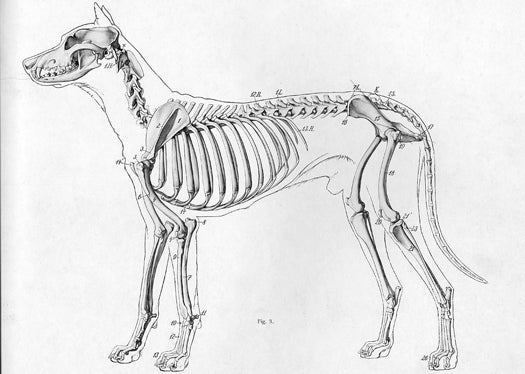
Dog Skeleton
Dog Skeleton Wikipedia

At first blush, the emergence of man's best friend is pretty straightforward. The first dogs descended from wolves in Europe about 14,000 years ago. Then humans domesticated those proto-dogs until the eventual animal known as a "dog" had many of the traits we associated with the animal today. That much of the evolutionary history of the modern dog has been clearly understood. But further research suggests that that European dog is not the ancestor of all our dogs; instead, every modern Western dog hails from a Southeast Asian progenitor lineage. Why? Why did some upstart Southeast Asian lineage triumph, even in Europe, instead of the endemic European one? Turns out, it might have to do with your pet dog's affinity for Cheetos.

According to research conducted by Ben Sacks from the University of California at Davis and his colleagues, the Southeast Asian dogs prospered because, after they were brought south of the Yangtze River some 6,000 years ago, the dogs were isolated from their wolf forebears. Without that proximity, the Southeast Asian dogs could no longer interbreed with wolves, and thus followed their own evolutionary path. In contrast, northern Asian and European dogs still had contact with, and interbred with, the native wolf populations. Put more clearly, if dogs and wolves interbreed, as they did in Europe, they ended up in an evolutionary cul-de-sac. Isolated from one another, traits that benefited the newly emergent dog lineage flourished.

Another slice of data, published in January in Nature by Erik Axelsson of Uppsala University, suggests that one of the main differences between dogs and wolves is their ability to digest starch. As dogs continued their co-existence with humans -- who were, at the same time, mastering agriculture and switching to a grain-based diet -- those individuals who could eat starch would be better suited to a domesticated lifestyle than those who had to constantly hunt. Sacks and Axelsson disagree on when that switch took place: Axelsson says that it happened before humans switched from a hunter-gatherer lifestyle to a farming one; Sacks says that the mutation occurred once rice cultivation in Southeast Asia was well underway.

Further work will be required to pinpoint just when the modern dog eventually emerged and to clarify where other canids, such as dingoes, fit into this evolutionary picture. In the interim, sit back and marvel at the process that eventually produced the donut-stealing canine scamps
we know and love today.

8 Comments

in order to thank everyone, characteristic, novel style, varieties, low price and good quality, and the low sale price. Thank everyone

http://al.ly/AvJ

http://al.ly/AvJ

http://al.ly/AvJ

http://al.ly/AvJ

│\_╭╭╭╭╭_/│  
 │         │\|/  
 │ ●     ● │—☆—  
 │○ ╰┬┬┬╯ ○│/|\  
 │   ╰—╯   /  
 ╰—┬○————┬○╯  
  ╭│     │╮  
  ╰┴—————┴╯ sdfgwegew

And yet, they still can interbreed with wolves, produce fertile offspring, etc. No changes to make them anything other than the same dog kind they had always been.

They used forms of the world 'evolution' how many times in the article for such a poor example of the 'origins of the species'. They have one type of animal here that shifts around within that type, but remains that type.

Evolution does not mean "transforming to another species" it just means "change". "Species" is just a word we use to help us classify life.
They are not trying to prove dogs evolved, we already know ALL life is related because we share the same DNA. They are talking about how dogs changed over time, which is EXACTLY what evolution is.
They could have also titled the article "How dogs evolved"

@killerT

Evolution is not a well defined term. It has many meanings, which one is used depends on which counterexample to the theory as a whole is presented.

BTW, if all species are related because they have DNA, are all computers with an Intel processor built by Dell?

@Bagpipes Intel processors are a component of a constructed machine, with each part constructed by different manufacturers and then assembled. Are you suggesting one God made DNA, one God made RNA, one God designed lungs, one God designed stomachs, and one final God is responsible for putting each species together? No, I assume? Then your example is invalid. What you are actually arguing is the concept of taxonomy which, while related to evolution, is definitively separate. Incidentally, taxonomy in fact addresses the philosophy behind your question.

As for the definition of evolution, you intentionally misidentified the intended connotation in the article in an attempt to bolster your argument. Clearly wolves and dogs are closely related. Why then would you criticize them on the basis that they intended the discussion in terms of the long-term effects of evolution that creates entirely new classes and phyla of life? Evolution has multiple definitions, indeed, so why do you get to pick which one best serves your counterargument of evolution while simultaneously insisting that every instance of evolution rigidly means "dogs came from fish" or some such easily countered Strawman argument?

Would not a rose by any other name still poop on your couch?

@ bagpipes buuurrrnnned! the game is up, go home

@ Moose: I don't think bagpipes cares if you think he got burned or not.

@ Firehorn. You make a good point about the issue of taxonomy. The categorization of certain organisms often runs counter to the evolutionary definition of a species. The article seems to be delving into the concept of "speciation," whereby which a new species emerges through the processes of evolution.

Up until 1993, wolves were known as Canis lupus and dogs by the name Canis domesticus (at least by the majority of American scientists)

But then comes bagpipes' point, if clumsily made, that dogs and wolves are the same species by definition of the word species. (A species is a set of organisms that can interbreed and produce fertile offspring.) He is right and has been confirmed by the American Society of Mammologists. In 1993, they chose to reclassify dos as a subspecies of wolves, Canis lupus familiaris.

See itis.gov/servlet/SingleRpt/SingleRpt?search_topic=TSN&search_value=726821

I think this argument above is unhelpful for a design vs. evolution debate.

The fact is that bagpipes is right on this point and the "other" fact is that evolutionary biologists agree with him on this point.

Dogs and wolves are the same species. We all agree. The article handles this fact with a lack of clarity.


June 2013: American Energy Independence

Five amazing, clean technologies that will set us free, in this month's energy-focused issue. Also: how to build a better bomb detector, the robotic toys that are raising your children, a human catapult, the world's smallest arcade, and much more.


Online Content Director: Suzanne LaBarre | Email
Senior Editor: Paul Adams | Email
Associate Editor: Dan Nosowitz | Email
Assistant Editor: Colin Lecher | Email
Assistant Editor: Rose Pastore | Email

Contributing Writers:

Kelsey D. Atherton | Email
Francie Diep | Email
Shaunacy Ferro | Email

circ-top-header.gif
circ-cover.gif
bmxmag-ps