A mass animal-hunting contest that actually, well, makes sense.
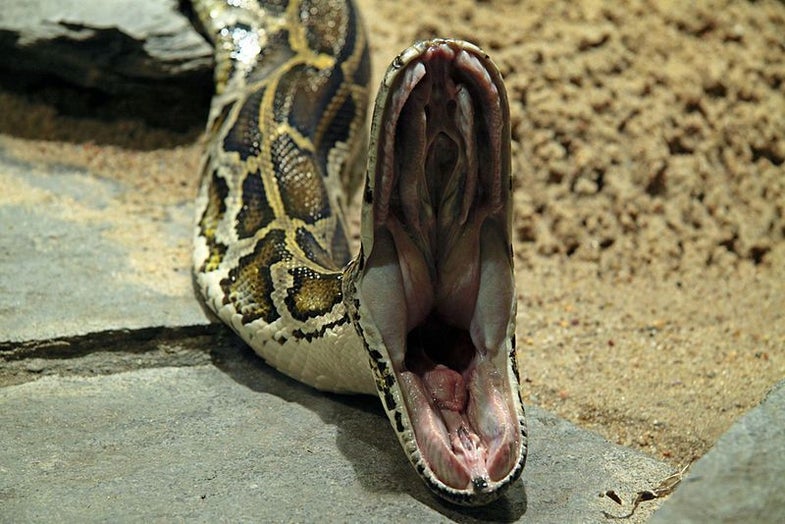
Burmese Python
Burmese Python Wikimedia Commons

This weekend, the Florida Fish and Wildlife Commission kicked off the 2013 Python Challenge in Davie, Florida, a smallish city near Fort Lauderdale. The Python Challenge registers python hunters and gives cash prizes to those who can gather the most--or the biggest--pythons. As much as it's weird to award people for killing the most snakes, this is absolutely the right move for Florida--unlike Wyoming's stance on wolves.

Burmese pythons, native to southeast Asia, are massive constrictors, reaching up to 17 feet long. They were brought to Florida as pets and either escaped or were released into the wild, and found themselves an environment totally unprepared for them. South Florida, especially the area in and around the Everglades, is home to an astounding number of rare and vanishing plants and animals, vanishing faster due to an all-out frontal environmental assault from land developers and politicians. The Everglades is a quarter of its natural size and nowhere near as healthy as it should be. And the Burmese python is one of the worst invasive species in the entire country.

Burmese pythons eat small endangered animals like the mangrove fox squirrel, the Key Largo woodrat, the wood stork, and the Key Largo cotton mouse. Burmese pythons drastically reduce the number of non-endangered species like raccoons, opossums, white-tailed deer (yeah. They are fearsome hunters), and coyotes, which can have a negative effect on the health of the ecosystem as a whole. There is no snake in south Florida anywhere near as big or as effective a hunter as the python, so these animals do not see snakes as a threat and do not attempt evasive action. Burmese pythons compete for resources--very effectively--with endangered or vulnerable endemic species like the Florida panther, American crocodile, and many native snakes.

In short, Burmese pythons are a menace, and they are bad for Florida. We know that because scientists have told us that. So, good. Offer cash to python hunters. But not all snake hunters! Snake hunting is a common event in much of the country, but in the cases of even dangerous snakes like rattlesnakes, mass killings are very bad for the environment, as this petition argues. That doesn't apply to introduced snakes like the Burmese python, so, go nuts, Florida. Win that prize.

16 Comments

i think i became dumber while reading this article....

Wikimedia Commons didn't have a better picture of a Burmese python than one yawning? :)

"...Burmese pythons are a menace, and they are bad for Florida. We know that because scientists have told us that..." ~ Dan Nosowitz

Burmese Python must DIE!

“In short, Burmese pythons are a menace, and they are bad for Florida. We know that because scientists have told us that.”

I am not sure how to take this statement.

On the positive side, people are actually listening to what the scientists say for a change.

On the negative side, someone in a white lab coat with a couple of letters after his name said something and so it must be true.

@matsci1

Take it. Don't try to think about it. Scientists are all above pettiness and ill-will. They are infallible. Politics never effect a scientists results.

"Also, I wasn't able to find any heart warming baby snake photos, so this is totally unlike population management of wolves, which have cute and fluffy babies. I'm comfortably blind to my hypocrisy."

Unintended consequences....

See: 'Cobra Effect'

Wasn't this a Simpson episode?

@ Bagpipes100

Undesirable personality characteristics exist in scientists just like anyone else. I will name you an example in a moment. However, scientists have the tools and are more active in policing their own ranks than other groups.

Consider the case of Pons and Fleischmann…cold fusion. They reported that their results indicated that a nuclear reaction was taking place in their experiment at lower energies than was thought possible. When other scientists tried to repeat their experiments they were not consistent in their results. Because of the inability to consistently reproduce the results, the phenomenon of “Cold Fusion” was considered to be not a reality. This was all done within the scientific community.

Another case is the recent “Faster than light particles” that proved to be due to experimental error. Again, all taken care of within the community.

If you want an example of politics effecting the behavior of a scientist look at Angelika Merkel the chanclor of Germany. She has a PhD in Physics and served in the Kohl administration as the Minister for environmental, nature protection and reactor security. There is no question in my mind that she knows a lot about nuclear energy in its many forms.

However, during the debate on nuclear power in Germany, she did not make one suggestion as to the use of Thorium Energy which is a very safe and accessible form of nuclear power.

www.thoriumenergyalliance.com/

With her background there is no way that she can not know of this. But she kept quiet and did not show any leadership because that would upset the money flow of the nuclear industry…which is heavily invested in uranium as a fuel.

This lack of leadership and applying the knowledge that she has can not be delt with in the scientific community because she is no longer in that community…she is in the political community and she does not have to answer questions when pressed about it.
However, I would love to have her in a courtroom where she can not walk away from the questions but be required to give account of her actions…or better yet non-action…in the matter.

Also, thorium energy is just one example of many where politicians say “We have a problem”…in this case clean energy…and the scientists are jumping up and down screaming the answer but the politicians do not want to listen to them because it upsets the money flow of the energy industry.

Well at least India is developing this technology…
www.youtube.com/watch?v=8WRPZbE1mnw

@matsci1 I think you were much more correct with your positive comment. I interpreted the article to be remarking on how policy is actually being decided on by scientific evidence using surprise. I haven't seen much of any policy being based on anything an expert in the field would advise. The evidence is there that the burmese python is bad.

@iambronco your ignorance of the wildlife management issues here is staggering. Comparing the needless killing of an apex predator in its own habitat resulting in severe effects on an ecosystem with the removal of an invasive species that is also causing negative effects has nothing to do with its fluffiness. Wolves are supposed to be there, stop killing them for no reason. Snakes aren't supposed to be there and they're ruining things, so start killing them. Based on that, how is it at all hypocrisy?

I smell trolls but just in case... I'll bite.

The Burmese python is invasive, just like starlings, house sparrows (and pigeons but those aren't as ecologically devastating but they cause LOTS of other problems), garlic mustard, scotch broom (out West), and Asian carp. North America is crawling with damaging invasive species, both animals, plants, fungal (and other) diseases of plants and animals that are killing the highly diverse native wildlife either through disease, predation, killing over territorial disputes (as with house sparrows), or competition for space and resources.

Everyone wants to hunt native white tailed deer and fish native fishes (those that aren't already extinct) but the minute we want to control an invasive species people are up in arms?

Ignorance.

People don't realize that the field next to their house that is overgrown with non-native honeysuckles and autumn olive is nearly as useless a habitat for deer as a parking lot (nearly).

Invasive species worldwide are one of the absolute top priority issues of ecology today, only exceeded by human induced climate change resulting from greenhouse gas emissions and loss of natural habitat in priority. Overhunting/poaching and polution (besides greenhouse gases) are also problems but governments and individuals already recognize this and regulate these. Invasive species are an ecological challenge of our generation. Control of current invasive species such as this program, are key and we need to see more of them, and make them economically important (why can't we make snakeskin purses and boots from these pythons?). What is even more important is to stop the rapid introduction of non-native species. This can be done through legislation (which most people tend to dislike), and/or by changing culture and making the prevention of invasive species introduction a moral obligation, just like how we as a society look down on littering (although technically that is illegal too).

@Vulpinor

Ignorance... yes, yes, somewhat like uninformed speculation as to someones knowledge with only two marginally related sentences as reference, no?

To be more clear, and totally blunt, I take issue with Mr Nosowitz's incredibly ham-fisted approach to covering wildlife management and laying them in such black and white terms. I am not of the opinion that wolves should be wantonly killed, but his previous article, if you can manage to read past the off putting writing style, suggests that the Wyoming management plan actively ignored relevant scientists' objections, though perhaps if you were to dig farther you would find that the plan did indeed go through peer review with multiple scientists with relevant expertise.

Were those scientists right, or were those who disagreed with the plan correct? I do not know; I'm not an environmental biologist, nor will I pretend to be one. What I can state with certainty is that it is not the definitive 'special interest vs Scientist' that Nosowitz paints when he states:

"And that's why we need to listen to scientists, not ranchers or hunters."

That is a disingenuous statement at best, and actively misleads the reader. If you care to read rather than subscribing to the academic laziness Mr. Nosowitz promotes, you can read the peer review report from Atkins Global, which also identifies the scientific panelists, their qualifications, and their concerns.

I find it interesting, though, that you seem to think that only invasive species necessitate population control. Even Mr. Nosowitz, in his previous article, conceded (begrudgingly) many native animal populations do require management, such as white tail deer in his home state. Do you disagree? Or perhaps the over-simplification was convenient for you in this instance...

Mmm, just wait until one or several of these Burmese pythons take a little smile south and settle in Cuba. D'Oh!

While highly unlikely, it is in the realm of possibility.
Perhaps they are there now and the media just hasn't got wind of it yet...

hm... link to the report was removed..

http://www.fws.gov/mountain-prairie/species/mammals/wolf/Atkins_Wolf_Peer_Review_Rep_12-27-11-Final.pdf

Smile, smile, what was I thinking... lol.
"swim".

@ iambronco. I consider myself somewhat schooled, and somewhat less ignorant than I was before. I appreciate your time to try to educate me further and apologize for my assumptions that I made about you.

My defense for Mr. Nosowitz's articles still remains though. I read the wolf article, but am embarrassed to say that I did not research as deeply as you. Though he may have oversimplified the issue, I have to think about the result that he hopes to gain from the use of tone in his writing. Would fewer wolf killings in Wyoming be good? Probably. Would more python killings in Florida be good? Also probably. I'd be curious to hear your thoughts on that point.

Also, I'm not sure if your "I find it interesting, though, that you seem to think that only invasive species necessitate population control." was to me or the other commenter, but I didn't mention indigenous species needing control or not. There is a provincial park near where I live that is in desperate need of a deer culling, but special interest groups have made enough of a fuss that for the last seven years, no officials have even bothered to try to start planning one because that fear the backlash. I appreciate Mr. Nosowitz's popular (if sensationalized) promotion of public policy being informed by scientists who have knowledge or expertise in the field.


July 2013: The Future Of Flight

The incredible innovations, like drone swarms and perpetual flight, bringing aviation into the world of tomorrow. Plus: today's greatest sci-fi writers predict the future, the science behind the summer's biggest blockbusters, a Doctor Who-themed DIY 'bot, the organs you can do without, and much more.


Online Content Director: Suzanne LaBarre | Email
Senior Editor: Paul Adams | Email
Associate Editor: Dan Nosowitz | Email
Assistant Editor: Colin Lecher | Email
Assistant Editor: Rose Pastore | Email

Contributing Writers:

Kelsey D. Atherton | Email
Francie Diep | Email
Shaunacy Ferro | Email

circ-top-header.gif
circ-cover.gif
bmxmag-ps