Billions And Billions: Our Galaxy Has At Least 100 Billion Planets, Of Which 17 Billion Are Earthlike
There is also a cornucopia of comets.
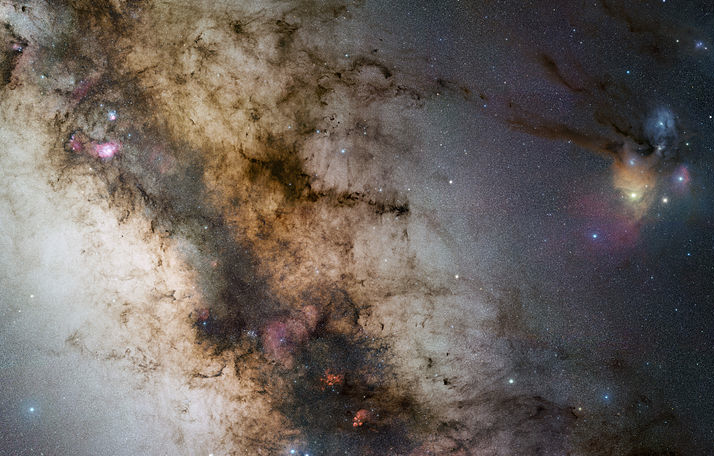
Comfortably a few years into their mission, scientists working with the Kepler Space Telescope are now getting deep into statistics. Like pollsters drawing conclusions from a small sample of voters, they’re confident the few thousand planets and planet candidates they’ve found are good analogs for the rest of the Milky Way.
And they say the Milky Way has a lot of worlds: At least one for every star, and at least one Earth-like one for every six stars.
There’s a ton of exo-news coming from the American Astronomical Society’s winter meeting in Long Beach, Calif., today. Tops on the list is the announcement that Kepler has found 461 new planet candidates. This brings the Kepler catalog to 2,740 potential planets orbiting 2,036 stars, according to NASA, which operates the telescope. The most dramatic increases were seen in the number of Earth-size and super Earth-size candidates, which grew by 43 and 21 percent, respectively.
Also interesting: 43 percent of Kepler’s planet candidates have at least one neighbor. That means a substantial number of planets reside in planetary systems, and are not solo orbiters. And one more bit of statistics: Astronomers have also found whatever type of star you’re talking about, it can have an Earth-size planet around it. Based on estimates of Earth-size planet candidates found so far, there could be 17 billion of them.
Billions and billions of Earth-like planets, that means. Carl Sagan would no doubt be thrilled.
Kepler finds planets by staring at about 156,000 stars and noticing blips in their brightnesses, which could be the result of planets passing in front of them as viewed from our vantage point. These blips have to be further studied to ensure they are really planets, which is why astronomers refer to candidates versus confirmed planets. So far there are 105 definite, confirmed planets among that exoplanetary census.
Caltech astronomers John Johnson and Jonathan Swift confirmed a few of those recently for a study measuring planetary abundance in our galaxy. They looked at Kepler-32, a five-planet system hosted by an M-dwarf star. These stars are incredibly common in our galaxy; about 76 percent of all stars are M-dwarves. These are orange-ish stars compared to our yellow sun, and they’re about half the sun’s size. Other astronomers have already guessed there’s about one planet per star in our parts, but this is the first time anyone has figured that estimate using the most common stars.
Two planets in Kepler-32 had already been confirmed using Earth-based double-check methods, and the Caltech team confirmed the other three. The planets are similar in size to Earth and orbit pretty close to their star. These planets are also a lot like the other ones orbiting M-class stars that Kepler has seen so far, according to Johnson and his coauthors. That means the majority of planets orbiting common stars probably are comparable with these planets. Therefore, the one-planet-per-star calculation is probably conservative, Johnson and Swift say. Further analysis could turn up numbers that support at least two planets per star.
The planets in Kepler-32 are also helping refine theories of how planets form. The planets probably formed farther away from their star than they are now, and moved inward. And they formed from a disk of gas and dust that surrounded their star when it was younger.
This is further confirmed by another exo-study–this one involving exo-comets. After planets like the ones in Kepler-32 system (and in our solar system) are done forming, there are still some leftovers, planetisimals and comets. Barry Welsh, a research astronomer at the University of California, Berkeley’s Space Sciences Laboratory, set out to find these remnants, and located six new exocomet systems. These comets orbit A-type stars, which are very young (around 5 million years old). But again, statistical evidence suggests the older stars should have comets, too. Exocomets may be as common as exoplanets.
What are the implications of all these findings? For astronomers, they show Kepler and ground-based observatories are capable of finding a huge range of planets and planetisimals around a huge range of stars, which means many more findings like this are still to come. But in the broadest terms, they confirm something every human should know: We are not unique. Other rocky worlds orbit other middle-aged, medium-bright stars, everywhere in our corner of the cosmos.
Swift, a postdoc at Caltech who was lead author of the Kepler-32 paper, summed it up perfectly: “Kepler has enabled us to look up at the sky and know that there are more planets out there than stars we can see.”