The protostar and its protoplanetary disk are still in the process of being born.
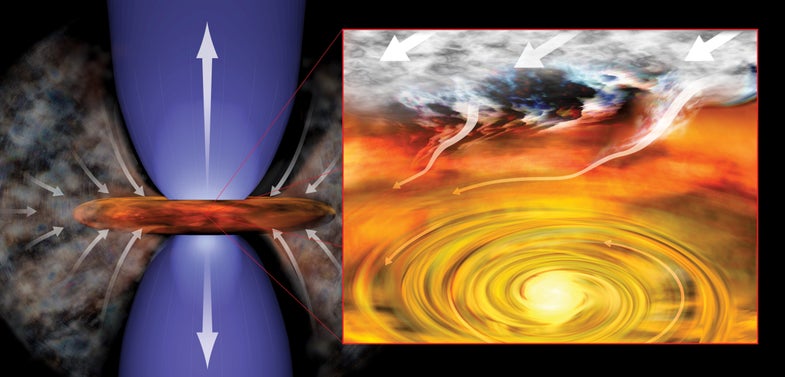
Baby Planet Nursery In this artist's conception of a newly found infant solar system, a young star pulls material from its surroundings into a rotating disk (right) and generates outflowing jets of material (left). Bill Saxton, NRAO/AUI/NSF

In a stellar nursery far away, a solar system with enough heft to make seven Jupiters is in the process of being born, the youngest planetary system ever observed. The system is just 300,000 years old, astronomers say. That’s incredibly young--our own middle-aged system is 4.6 billion years old.

Before this new observation, the oldest baby star disks were of fully grown “protostars,” which had already swallowed up most of the mass in the gassy dust disks surrounding them. But this new star has only used up 20 percent of the mass in its surrounding envelope of material, according to astronomers at the National Radio Astronomy Observatory. “This very young object has all the elements of a solar system in the making,” said John Tobin of the NRAO in a statement.

The star system, which is called L1527 IRS and is located in the constellation Taurus, is currently about one-fifth the mass of the sun. It will eventually have about the same mass as our star, Tobin and colleagues estimate. It’s very bright, which is likely a result of the titanic energies involved in the accretion process.

This is an interesting observation for many reasons, not the least of which is the sensitive radio-range data used to ascertain the nascent star’s existence. The astronomers used the Submillimeter Array and the Combined Array for Millimeter-wave Astronomy to detect dust and carbon monoxide around the object. They examined radio waves emanating from the carbon monoxide, and used the Doppler effect to study how the disk was rotating. They found the speed in the disk changes relative to its distance from the star, just like the planets in our solar system change their speeds relative to our star.

This is called Keplerian rotation, after planet-motion-genius Johannes Kepler. The phenomenon will allow planets to form, explained Hsin-Fang Chiang of the University of Illinois and the Institute for Astronomy of the University of Hawaii. The disk’s rotation and slower speeds far out will prevent all the material in the disk from accreting onto the star. The leftover swirling material will coalesce to form planets.

Next up is studying the baby disk in more detail with the Atacama Large Millimeter/submillimeter Array, which is almost done being built at 16,400 feet in the Chilean desert. ALMA will be able to provide even more detail about what’s happening to the disk, which will tell astronomers how planetary systems are born, Tobin said.

The paper describing the infant system is published in the journal Nature.
Newly Forming Solar System
Newly Forming Solar System: This image is showing reflected light from the upper surface of the disk around the protostar, and the contours show the emission from cold, dusty material in the disk.  John Tobin, Bill Saxton

[NRAO]

5 Comments

Too bad none of us will be around to see it do anything significant.

I am intersted in solar systems. Thanks for this useful post.

Cosmic solar miniature systems WoWzers!

Cell division at its finest (growth) this baby and your baby!

Known images of the earths megnetic field are wrong, the above image showing reflected light from the upper surface of the disk around the protostar is more true to form.

A bit about my discovery of CELL DIVISION! …
The cell has a nucleus with chips (nuclei) of itself in orbit.
Horizontally to the nuclei orbit, chips are flung out to produce a pole on each side of the orbit.

The cell and all its chips contain the complete make up of the species.

The nuclei orbit speed and maturity will determine the strength needed for the poles to pull the cell apart. The nuclei at a pole with all the information of the nucleus of the cell centers to the mass producing a new nucleus with its orbiting chips.

The cell earth with one orbit, rock with two some minerals and all life with three and a new species (BRAIN) with four.

Cells are separated by their aura and will maintain to be in a packed state. In the case of giving three gallons of blood to the Red Cross the blood cells that are left are no longer packed and cell division takes place replacing what was taken (thank goodness)!

BruceVoigt,

In your daily journey of walking from your bedroom to your refrigerator in the kitchen, do you get lost by the distraction nonsensical imagination?

By the way, as long as you function in life and are happy, please do not change the way you are. I appreciate different perspectives.


June 2013: American Energy Independence

Five amazing, clean technologies that will set us free, in this month's energy-focused issue. Also: how to build a better bomb detector, the robotic toys that are raising your children, a human catapult, the world's smallest arcade, and much more.


Online Content Director: Suzanne LaBarre | Email
Senior Editor: Paul Adams | Email
Associate Editor: Dan Nosowitz | Email
Assistant Editor: Colin Lecher | Email
Assistant Editor: Rose Pastore | Email

Contributing Writers:
Rebecca Boyle | Email
Kelsey D. Atherton | Email
Francie Diep | Email
Shaunacy Ferro | Email

circ-top-header.gif
circ-cover.gif
bmxmag-ps