The universe is neither a computer nor a brain, but there are surprisingly similar laws to rule them all.

Universal Structure This composite image from the Chandra and Hubble space telescopes shows the massive galaxy cluster MACS J0717.5+3745 (MACS J0717, for short), where four separate galaxy clusters have been involved in a collision. The repeated collisions are caused by a 13-million-light-year-long stream of galaxies, gas, and a dark matter filament pouring into a region already full of matter. Dark matter is thought to greatly contribute to the large-scale structure of the universe. NASA/ESA/Hubble Space Telescope

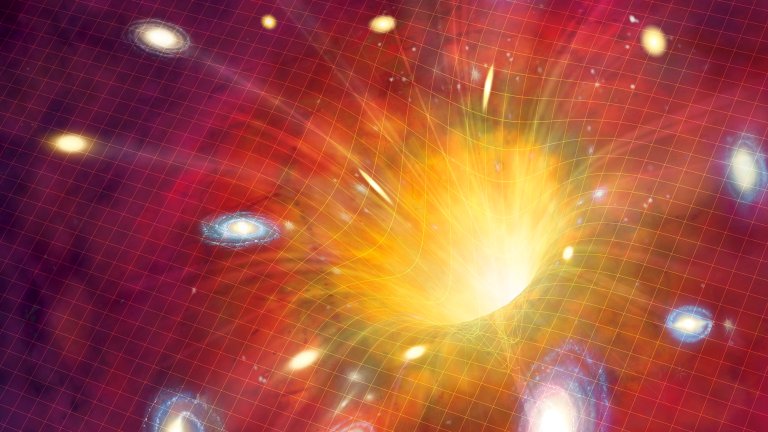
The structure of the universe is quite similar to the structure and design of other large, complex networks, like human brains and the Internet, according to a new study. This is not to say brains and universes follow some sort of master plan, though. Rather, it’s that the rules underlying the structures of such complex things can be understood in a similar way.

This is interesting because it suggests some kind of universal rule or system of laws controlling large systems. Network science is about unraveling those rules and trying to predict or control the behavior of complex networks.

“By no means do we claim that the universe is a global brain or a computer,” said Dmitri Krioukov, co-author of the new paper, which was published by the Cooperative Association for Internet Data Analysis at the San Diego Supercomputer Center (SDSC) at the University of California, San Diego. “But the discovered equivalence between the growth of the universe and complex networks strongly suggests that unexpectedly similar laws govern the dynamics of these very different complex systems.”

It’s not possible to simulate infinity, so the researchers assumed the universe is really huge--for the sake of having an input, they said it would be at least 10250 atoms of space and time (a 1 followed by 250 zeroes). That is very large. This was scaled down to a more manageable size and put into a supercomputer named Trestles. Trestles used this data to perform detailed simulations of the universe’s causal network, and computer scientists were able to do it in a day. Without parallel operations and some creative programming, this computation would have taken three or four years, according to SDSC.

The result is a graph that looks a lot like the visualizations representing other complex networks, like the Internet, social networks and biological networks, according to SDSC. “Who would have guessed that the emergence of our universe’s four-dimensional spacetime from the quantum vacuum would have anything to do with the growth of the Internet? Causality is at the heart of both, so perhaps the similarity Krioukov and his collaborators found is to be expected,” SDSC Director Michael Norman said in a statement.

This similarity in structure is probably not a coincidence, the researchers say. It might even be a step toward a new discovery of some universal rules. Maybe the rules are the same everywhere, but there are certain limiting factors--like gravity--that change the size and eventual outcomes.

[UCSD]

12 Comments

Ah, to contemplate nothing, add to contemplate everything, add to contemplate a finite point, add to contemplate a infinite cosmos, oh let’s not forget, mix in a whole lot of dark matter and dark energy for all the questions we simply cannot answer.

Everything in the bowl now, mix well and we call it,
wa la, our reality!

1 with 251 zeros i believe LOL

Nope, it's 1 with 250 zeros.

10^1 = 10
10^2 = 100
10^3 = 1,000

The exponent is the same as the number of zeros

yup lol wow messed that one up lol

Let me get this straight.

The best way we have to describe large complex relationships is though graph theory.

Some computer scientists made a program to represent the relationships in the universe as a graph.

Some other computer scientists made a program to represent the brain as a graph.

Both programs made graphs!!!! HOLY CRAP BATMAN!!!! What are the chances?!??!

It is very possible that this reality is a simulation.

-

"I contend that we are both atheists. I just believe in one fewer god than you do. When you understand why you dismiss all the other possible gods, you will understand why I dismiss yours"

- Stephen Roberts

Wikipedia says "... approximate calculations give the number of atoms in the observable universe to be close to 10^80". Even if this is just "regular" matter, and dark matter and dark energy also consist of atoms, total number should be less than 10^82. Much less than 10^250, still inconceivable number though.

I've been saying this for years, as have many others. Glad the rest of mainstream science caught on.

*armchair science incoming*
Fractal recursion would dictate that there are universal forces at work with the mass and energy of every system, which are defined locally.
It is no coincidence that we have regular atomic shapes, regular star shapes and regular galactic shapes.

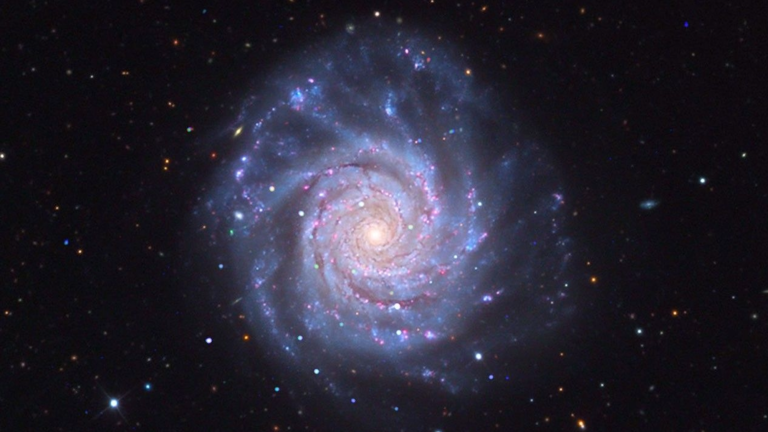
Pretty Purple Cosmic Picture!

Maybe our universe is just an subatomic particle in somebody else's universe. Now wait till he loads his LHC with our particle and starts charging the magnets.

I agree with Bagpipes100. While I'd love to believe the systems are very much governed by the same rules, Its a very philosophical point. However, a simulation is inherently flawed because it is always limited to the system it is being simulated on. Those flaws might be small or even non existant if both systems have the same design, but it should be looked into.


June 2013: American Energy Independence

Five amazing, clean technologies that will set us free, in this month's energy-focused issue. Also: how to build a better bomb detector, the robotic toys that are raising your children, a human catapult, the world's smallest arcade, and much more.


Online Content Director: Suzanne LaBarre | Email
Senior Editor: Paul Adams | Email
Associate Editor: Dan Nosowitz | Email
Assistant Editor: Colin Lecher | Email
Assistant Editor: Rose Pastore | Email

Contributing Writers:
Rebecca Boyle | Email
Kelsey D. Atherton | Email
Francie Diep | Email
Shaunacy Ferro | Email

circ-top-header.gif
circ-cover.gif
bmxmag-ps