Labs That Go Boom
Where students study the phenomenon, and get to play Zeus
Build Your Own One of These John B. Carnett

This month, as part of our special on the future of education, PopSci presents 10 labs where students do serious research (and career training) by blowing stuff up.

Lab: The Lightning Research Lab at the University of Florida
Career: Lightning-tolerant spacecraft designer, power utilities engineer

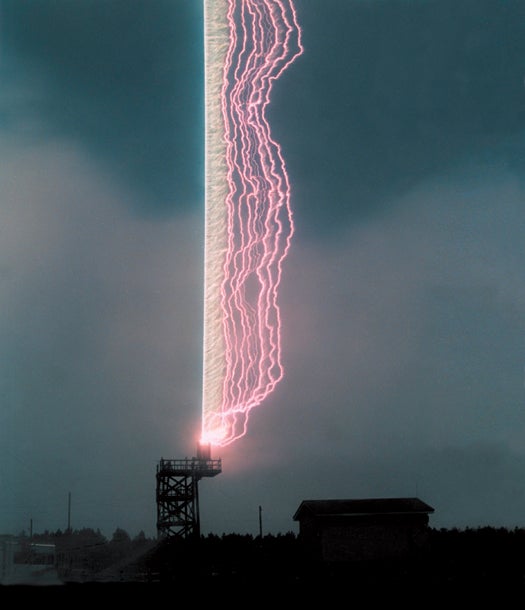
A lucky few engineering students at the University of Florida get to do something vaguely magical: conjure their own lightning. To make bolts, students fire specially designed rockets, each of which trails metal wires connected to sensors, directly into thunderstorms. Students examine high-speed video of strikes to study lightning-bolt physics and test materials by directing bolts toward a target.

7 Comments

Many PopSci fans are scared of Skynet. Here is the solution.
Honestly this research is neat, but boring if you are waiting with them to see the lightning strike.

Velociter Superare Futuris

It would be very usefull if scientists find a way to harness and store the energy of lightnings.

i agree with badbot it would a great source of untapped energy that if you have enough lightning could produce more than the amount of energy produced by nuclear reactor

I believe they must really have some big mosquitoes at UNF!
WoWzers!

@ badbot,scienceperson8p

The sad part about trying to harness lightning as a power source is that even when you can attract it, it is dependent on a sufficiently large storm system passing over the collector(s). Even without that problem, you have to consider that the massive voltage in a strike would have to be stepped down, and then stored. Storage would be relatively simple, but attempting to bring the voltage down to a manageable level would cause all kinds of problems.

Harnessed lightning is not a viable power source. Even ignoring the randomness of storms and the large potential difference, there is still the issue of exactly how much power IS in a lightning bolt. If we assume that there is about 2,000,000 volts, and that the peak average amperage is around 100,000 amps, that gives us 20,000 MWs of energy. That may sound like a lot, but each strike lasts only about 50 microseconds. That gives 277.8 Watt hours of power. In simple speak, that means you could run 3 100 watt light bulbs for 1 hour off of one lightning strike.

at 70 deg. 70% humidity it takes 10,000 Volts to jump 1 inch this lightning is jumping 1/2 mile and more the amount of energy is for all practical purposes is incomprehensible billions of volts millions of amps the rules change when the voltage gits much above 500 KV. Some day I think man will play with this kind of power but for now its just VERY dangerous research "The most important tool you own is the greasy jello between your ears"


June 2013: American Energy Independence

Five amazing, clean technologies that will set us free, in this month's energy-focused issue. Also: how to build a better bomb detector, the robotic toys that are raising your children, a human catapult, the world's smallest arcade, and much more.


Online Content Director: Suzanne LaBarre | Email
Senior Editor: Paul Adams | Email
Associate Editor: Dan Nosowitz | Email
Assistant Editor: Colin Lecher | Email
Assistant Editor: Rose Pastore | Email

Contributing Writers:
Rebecca Boyle | Email
Kelsey D. Atherton | Email
Francie Diep | Email
Shaunacy Ferro | Email

circ-top-header.gif
circ-cover.gif
bmxmag-ps