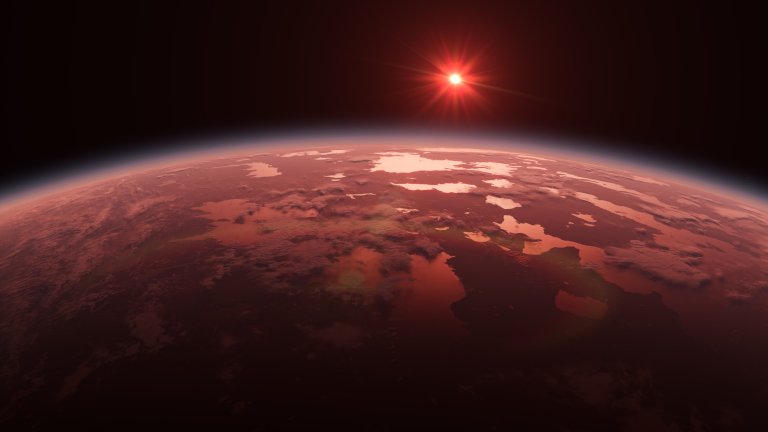
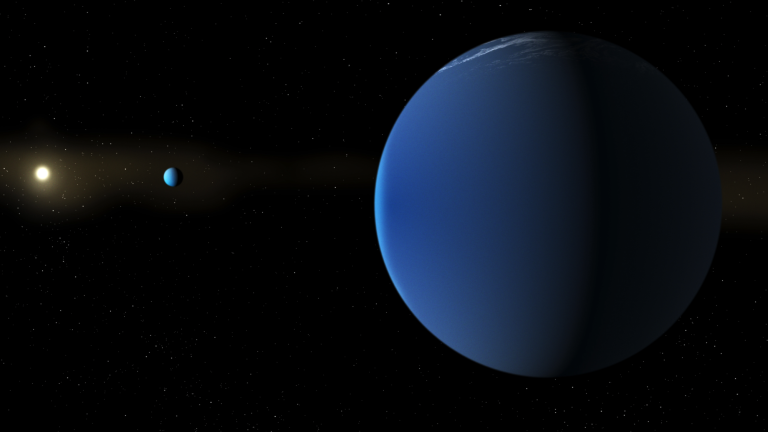
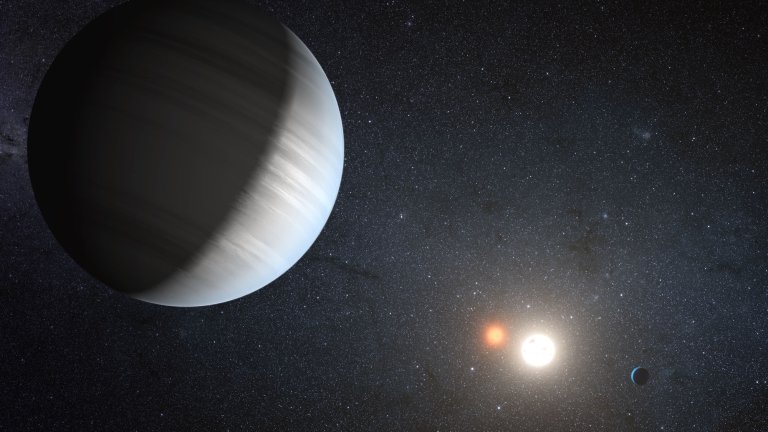
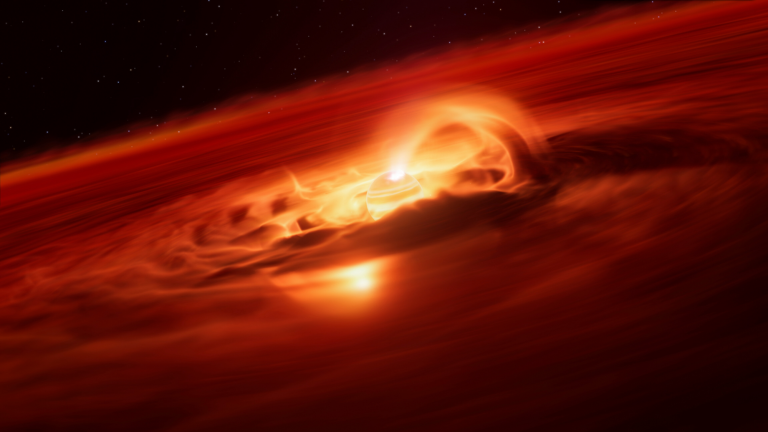
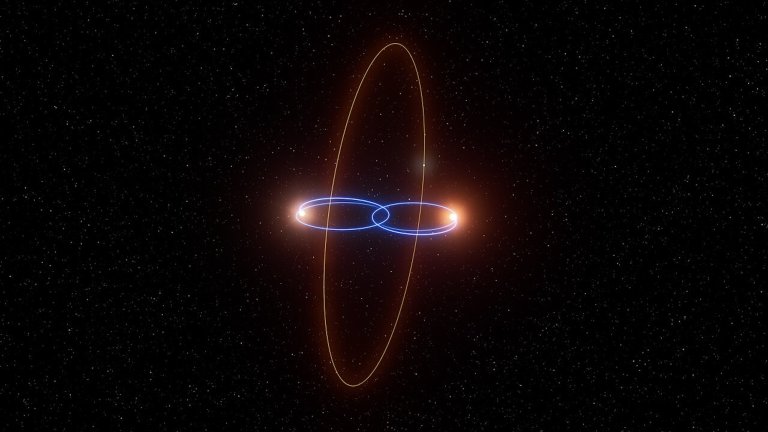
Behold, by decree, the most habitable exoplanet known to date. Some people think Gliese 581g may not exist, sure, but if it does it’s probably nice and Earthy warm.
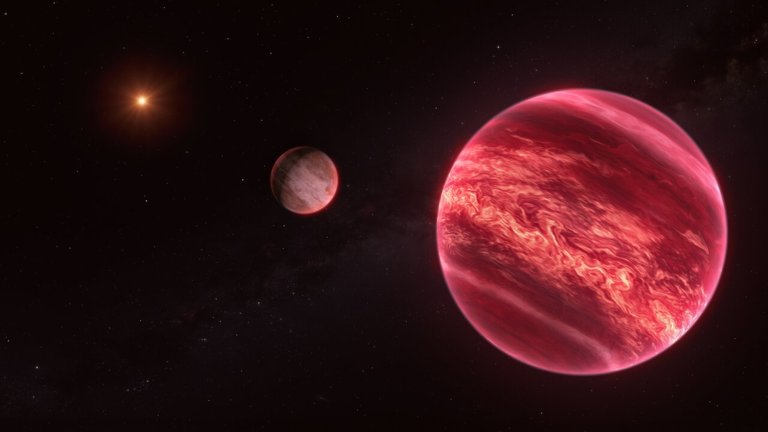
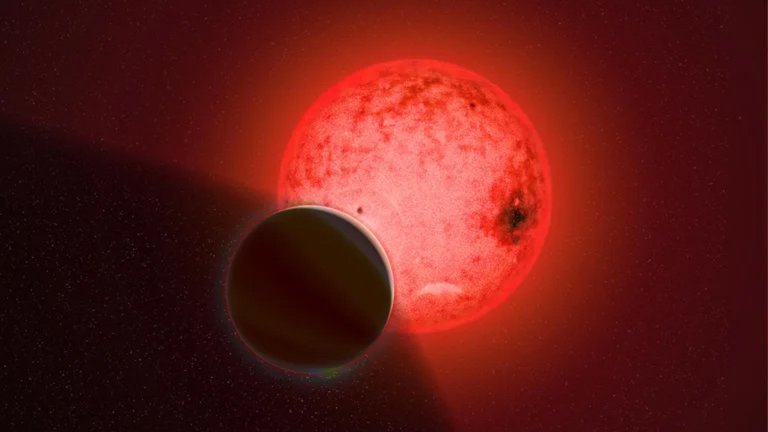
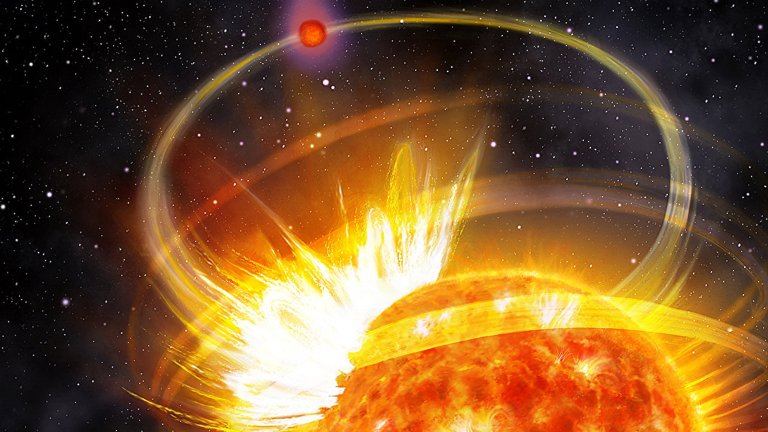
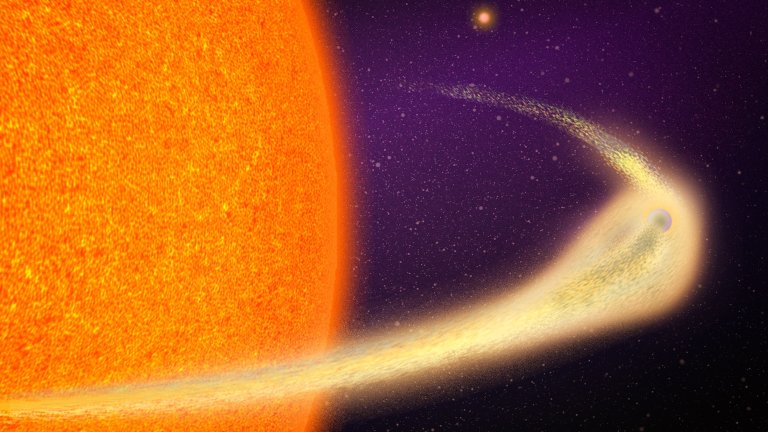
Gliese 581 is one of our favorite exoplanet systems, anchored by a red dwarf star only 20 light years from Earth. Astronomers think it has at least four, maybe five exoplanets, one or maybe two of which is possibly habitable. Gliese 581c is too close to its star, giving it Venus-like boiling temperatures that would prevent liquid water. Gliese 581d may be too far, staying too chilly to support water or life — although models suggest it could have a dense carbon-rich atmosphere to keep it warm. (It’s also on this new maybe-habitable exoplanet list.)
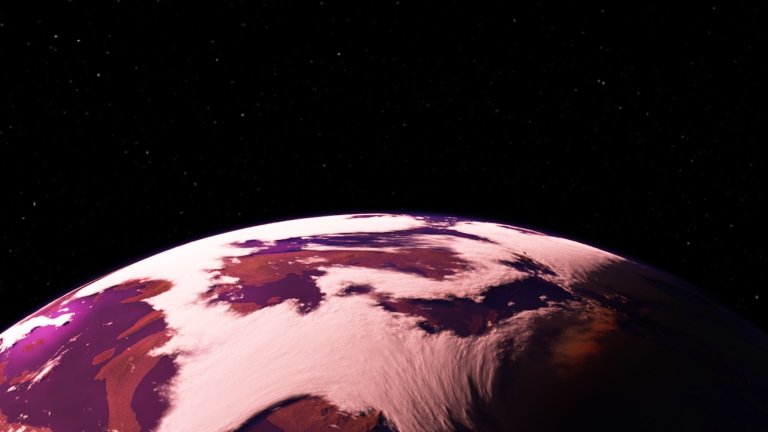
Gliese 581g was another story. It’s only one and a half, maybe two times the size of Earth and thought to exist smack in the star’s “Goldilocks zone.” It receives the same light flux from its star that Earth does from the sun.Upon closer inspection, some astronomers thought 581g didn’t even exist. But new evidence from the team who discovered it says that it does, proven by the planets’ circular, rather than elliptical, orbits.
This debate is likely far from settled, but the University of Puerto Rico at Arecibo’s Planetary Habitability Laboratory says this world is the most habitable one out there, topping a brand-new list of the top five most habitable exoplanets.
Exoplanet habitability is a budding science, with several competing theories about how one might ascertain a planet’s likelihood to support life. The Earth Similarity Index is one way to do that, with planets falling on a spectrum from zero (not Earth-like) to one (very Earth-like). Gliese 581g has an ESI rating of 0.92, the highest of all — and way better than Mars, by the way, which rings in at 0.66.
A new paper describing Gliese 581g appears in the journal Astronomical Notes.

[via Space.com]
Five amazing, clean technologies that will set us free, in this month's energy-focused issue. Also: how to build a better bomb detector, the robotic toys that are raising your children, a human catapult, the world's smallest arcade, and much more.


Online Content Director: Suzanne LaBarre | Email
Senior Editor: Paul Adams | Email
Associate Editor: Dan Nosowitz | Email
Assistant Editor: Colin Lecher | Email
Assistant Editor: Rose Pastore | Email
Contributing Writers:
Rebecca Boyle | Email
Kelsey D. Atherton | Email
Francie Diep | Email
Shaunacy Ferro | Email
We already know that Mars, at .66 according to this scale, can theoretically be terraformed in such a way to support human life. With 3 planets at .92 to .72, sounds to me that the Gliese 581 system is ideal.
Matt5327,
Do we actually 'know' or do the scientist theorize that Mars can be terraformed? Following with the idea of Mars being terraformed, on the slim chance life does exist there in some small detailed way, won't terraforming destroy or corrupt it? Assuming Mars can be terraformed, how do we as a country get authorization to do that; would we have to get the United Nations or more to sign off on such a project?
Back to Gliese 581 Planet G, I really hope it does have life! That would be so cool!!!
..........................................
See life in all its beautiful colors, and
from different perspectives too!
I think humans are stuck on earth so long as we are bound by our weak fleshy bodies. A robot or machine however, Does not have near the amount of restrictions for what is considered habitable.
Even though Mars is 0.66 on that scale, at least we are 99.9% certain that it is uninhabited by life. From 20 light years away Glise 581g looks ideal to travel too and colonize but an advanced civilization on that planet could be looking in our direction thinking the same thing. We might get there and realize they are worse off then we are. Or they could beat us to the punch and be on their way over here right now.
I'm not saying we should stop any progress or plans to visit these places, but we should think of different solutions for colonization outside of Earth. We would most likely need to be a type II civilization anyway to accomplish a mission where the destination is 20 light years away.
@space,
I guess we could get the united nations "permission" just for the hell of it but really, if we are the only nation capable of colonizing Mars then who could say no? Not like they can do anything to stop us. The UN has been trying to prevent countries from doing all kinds of things much worse and more pressing then colonizing another planet. In all the UN's greatests efforts they still couldn't stop North Korea from getting nuclear technology or creating a nuclear bomb(if they have even made a legitimate one yet). The UN is a joke.
I'm sure the EPA would be up in arms about us potentially destroying microbial life living under several feet of Martian soil but if it comes down to expanding the human race and prolonging our existence then the microbial life can go by the way side. It would be different if Mars had complex organism or intelligent life.
Army Juggernaut,
I ask the question, simply because I think it warrants a broad commentary discussion. I hope a lot of other people comment further.
..........................................
See life in all its beautiful colors, and
from different perspectives too!
I think it's a bit illogical not to count proximity in the habitability index, because even if a planet appears 99.9% consistent with Earth; if it's 1000 light years away, then it's NOT as habitable as Mars, or the Gliese systems, or even our moon.
@Space
U.N.? Really?
Who ever gets there first, be it a country or company they get to start doing what they will with it. Who ever has a plan and the resources, it's an open frontier.
And no, there isn't life there. Even if there was, the EPA would not have jurisdiction to regulate it.
I am for good stewardship of what ever resources there may be on mars, so trashing another planet would be ridiculous. But if there are good sources of resources on mars, the moon, or asteroids....better to harvest them there and protect the one place in the universe we know life to exist. That really ought to be the goal of space exploration right now. But I am also for creating new governments and countries and colonies so that lessens my concern about what the EPA or UN has to say about things.
Why doesn't the issue of mass come up more often? At 1 1/2 to 2 times Earth's size (I'm assuming that goes hand-in-hand with mass for a rocky planet), gravity would be difficult to impossible, right?
What am I missing here?
Ah yes, the initial phases of creating stellar cartography charts. If it is 20 light years away even if we could get to near light speed thats not the way to go. Nope... ideally the mission should at most be mere months. At max the length of time it takes us to get to mars with current technology. Obviously it would be best to have a vessel capable of traveling warp speeds. Lets hope some day soon physicists crack the code, so to speak, on traveling faster than light. So as to make it easy and safe for humans to build the technology then we can visit the planet in a timely manner. Heres hoping.
@Lobo-Tommy
Just because a planet is 2x the size of Earth does not mean it has 2x the gravity. I remember reading that Gliese g is something like .92 Gs. That means its less dense. and .92Gs is quite nice.
"I think humans are stuck on earth so long as we are bound by our weak fleshy bodies"
Once we have the technology to solve this, it won't matter that we have fleshy bodies. Force fields for our starships to keep out radiation and debris, and high tech spacesuits for our bodies when we want to walk outside of our habitats.
Think Star Trek because every single piece of technology in Star Trek, all though science fiction right now, will be science fact in the future. Whether obtaining Star Trek technology will take us 100 years, 200, or 500, I don't know, but it will happen eventually. Btw, the tricorder from the original series we have today. It's in the form of a smart phone more or less, and it can do sonograms and other neat stuff. Also it would be important to note that the inventor of the cell phone got the idea from Star Trek.....but yeah I'm a firm believer that technology will basically help us do anything...like colonizing the cosmos....just a matter of time...
The environment we live live in is much, much more complex than temperature and gravity and the length of a day. The earth generates a magnetic field from a liquid metal outer core circulating around a solid inner core deep in the planet. This magnetic field traps particles in the Van Allen belts and generally protects us from the sun's radiation that would turn our planet into a cinder. The interplay between the sun's radiation, the magnetic field and the atmosphere sets up a dielectric field that generates lightning somewhere on the planet from 50 to 200 times per second and this, in turn, sets up a pulse in the atmosphere. The lightning stikes that do strike the earth set up a pattern in the earth itself that operates at a different frequency. And all of this intermixes to affect every living thing on the planet. It is a lot more complex than this. This is just a simplification.
Now consider that life as we know it has evolved in this intricately intermixed environment of gravity, magnetism, electrical fields, atmosphere, fluid and solid components and anyone of which could have been different and caused evolution to take a completely different route or no life at all.
Exposure to low frequency sound waves and/or electrical waves can drive the human brain mad and its been documented. To think that we can adapt to an alien world when we know so little about this one and all of its interacting systems, IMHO, is folly.
To me talk of terraforming Mars is quite silly. How do you terraform a self generating magnetic field on a planetary scale? If that cannot be accomplished Mars cannot sustain an atmosphere because the solar wind will basically blow it away. Without the magnetic field there are no protective Van Allen belts, no protection from the charged particles in the solar wind and any life that were to adapt to such an environment would be unrecognizable as life to us.
Could it happen? I would give that the most tenuous maybe, but it won't be accomplished by anyone alive today and my guess would be not by any of our children ot their children. We simply don't have enough knowledge.
And by far the best way to gain that knowledge is with robotic tools and sensors, not manned explorations. By and large that is how the deep oceans are explored today and the art is making great strides in space as well.
Think I'm nuts? Ask Slartibartfast.
Whoa, this exploded.
@thx1138v2
Conveniently, Mars already has an iron core and a magnetic field - the reason for its weakness, geologists generally concur that it has been a long time since it has rotated at as high as speeds as Earth's due to the lack of tectonic plates (which help the planet remain geologically active). The technology to spin a giant molten ball of iron is easy technologically, just expensive. I likelier approach would be the force-creation of volcanoes and rifts (still expensive, but just as doable).
Another protection the earth has that Mars does not that you did not mention is Ozone - but that will form naturally over a long time (and I'm sure we can find a way to synthesize it) once the field is strengthened and hardy plants/bacteria farmed.
So yes, we do have the knowledge. Just either not enough money or not enough passionate people.
To my main point, though - three planets in the Gliese 581 system are more habitable than Mars - and thus an excellent location for humanity to look towards.
Wouldn't it be awesome if, like Army Juggernaut (Hooah!) proposed, we find the planet has intelligent life and we meet them halfway, they decided they liked us and basically brought their top scientists down and taught us how to build the tech they have? Maybe some kind of trade alliance would form...
Can I go on the treaty signing trip?
D13, you do not take into account adaptation. The gravity isn't the same, sure, but it could be close... ish. Just enough for us to live until we adapt.
Terraforming Mars will never make economic sense, it would take decades or even centuries to complete and it would never been another Earth. It would make much more sense to build space habitats. Centrifuge forces could simulate the exact gravity we need and closed ecosystems could easily be created. Radiation shielding would be a challenge, but still much easier then trying to jump start a planetary magnetic field. For the same effort required to make Mars semi livable we could build thousands of island in space with what ever environment we want.
I do not see people living on Mars or the moon from cradle to grave. Rather I see living on Mars like living on an off shore oil rig or a remote mining camp. It is a place to go to work for 6 months, then go home for 6 months. Mine Mars for minerals then ship the ore to orbiting space habitats via space elevator or rail gun. Or better yet just use a little anti-matter to blow the whole thing up.
if one could travel even 10% of light speed (30,000 km/sec), then it would take 200 years to reach the planet. now humans must start research on indefinite suspended animation in order to have a chance.
What i find awesome about this system is that it's only 20 light years away, so the light is only "on delay" 20 years. So it's not like we are seeing some billion year old images, If there are beings on this planet looking at us, they would be looking at the early 1990's right now. And I'm pretty sure that any intelligent being would research advanced imagery before even 10% light speed craft could be created. So something could very well be looking at us this very moment. This should be what we train our long baseline telescopes at as well, getting a clear visual image would be fantastic. I can only imagine what the uber religious would say if we did in fact find life on Mars, or in this system. Can you hear the backpedling already?
Playing Devil's Advocate since 1978
"The only constant in the universe is change"
-Heraclitus of Ephesus 535 BC - 475 BC
We all now realize that are millions of "habitable" planets in our Milky Way (given the statistical extrapolation of the number of planets in our "neighborhood"). Not to mention that there are billions of galaxies, and likely billions of universes (it is likely that our universe is part of a multiverse).
The number of habitable planets seems potentially limitless.
However, as other comments have noted, we evolved not only on the earth, but WITH with Earth. A clear example of this is the fact that out bodies are comprised of more non-human cells than human ones (Google "Human microbiome"). We can't survive without these microbes and the symbiotic relationship we have with them.
Our biological relationship to our planet simply can't be dismissed.
My own perspective on planetary colonization is that it will occur, but not by humans. It will be done by our progeny, "machines" with artificial intelligence that will be largely immune to the challenges of lengthy space flight over vast distances.
The human body is just so limited, and suited only for life on the Earth. The next phase of human evolution will be to transcend the human body via machine intelligence.
Since Sol should be fine for a few billion years, all we need to do (for those who decide to remain in mortal human form) is to be dependable caretakers of our planet, and life will be good here on Mother Earth.