Cage Match
How science is transforming the sport of MMA fighting
Greg Jackson, the single most successful trainer in the multi-billion-dollar sport of professional mixed martial arts fighting, works out of a musty old gym in Albuquerque, New Mexico, not far from the base of the Sandia Mountains. On a recent morning, the 38-year-old Jackson, who has the cauliflowered ears and bulbous nose of a career fighter, watched two of his students square off inside the chain-link walls of a blood-splattered ring called the Octagon.
One of them was Jon Jones, the light heavyweight champion of the Ultimate Fighting Championship (UFC), the premier MMA league. In four weeks, Jones would be defending his title against Rashad Evans, an expert fighter and his former training partner. To prepare him, Jackson had set up a sparring session with Shawn “The Savage” Jordan, a heavyset fighter from Baton Rouge.
Jones and Jordan met in the middle of the ring. Jordan threw first. Jones backpedaled and protected his face with his forearms.
“Look for that space, Jones!” Jackson hollered. “You. Do. Not let him close those angles on you.” Jordan threw a flurry of blows. To me, the exchange appeared disorganized, nonsensical—a blur of flesh, sinew and the red flash of Jordan’s mouth guard.
To Jackson, it was a logical sequence, one with only one possible effective response. “Jones,” he said, “move inside.” The fighter seemed to hesitate. If he moved within range of Jordan’s fists, he risked catching a glove square in the face.
“Go on,” Jackson said.
Jones ducked under one fist and whipped his right leg out in a short arc. The kick missed. Jordan threw again. This time Jones dropped down, flicked his head to the side, and, leaping off one foot, launched a flying jab followed by a knee to Jordan’s midsection, which landed with a wet whoompf. Jordan groaned and crumpled onto the mat.
“Goddamn, Jones!” Jackson yelled. “Exactly correct.”
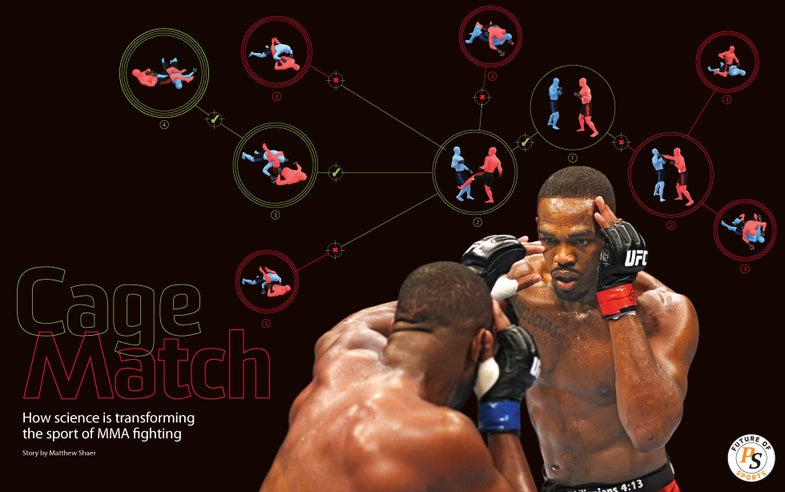
Producing a notepad from his back pocket, Jackson sketched a spiderweb of circles and lines. It was a game tree, he explained—a graph game theorists use to analyze a sequence of decisions. In a traditional game tree, each circle, or node, represents the point at which a decision can be made. Each line, or edge, represents the decision itself. Game trees eventually end in a terminal node—either a tie or a win for one of the players. This game tree, Jackson told me, showed the exchange between Jones and Jordan from Jones’s perspective.
The Breakdown
At the start, the two men stood a few feet apart. Jackson drew a circle. The node had three edges, or moves that Jackson was training Jones to use. He could execute a leg kick, or a punch, or he could shoot for a takedown (attempt to grab Jordan by the backs of his legs and drive him into the ground). But the initial node was not “optimal,” he said, because it allowed Jordan to swing freely with both fists. Although it seemed counterintuitive, the fast track to what Jackson calls the “damage” node (in this case, Jones’s advantageous position following his hard knee) was to move in close, where Jordan would not be able to fully wind up. Another circle, representing Jones’s inside position, and a series of edges, representing his potential decisions from there, appeared on the notepad.
“From inside,” Jackson said, “he can do a knee, he can do an uppercut, he can do elbows. He could have done anything there, and done it effectively.”
Since 1992, when he opened his first gym, Jackson has been using math to inform his training techniques. Unlike other MMA coaches, he continually collects data while watching live bouts, logs old fight videos to determine which moves work and when, and fills notebooks with game trees to determine the optimal nodes for various situations in a match. “I’ve always seen the ring like a lab,” he says. “I’ve tried to think rigorously, logically.”
“I’ve always seen the ring like a lab,” Jackson says. “I try to think logically.”Jackson’s attempts to impose some measure of order on the primal, violent world of MMA mirror a larger movement within the sport. Science may not be civilizing cage fighting, but it is refining it. Specialty firms compile detailed statistics on matches. MMA pros appear on ESPN rigged head to toe with sensors and monitors that measure their striking power and speed. Academics are writing peer-reviewed articles on subjects such as the physiology of top fighters and the role that fear plays in the Octagon. And now fighters, most of them trained by Jackson, are beginning to use this data and analysis to become ever more brutally effective in the ring.
The very first UFC event took place before a crowd of about 7,800 in a Denver auditorium in 1993. It was an odd spectacle. Karate masters clashed with boxers. Kickboxers dueled with sumo wrestlers. There were few real rules.
Over the next decade, in an effort to placate critics and state athletic commissions, the UFC introduced a comprehensive set of regulations that outlawed especially dangerous moves such as low blows and hair pulling. The campaign was largely successful, and by the mid-2000s, dozens of states had agreed to sanction MMA events.
TV networks, meanwhile, noticed the UFC’s large following and began to broadcast highlights from the big bouts. A popular reality show called The Ultimate Fighter debuted, and a mixed martial artist appeared for the first time on the cover of Sports Illustrated. Ticket prices kept increasing. So did the size of the sport’s fan base.
Among the many die-hard UFC fans was Rami Genauer, a journalist based in Washington, D.C. Genauer had read Moneyball, Michael Lewis’s best seller about Oakland Athletics general manager Billy Beane and his statistics-driven approach to player evaluation. He dreamed of analyzing mixed martial arts in the same way.
“There were no numbers,” Genauer says. “You’d try to write something, and you’d come to the place where you’d put in the numbers to back up your assertions, and there was absolutely nothing.”
In 2007 Genauer obtained a video of a recent UFC event, and using the slow-motion function on his TiVo, he broke each fight down by the number of strikes attempted, the volume of strikes landed, the type of strike (power leg versus leg jab, for instance) and the finishing move (rear naked choke versus guillotine, and so on). The process took hours, but the end result was something completely new to the sport: a comprehensive data set.
Genauer titled his data-collection project FightMetric and created a website to house the information. Some UFC fans registered their disapproval on Web forums. “‘We don’t need math with our fighting,’ people would say. I disagreed,” Genauer says.
In 2008 he managed to persuade the UFC to use FightMetric data from past matches to support a televised event in Minneapolis. “The idea was that this would be good for the producers, who could use the numbers to illustrate the story,” he says. “It’d also be good for the broadcaster—they’d have ammunition, something to rely on just like they do in other sports.”
Officials liked having Genauer’s fight data, and when the UFC began spiffing up its broadcasts with more graphics and statistics—part of an effort to make MMA seem like a real sport instead of a series of cage brawls—it hired FightMetric as its statistics provider. Genauer quit his job and opened an office in D.C.
Today FightMetric has five full-time staffers and a rotating cast of 15 specialists who collect a large data set for each fight using a video feed, proprietary software and a video-game controller with which they can record every type of strike. Among the statistics they track: each fighter’s number and type of strikes, number of significant strikes (defined as all strikes landed from a distance, as well as power strikes landed from close range) and the accuracy and location of kicks and punches.
The FightMetric team collects the strike and location statistics in real time. The UFC uses some of the data for graphics during broadcasts and on its website. FightMetric goes into even greater detail on its own website, presenting statistics over outlines of a human body. Colored lines indicate the accuracy of each type of strike, and boxes show which ground move, whether arm bar, kimura lock or triangle choke, each fighter used to try to induce a submission. The analysis is strangely disconnected from the violence of the Octagon—a savage fight broken down into simple, neat figures.

Greg Jackson
As the available body of data from FightMetric (and its main competitor, CompuStrike) grows, Genauer and others are attempting to analyze it in new ways. Already Genauer and his colleagues have identified some clear trends in MMA matches. For instance, the number of fights that end in decisions, especially at the lower weight classes, has risen from a third in 2007 to half today. That’s a significant change from the wilder early days of the UFC, when fighters swung crazily and the vast majority of bouts ended in knockouts. It points to increasing skill levels among UFC fighters (knockouts usually happen when one fighter is obviously superior to the other), a factor that could affect fighters’ styles and training methods. A lighter-weight fighter, expecting now to go the distance in his next fight, might accordingly develop his aerobic threshold (so he can wear out bigger opponents) rather than his ability to throw first-round knockout blows.
Earlier this year, John Ruggiero and Trevor Collier, economists at the University of Dayton, and Andrew L. Johnson, an engineering professor at Texas A&M, released a study called “Aggression in Mixed Martial Arts: An Analysis of the Likelihood of Winning a Decision.” With data from FightMetric, the researchers estimated the probability of winning based on fighter characteristics like height and age. From a sample of 946 matches, they measured dozens of variables, including blows attempted versus blows landed, stand-ups, knockdowns and slams. Next they ran that data through a binary response model (a kind of algorithm) to determine which characteristics or approaches most affected a fighter’s chances.
Some of the study’s conclusions were surprising. For example, in fights that end in decisions, the number of strikes thrown appears to be more important than the number of strikes landed. This may have something to do with the vantage point of the judges, who can’t always see the fighters clearly, and so occasionally in error mark a thrown strike as a landed one. Or it may be that a high number of thrown punches simply contributes to the appearance of dominance. Either way, the study is something a fighter can use: The more punches you throw, the more fights you’ll win.
Researchers studied matches to determine which variables most affected a fighter’s chances of winning.Genauer says he is constantly working to improve both the hardware and software used to collect fight data. As collection methods improve, the data will become richer, analysis will become more granular and the results more useful. That’s been the case in other sports such as baseball, which have changed as statistical analysis of in-game strategies has become more sophisticated (as Moneyball first highlighted). Stats have suggested, for example, that sacrifice bunting is not as useful as previously thought, leading many teams to attempt it less frequently. In MMA, trainers might find demonstrable proof that certain moves, like sidekicks or flying punches, are less effective than others, like knees or arm triangles. They might see the consistent success of a shoulder lock or the repeated triumph of the arm bar. They might rely on that data to engineer a better approach to MMA fighting—one, as FightMetric’s website advertises, “rooted in data and demonstrated effectiveness rather than in gut feelings and bandwagon jumping.”
* * *
“Data and demonstrated effectiveness” is something that Greg Jackson has stressed for years. Unlike other MMA coaches, Jackson holds no belt in any martial art and has no allegiance to any guru. In fact, he had hardly any formal training at all. He opened his first gym at the age of 17. In the absence of a particular fighting style, he experimented with practically all of them: aikido, karate, Jiu-Jitsu, Muay Thai, kickboxing, straight-up boxing. “All I was doing was looking for empirical evidence,” he says. “I’d form a hypothesis and I’d try it out in a fight. If it didn’t work I’d get rid of it, and if it did I kept it. It was science at its purest. It was driven by need.”
Jackson would have two evenly matched fighters spar 10, 15, even 20 times in a row. Waiting nearby, notepad in hand, he would assiduously track which moves worked in the greatest number of situations. Unlike most trainers, he held no sentimental attachment to any specific moves. If he found that a flying sidekick didn’t consistently do enough damage, he’d stop teaching it.

Battle Lines
By the early ’90s Jackson had incorporated his results into his own homegrown martial art, which he dubbed Gaidojutsu—”way of the street,” roughly, in Japanese. Gaidojutsu combined rudimentary striking with grappling and wrestling. At the time, it was rare to blend fighting styles—most fighters trained in a single discipline. But Jackson’s students relished the chance to play mix-and-match, and his stable of trainees grew. A few of them persuaded him to let them compete in bare-knuckle tournaments, where they dominated their undisciplined opponents. By the time the UFC came around, Jackson says, he was completely addicted to winning competitions.
But he knew the UFC would be a far cry from the bare-knuckle bouts. He’d need to further refine his methods. One person he relied on for help was Jim Dudley, a close friend and mentor who also happened to be a mathematics lecturer at the University of New Mexico. Dudley gave him private math lessons in the desert, giving him assignments from books on subjects such as discrete mathematics and discussing how he might apply math in an MMA match.
“My first memory is Greg asking me about fractals,” Dudley says. “Then it was game theory. I had no idea at first that all of this pertained to fighting. When he finally told me, I thought, ‘OK, that’s odd.’ But then again, I knew [math] could be applied to very surprising topics. It made sense that Greg would be finding these interesting patterns in fighting.”
The patterns that Jackson found were sequences of moves and positions that most consistently led to success in the Octagon. “I saw these certain positions over and over again: the side-mount, for instance, or the full-mount,” he says. “And I started thinking of them in terms of edges. Judging from the data, which positions offered the most opportunities? Which left the fighter in trouble? And which allowed him the quickest path to victory?”
What Jackson was developing was a new way of thinking about fighting, one informed by mathematical and logical frameworks rather than gut instinct. Crucial to that was constant data collection. Where other coaches might drift in and out of the gym, catching snippets of training rounds here or there, Jackson almost never leaves the apron of the Octagon. He is responsible for approximately 60 professional fighters, some champions and some up-and-comers, and every day he watches almost all of them spar for hours on end. When he is not watching training bouts or traveling with his team, he is clicking through clips of older matches on his iPhone, on the TV, on one of the scarred laptops that sit in his cluttered office alongside a photograph of Albert Einstein and one of his personal heroes, the famous logician Kurt Gödel. His desk spills over with handwritten logs of successful fights, hastily scrawled game trees of sparring sessions, points about form and function and technique.
All of these notes contain usable data. Analyzing his game trees shows him the best moves to make at different points in a match, while logs of his fighters’ and their opponents’ past matches help him predict how long an upcoming fight is likely to last, when in each round the opponent will strike and what moves he’ll make. It’s an advantage no other trainer yet has.
* * *
In early April Jon Jones defended the light heavyweight belt against Rashad Evans. The fighters were once friends who trained together under Jackson, but they’d had a falling out. In the weeks before the bout, they spent plenty of time trash-talking each other in the media. The fight was a true grudge match, as the UFC billed it, and by the time Jones and Evans climbed into the Octagon at Philips Arena in Atlanta, anticipation (and the noise level) was at a peak.
The fight opened slow. The fighters danced around each other warily. Evans, shorter and stockier than Jones, snapped away with his jab. Jones slipped around him, throwing a mix of “superman” punches (a punch executed while leaping forward) and flying knees.
Near the end of the first round, Evans caught Jones with his foot, sending him off balance. The bell rang. Jackson was waiting for Jones in the corner, a red cap pulled over his shaved head. His gaze was intent. He knew Evans had a superb defense and fast hands, limiting Jones’s options. He began constructing a game tree in his mind. In the first node, the two men were squared off against each other. Jones could punch away, but Evans would block most of the blows. He needed to move to another node, one with more edges.
One node appeared optimal: If Jones could manage to get in position to effectively neutralize both of Evans’s hands, he might be able to land at least one big shot. Jackson shouted in Jones’s ear. His student nodded.
Toward the end of the next round, Jones, heeding Jackson’s advice, squared up against Evans and extended both hands, open-gloved. Evans matched him, and for a moment it looked as if the two men were about to play patty-cake. This was the node that Jackson was looking for. Evans was momentarily exposed. In dazzlingly quick succession, Jones threw a right elbow, then a left, then another right. Evans wobbled, and Jones surged forward with a knee and a left hook.

Kings of the Cage
By the third round, Jones had his opponent on the defensive. Evans turned one way, and Jones was there. Turned another, and there he was again. In the fourth, Jones buried his knee in Evans’s stomach, and the crowd, more than 15,000 strong, roared its approval.
At the end of the night, Jones was awarded a unanimous decision. He would keep his belt. But it was the work of the FightMetric data collectors, not the judges’ decision, that revealed how truly dominant Jones had been. Their report showed that he’d landed 116 strikes, 105 of which were deemed significant. Evans, by comparison, landed only 49 strikes, 45 of them significant. Jones not only ran Evans ragged around the ring, but he also doubled his output, continually finding the node where he could throw the most blows.
A few days after the fight, I spoke to Jackson by phone. Already he was dissecting what had happened, picking out the things that Jones had done right to further hone his fight strategies. But he realizes that a time will come when other trainers, eager to gain any advantage they can, will begin to emulate his methods. Eventually more and more mixed martial artists will base their training and match plans on statistical probabilities instead of instinct and tradition, raising the quality of competition.
That means Jackson will have to work harder than ever to stay on top of the sport. But when I asked him how important winning is to him, he got quiet. “Never put a node for victory,” he said finally. “That doesn’t mean we don’t want to win. I want my guys to be thinking about trying to get to the strongest position they can, with the most edges, over and over. Like any science, it’s more about the process than it is the outcome.”
Matthew Shaer is the author of the book Among Righteous Men.