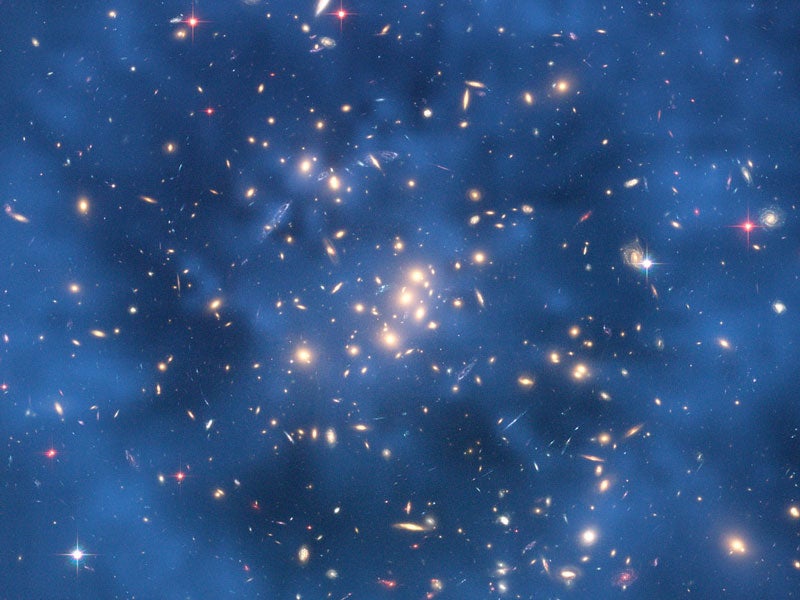
Dark Matter Ring Does this ring pattern truly reflect the presence of dark matter? NASA/ESA/M. J. Jee & H. Ford et al.

A dark matter particle smacks into an average person’s body about once a minute, and careens off oxygen and hydrogen nuclei in your cells, according to theoretical physicists. Dark matter is streaming through you as you read this, most of it unimpeded.

Dark matter is arguably the greatest mystery in modern physics. Observations from multiple sources across a few decades now shows that most of the universe is made of matter we can’t see — hence the name — but no one has been able to find it. One strong candidate for this dark material is called a WIMP, for weakly interacting massive particle, and there are a variety of observatories in Europe and the U.S. that are looking for these things. Some have found promising hints, but others have seen a whole lot of nothing.

Still, cosmologists generally agree there’s a halo of dark matter particles out there, and our solar system and our planet are flying through it. In a new paper, Katherine Freese at the University of Michigan and Christopher Savage at Stockholm University in Sweden thought about what this means for our bodies.

We know dark matter does not interact normally with regular matter — otherwise we’d be able to see it — so that means most of the particles pass through us. But some might interact with a hydrogen or oxygen nucleus, changing their energies or spins. The researchers use a 70-kg human (about 155 pounds) as an example, and calculate how many particles may be careening around based on signals from the DAMA, CoGeNT and CRESST experiments. Of the billions of high-energy WIMPs passing through a body every second, fewer than 10 hit a body’s nuclei in a given year. But lower energy WIMPs make impact much more frequently, around 100,000 collisions per person per year. That’s about one per minute.

What does this mean? Maybe nothing, in terms of impacts on human health — cosmic and solar radiation also rains down on us all the time, and it has many more detrimental effects. But it’s interesting to think that we ourselves could be dark matter detectors. The paper is posted on the astrophysics arXiv preprint server.

[Technology Review]

12 Comments

Ask a Question
Do Background Research
Construct a Hypothesis
Test Your Hypothesis by Doing an Experiment
Analyze Your Data and Draw a Conclusion
Communicate Your Results

^The scientific method...

So what part of dark matter is science? Repeatedly we are told it's never been observed. But yet we know how often it hits a human?

Lol! Cosmologists are funny people.

Correction: what part of science is dark matter?

We can observe dark matter, it has gravity. We can "see it" through its gravitational field, but it has no electrical charge and no nuclear forces or very weak. All we know is that it exists and has gravity.

I'm not sure we can even say that. I think it is more dark matter is inferred because otherwise they couldn't explain observations which would otherwise contradict their models. Like why the milky way can be shaped like it is.....but yet still be as old as they want it to be.

It may be naive to assume we can interact with all forms of energy. Just because we can't touch it, feel it, or sense it directly with instruments yet doesn't mean it isn't there. The indirect information we can gather about dark matter is enough for scientists to keep trying and working towards inventing instruments to enable us to sense it. Those who can't imagine a world beyond our senses are missing out on the mystery of science!

@Bagpipes100 It's called gravitational lensing.

I'm not sure who did the math for 100,000 interactions a year equals about 1 interaction per minute. 60*24*365 = 525600 minutes in a year....so in reality there's about 1 interaction every 5 minutes. I'm just saying this is the main caption for this article and it's not even right based on the 100,000 interaction per year. WTF

i think dark matter is like the "Force" from Star wars. taken in large amounts makes one "superhuman". or maybe its the deleted stuff from this simulation we call reality. maybe the makers made a mistake not getting rid of it. in order to get rid of it they would have to "format" our entire existence. and they dont want to do that since they are studying how long we flourish on "earth".

"religion is like a prison for the seekers of wisdom"

-Killah Priest

Eating too many prunes makes for much dark matter....
And for the rest of dark energy and dark matter, always remember it is just a theory that fits an equation nicely, but still not found.

.............................
Science sees no further than what it can sense, i.e. facts.
Religion sees beyond the senses, i.e. faith.
Open your mind and see!

Dark Matter is the name of the fictional missing matter in the universe. Science- "must be sumphin makin all this here stuff stick together, cause there ain't enough stuff to make her stick". This article however is the extrapolation of nothing to the Nth degree and explains how nothing could interact with us. Dumb article to make dumber people feel sorta smart.

So for the benefit of Bagpipes and all the commenters who think they're smarter than theoretical physicists, here's the short explanation.
We have Newton's excellent theory of gravity which, combined with Einstein's general Relativity, explain all the phenomena we can observe up close. With some minor refinements, we have figured it out well enough that we can keep GPS sattelites tracking accurately, and throw a space probe all the way to Pluto, banking it off several planets along the way. We have this down, guys!

The problem arises when we observe distant galaxies and take note of their rotation and their gravitational effects on light passing from behind them. It doesn't add up to what we already know about how gravity works.

So Dark Matter is theorized to make up the difference. We can't observe it directly, but we are observing effect that indicate either A: Dark Matter exists in approximately the amounts theorized, or B: Everything we know about gravity is wrong. It's possible that B is correct, but we have no reason to suspect that so far, so currently everyone who knows what they're talking about is going with A.

So unless you know something Newton & Einstein didn't, and you have a theory that will stand up to exhaustive testing and peer review, try not to make yourself look like an idiot by posting inane New-age crap or creationist garbage on science articles. And go read something better than these lamely-written Pop-Sci articles. There's alot of fascinating science blogs out there written by real scientist that know what they're talking about. PopSci.com is not one of them.

I think dark matter and energy is the 90% of the iceberg under the surface that gives rise to the 10% of the iceberg we actually see. For a more in depth explanation please check this out.
http://www.kickstarter.com/projects/irwitte/an-amateurs-cosmological-theory-of-everything


June 2013: American Energy Independence

Five amazing, clean technologies that will set us free, in this month's energy-focused issue. Also: how to build a better bomb detector, the robotic toys that are raising your children, a human catapult, the world's smallest arcade, and much more.


Online Content Director: Suzanne LaBarre | Email
Senior Editor: Paul Adams | Email
Associate Editor: Dan Nosowitz | Email
Assistant Editor: Colin Lecher | Email
Assistant Editor: Rose Pastore | Email

Contributing Writers:

Kelsey D. Atherton | Email
Francie Diep | Email
Shaunacy Ferro | Email

circ-top-header.gif
circ-cover.gif