Feature
Microraptors like these used to roam the Earth
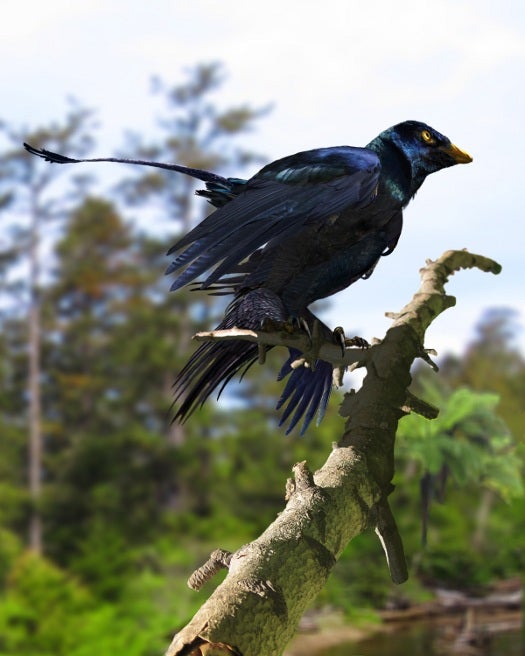
Reconstruction of Microraptor Jason Brougham, University of Texas at Austin

Dinosaur fans have barely recovered from the revelation that some dinosaurs were not scaly, but feathered. Now it looks like those fans will have to update their mental imagery once more: several of the same researchers who brought us vivid images of colorfully feathered velociraptors two years ago have come out with a paper today in Science offering conclusive evidence of the first known iridescent dinosaur.

That distinction belongs to the microraptor, one of a class of birdlike carnivores called dromaeosaurs (colloquially, “raptors”) that lived roughly 120 million years ago. It stands out from other raptors thanks to its unusual four-winged form and to the fact that, weighing in at less than 1 kilogram, it was small enough to fly, at least in a sense: scientists believe that the air resistance provided by its feathers helped it glide from tree to tree.

Those four wings appear even more striking now that we know they were iridescent. Iridescence is a property of some surfaces – such as soap bubbles, oil slicks, and birds like peacocks, hummingbirds, and grackles – that makes them appear to change color when viewed from different angles. When it occurs in plumage, it’s because of alternating layers of keratin, air, and melanin at the cellular level of the feather, all scattering light at different frequencies.

The team produced a conservative reconstruction that assumed the simplest kind of iridescence, the glossy blue-on-black found on grackles and crows.By studying a set of feathers from modern birds, for which both the cellular structure and the appearance are known, the Science team was able to derive a set of structural factors that tend to go along with iridescence. The most telltale sign? Long, narrow melanosomes, the organelles in a cell in which melanin is stored. After collecting 20 samples of fossilized melanosomes from a well-preserved microraptor specimen from China’s Liaoning province, the researchers were able to demonstrate that its slender melanosomes unambiguously match those associated with iridescence in all of the available bird species of which we’re currently aware.

We can’t be nearly as confident, warn the researchers, about which type of iridescence the microraptor’s feathers displayed. Iridescence can take many forms depending on the organization of the melanosomes and the keratin in which they are embedded. Examples in modern birds range from the grackle’s simple blue-black sheen, produced by a smooth layer of melanosomes topped by a smooth layer of keratin, to the peacock’s ever-shifting rainbow, produced by a spongy layer of keratin dotted with air bubbles.

Since keratin doesn’t fossilize, that structural information has been lost for the microraptor. “Imagine if you had a brick building and you removed the cement. All the bricks would collapse together,” said molecular paleobiologist and paper co-author Jakob Vinther. Lacking the ability to infer the microraptor’s particular kind of iridescence, his team produced a conservative reconstruction that assumed the simplest kind, the glossy blue-on-black found on grackles and crows.

Knowing that microraptor’s feathers were iridescent also sheds light on another recent debate. A 2011 paper in Science claimed to be able to infer whether a dinosaur was nocturnal (active at night) or diurnal (active during the day) based on the shape of its scleral ring, a feature of the eye, and used this method to declare the microraptor to be nocturnal. But this recent discovery raises a question: why would a nocturnal dinosaur have showy iridescent feathers that can only be seen in daylight? Vinther noted, “Nocturnal birds don’t have feathers designed for display purposes, because in the daytime when their feathers could be seen, they’re inactive.” Think, for example, of the drab plumage of owls. “This is an example of why it’s important to learn about coloration, because it can help us question other kinds of evidence,” Vinther said.
Microraptor Skull:  Mick Ellison, American Museum of Natural History

17 Comments

I'm sorry to say, but thats not a dinosaur, its a bird, plain and simple. Maybe it does have teeth, but there are lots of birds living today that have teeth as well. There are also birds alive today that have feathers protruding from their feet like little wings. I can't find one reason to believe that this is even related to a reptile.

A lot of birds have an egg tooth and some waterfowl have impressively serrated beaks, but what are some examples of birds today with a jaw showing a full socketed set?

Some birds do have feather on their feet, fancy bred pigeons come mind, but little wings?

Why wouldn't you think there is evidence of any relation to a reptile? How would you define "reptile" or "bird" anyhow? How about a definition for "dinosaur" that enables you to exclude anything that anyone might also want to call a "bird"?

@A-WALL
Birds are a subset of Dinosaurs. Dinosaurs are their own phylum, with birds being the only known surviving members of a clade, Teteanurae http://en.wikipedia.org/wiki/Tetanurae that is part of the suborder Theropodia http://en.wikipedia.org/wiki/Theropoda which, in turn, one of two suborders of Dinosoria, commonly known as Dinosaurs.
Oh, and Iridescence is reason 2,539 to love microraptors! (In chronologically discovered order.)
-Spouting a fountain of nonsense since 1995-

Funny that so many organic leftovers should be found in supposedly millions of year old fossiles.

Oh the many funny things that the naturalists have to ignore to maintain their religion.

THIS WASN'T A DINOSAUR! It was a bird (that's why it had feathers!), but evolutionists classified it as a dinosaur to fit their theory. Read the excellent Internet article, "Is New Fossil A Bird-Eating Dinosaur?" by biologist and creationist Brian Thomas.

There are natural limits to evolution. The genes already exist in all natural species for micro-evolution (variations within biological "kinds" such as for varieties of dogs, cats, etc.), but the genes do not exist in natural species for macro-evolution (variations across biological "kinds" such as from worm to human). How did species survive if their vital tissues, organs, reproductive systems, etc. were still evolving? Read my Pravda Internet article, WAR AMONG EVOLUTIONISTS! I discuss Punctuated Equilibrium, "Junk DNA," genetics, mutations, natural selection, fossils, genetic and biological similarities between species.

I thought it was common knowledge that birds and dinosaurs were related. I guess this world needs better education; really sad.

People act like bird, dinosaur, reptile, mammal, etc are absolutes of the world.

Biology is not that clear - there are always sliding scales. This argument is like two mathmeticians arguing whether a number is a 2 or a 3 based on the thousandth decimal place - utter nonsense, as it will never be 2 or 3 - just rounded one way or the other for clairity of thought.

There are feather footed birds, there are flying frogs with four gliding wings, there are squirrel that fly with wings attached to each appendage.

The science here is the irradesence of the plumbage. Everything else is specualtive crap marketing for attention from both sides.

I strongly dislike when I come on to this site to find ignorant people commenting on things they have no idea about. Naturalism isn't a religion. Evolution isn't a religion. We are all related to dinosaurs, just not as closely as this irridescent fellow.

I like that the photograph looks like this is a real live thing sitting on a branch and living in the world. Excellent recreation.

@a aharmless pie

Wait wait wait....you didn't know naturalism was a religion?

How quaint. :)

There are a huge list of assumptions which form the basis of naturalism which science is not capable of proving in the positive.

Unfortunately ignorant people tend to believe that just because their scientific model predicts a value and that value is observed that it automatically proves that model (however more than one model may predict the same value and therefore also be 'proven' under that logic).

Further ignorant people tend to believe in things even when a contradiction is blatant. For instance, "Long, narrow melanosomes" found in a several million year old fossile...... They don't last that long. If it really was millions of years old you wouldn't find these. Nor is this an isolated case, there have been numerous fossils which contain organic material which by naturalistic predictions should not be there. The only models which are not contradicted by these findings are ones which date these fossils only thousands of years old.

Why do you think it is funny? There have been some fossils found with organic material present; after all, it is tough to create or destroy matter. On the other hand, had you read the article, you might have noted that it specifically said that the keratin, an organic material, was gone and what was left was a fine-grained fossil impression of organelles. Very fine detail is one of the neat things about many fossils coming out of that area in China.

It is one of the serious things that Creationists have to ignore in order to live with the peculiar constraints of their version of religion.

Fascinating photo. I like the funny little tail it has. The reconstruction of the look and behavior of ancient creatures has advanced a whole lot since I was a kid looking at books with drawings of dinosaurs dragging their tails along the ground.

I just cannot resist responding to A-WALL and bgrnathan:
Evolution is not just an idea, it is an explanation for the fossil evidence. Why are almost all ancient creatures in the fossils no longer here? Why are modern creatures NOT found in ancient fossils? Darwin didn't just dream this stuff up, he was forced to a conclusion by all the evidence he had studied. And it wasn't just Darwin, either. Alfred Russel Wallace was 5 minutes behind him with basically the same explanation for how creatures adapt and change.

@ HBillyRufus
"Why are modern creatures NOT found in ancient fossils?" Seriously? Many are, with no noticible difference between the fossilized and current varities.

@trilobiter
Thanks for pointing out that one mistake of mine not reading the article. That being said there have been numerous findings of soft tissue still intact in fossiles, DNA found in fossiles, and many other organics which could not have survived millions of years.

Take the evidence where it leads people. Too much contradicts millions of years.

www. icr. org /soft-tissue-list/

hopefully you can reconstruct the link. But it gives a list of published documentation of soft tissues in supposed millions of year old fossils.

I think it is rather neat that there are cases of preserved soft tissue, although it is rare and even the list you linked suggests that a lot of the material is fragmentary and degraded. Still, just because something is old doesn't mean that it cannot exist.

You'll have to come up with something better or kids will keep on learning evolution in just about any accredited school.

Regarding modern creatures being found as fossils, Bagpipes100 says: Many are, with no noticible difference between the fossilized and current varities.

Are there really no differences or are there just differences that YOU didn't notice? A lot of fossilized critters do look similar to modern relatives, but then, that's how evolution works. Find a rabbit in Cambrian strata or a horse in Silurian rocks and you may overturn evolutionary theory, but if the best you can do is finding toothy birds with three-fingered clawed wings and long tails in Mesozoic sediments and you only build a case for evolutionary transitional forms.

I didn't know that the bird was fake at first glance.@suddenmischief-
Yes they do have excellent recreation.

Excellent recreation. I liked the article.

@aharmlesspie - Yes, and even more annoying when they believe that using science to argue that science is bunk actually makes any type of sense.


June 2013: American Energy Independence

Five amazing, clean technologies that will set us free, in this month's energy-focused issue. Also: how to build a better bomb detector, the robotic toys that are raising your children, a human catapult, the world's smallest arcade, and much more.


Online Content Director: Suzanne LaBarre | Email
Senior Editor: Paul Adams | Email
Associate Editor: Dan Nosowitz | Email
Assistant Editor: Colin Lecher | Email
Assistant Editor: Rose Pastore | Email

Contributing Writers:
Rebecca Boyle | Email
Kelsey D. Atherton | Email
Francie Diep | Email
Shaunacy Ferro | Email

circ-top-header.gif
circ-cover.gif
bmxmag-ps