A man who worked in a lead and gold mine in southwest Uganda died suddenly from a hemorrhagic fever. Concerned that it could be the beginning of an outbreak of Marburg virus, which is similar to Ebola, doctors sent a blood sample to the Uganda Virus Research Institute, where pathologists confirmed that Marburg was indeed the cause of death and alerted the World Health Organization and the Centers for Disease Control and Prevention. Both the WHO and the CDC are tasked with containing the spread of virulent diseases. If scientists could locate the animal that transmitted the virus to the miner, they could stop an outbreak.
Two days later, in Atlanta, a team of eight scientists from the Viral Special Pathogens Branch of the CDC loaded respirators and Tyvek suits, liquid nitrogen tanks, folding tables, a generator and five gallons of Lysol into the belly of a 747. They flew to Entebbe, outside Kampala, Uganda’s capital, and drove 200 miles to Ibanda village. Just outside the village, the group reached the mine, where they expected to find the animal host.
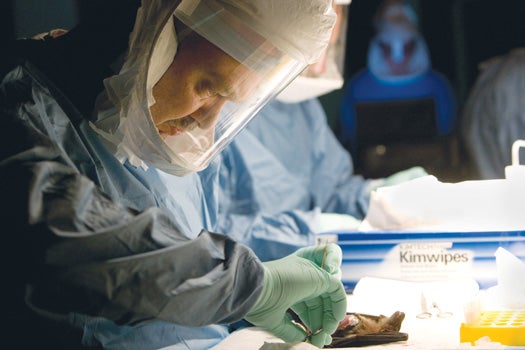
Bats, and their guano, were everywhere. The scientists donned their suits and respirators and entered, using nets to capture 800 bats before heading back to Ibanda, where the rest of the team had constructed a lab inside the village’s hospital. Then they euthanized the bats.

The team went to work dissecting in an assembly line. One group collected tissue samples from the bats’ kidneys, livers, lungs and hearts; another took blood samples; another entered data. They put the samples in tubes, put the tubes in women’s stockings (which fit snugly around the samples), and dipped the packages into tanks of liquid nitrogen, where they were stored for transit. A scientist returned to Entebbe with the frozen tubes.
Within a week of the call, the samples reached Atlanta and the CDC’s high-containment labs, where scientists hunted for signs of Marburg. “If we can know how a population with the disease acts, how it might impair them, we can get a jump on it,” says Craig Manning, a member of the CDC team. With the samples, they could begin to understand how the disease manifested itself in one species and jumped to another.
They discovered that 23 of the 800 bats carried Marburg, although they couldn’t find evidence of symptoms. Back in Uganda, the mine was shut down and the virus’s only victim buried.
Check out more from our Future of Medicine issue here.
Five amazing, clean technologies that will set us free, in this month's energy-focused issue. Also: how to build a better bomb detector, the robotic toys that are raising your children, a human catapult, the world's smallest arcade, and much more.


Online Content Director: Suzanne LaBarre | Email
Senior Editor: Paul Adams | Email
Associate Editor: Dan Nosowitz | Email
Assistant Editor: Colin Lecher | Email
Assistant Editor: Rose Pastore | Email
Contributing Writers:
Kelsey D. Atherton | Email
Francie Diep | Email
Shaunacy Ferro | Email
lol..imagine the stank they'd find in Rihanna's punani
“If we can know how a population with the disease acts, how it might impair them, we can get a jump on it,” says Craig Manning.
after killing 783 innocent bats. and the only known bats carrying the virus. The victim may not have even been bitten by a bat.
No further analysis is possible now, untill the next victim dies or is tested. And we put our trust in these people...they just destroyed an ecosystem and the only evidence and information that could be used to prevent an outbreak...what were they thinking??
please let me know what code of conduct I have violated with my top comment
Midolman: You left an 'L' out of your signature.
There should be an age limit to post to keep the 9-year-olds out, but I don't know how it would be verified.
Fora comment abuse does make me think about a similar thread on Scientific American's site where someone had the idea to create online ID cards with which to login or register on sites. I like the idea of that.
Sorry this was off-topic.
How about NOT bringing the freaking bats back here!!!! IDIOTS!
They gathered all that equipment to take with them and didn't think to grab the extra 1-200 lbs of equipment to build a sterilizer environment... 747 can lift more than 500,000LBS.
CCampbell:
...using nets to capture 800 bats before heading back to Ibanda, where the rest of the team had constructed a lab -->inside the village’s hospital<--. Then they euthanized the bats.
They didnt bring the bats back here they took them back to the village. They only brought back the samples.
Midolman: You left an 'L' out of your signature.
Not sure what you mean
There should be an age limit to post to keep the 9-year-olds out, but I don't know how it would be verified.
I am 23 so that fails
Fora comment abuse does make me think about a similar thread on Scientific American's site where someone had the idea to create online ID cards with which to login or register on sites. I like the idea of that.
I don't get it
Sorry this was off-topic.
No worries man I'm almost always off topic
Pazsion obviously has no ecological/virology knowledge. 783 bats are a drop in the bucket in that area of the world. Bats are on of the only ways in which such a virus can be transmitted to humans and by extrapolating out the prevalence of infected bats they can try to calculate the risk of an outbreak....welcome to the world of epidemiology