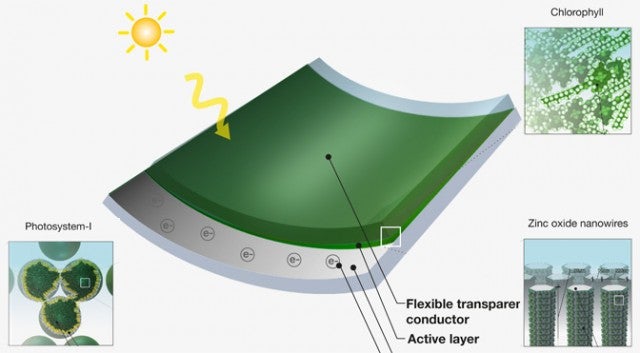
Installing a solar roof on your home could one day be as simple as mixing your yard clippings into a stew of inexpensive chemicals and painting the resulting mixture right onto your rooftop. An MIT researcher has developed a method of manufacturing solar panels on the spot from agricultural waste, sidestepping the need for silicon and making ready-to-mix solar cheap and abundant virtually anywhere.
But first things first. What MIT’s Andreas Mershin has done here is pretty interesting. His chemical cocktail extracts the photosynthesizing molecules from plant matter--including chlorophyll--and stabilizes them such that they can be spread on a glass substrate. Said substrate is coated in nanowires and titanium dioxide “sponges” that help convert photons to electrons and then ferry those electrons away as current.
But you were waiting for the other shoe to drop, and now it shall: the conversion efficiency of Mershin’s paintable solar panel is just one-tenth of one percent. To even begin to make an impact, a solar panel needs an efficiency many, many times greater than that. But it’s a starting place, and to sweeten the deal the technology is cheap. Mershin hopes now that he’s put the technology in play, he or others will be able to build on it. More over at ExtremeTech.
Five amazing, clean technologies that will set us free, in this month's energy-focused issue. Also: how to build a better bomb detector, the robotic toys that are raising your children, a human catapult, the world's smallest arcade, and much more.


Online Content Director: Suzanne LaBarre | Email
Senior Editor: Paul Adams | Email
Associate Editor: Dan Nosowitz | Email
Assistant Editor: Colin Lecher | Email
Assistant Editor: Rose Pastore | Email
Contributing Writers:
Kelsey D. Atherton | Email
Francie Diep | Email
Shaunacy Ferro | Email
meh
I dont think that if they make it work well the electric industry will allow the materials needed to stay cheap.
- RELIGION AND SCIENCE GO HAND IN HAND, NEITHER CAN DISPROVE THE OTHER!-
Efficiency is only 1 key component to the effectiveness of a solar panel (at least for commercial use), and I argue it's even the secondary concern. The primary one is cost. Now, obviously it has to have a certain amount of efficiency which it clearly doesn't yet, but after that, cost > all.
So on that point, I'm interested if they can improve its efficiency to a point that it actually pays for itself (say, around 9-20% efficiency). If it truly is cheap enough, and can be improved to a certain "sweet spot," I could see it taking off.
I really wonder just how cheap this technology really is, especially compared to other "cheap" products available that provide 9-20% efficiency already.
----------------
"Extraordinary claims require extraordinary evidence." - Carl Sagan
Everyone that has a degree in science is looking at this issue. Currently there is no way that a silicon based PV cell could return the amount of energy that is used to create it. PV cells are an energy negative creation. Until the energy used to create PV cells is dramatically reduced or the efficiency is greatly increased there will be no good or green PV use. Currently it is much better to use the heat of the sun as a source for electrical production. There are many examples that are energy positive designs. They can't be improved vastly in efficiency. The beauty of the heat designs is there is plenty of surface area reasonably near energy use that could be converted. Not like we are running out of deserts. While I welcome any design the total green solution is also the total live cycle. How are these chemicals going to pollute our water sources?
Cool.
Oh, and 11Bravo, religion should be testable by science.
-Spouting a fountain of nonsense since 1995-
This sounds like a version of the Grätzel Cell
http://en.wikipedia.org/wiki/Dye-sensitized_solar_cell
with the organic dye replaced by the photosynthesis compounds.
I would love to see the efficiency in a system like this get raised.
@skeptic
To a point I agree, but physical space will always place a ceiling on the feasibility of taking the low-cost/low-efficiency approach.
I occasionally work with R&D to integrate PV's into mobile field equipment, and of course mobility will enforce greater restraints on packaging size than PV arrays for a building would, but the premise is the same.
You can offer me the cheapest PV's around, maybe even give them to me for free, but if the efficiency dictates I need a million panels and I just don't have the space to place them, I'm going elsewhere.
It works fine as a trade off, but not when you're talking about efficiency sacrifice of orders of magnitude. There are exceptions, of course. Some applications have no practical limit on space I suppose.
As the MIT article (http://web.mit.edu/newsoffice/2012/biosolar-0203.html) notes, this is mostly for bringing cheap, low power production to third word nations, which would be great. Not sure this would ever be adequate for primary power production in a developed nation, or even for supplementary power for residential use.
Oh I agree, bronco. That's why I said the efficiency "sweet spot." Once you get it efficient enough the space issue is no longer a concern, cost becomes the primary factor.
In other words, you don't need a solar panel that's 95% efficient. 30% efficiency would work just fine if it met your energy needs, could be fit into your usable space and was affordable.
Cearly 0.1% efficiency isn't anywhere near efficient enough for most applications.
----------------
"Extraordinary claims require extraordinary evidence." - Carl Sagan
@ Skeptic
If it's cheap enough, it might be useful as green paint :)
Honestly, I'd be totally down with that. Imagine spray on grass with this stuff, too. No watering, and actually generates power for you.
----------------
"Extraordinary claims require extraordinary evidence." - Carl Sagan
The most efficient PV cell that I know about is only 42% efficient, and it still doesn't have a very high output. Efficiency and operational area dictate the size of the cell required.
some of my nerdy friends and i are working on a flexible solar panel roof shingle that interlocks. basic idea is to turn the entire roof into a massive solar panel instead of a traditional shingled roof. weather resistance is a key issue ofcourse
my roomate's aunt makes $83/hr on the laptop. She has been without work for 8 months but last month her pay was $8682 just working on the laptop for a few hours. Read more on this site...Nuttyrich . com