Otavia antiqua could be the earliest human ancestor, predating the previous earliest known animal by tens of millions of years.
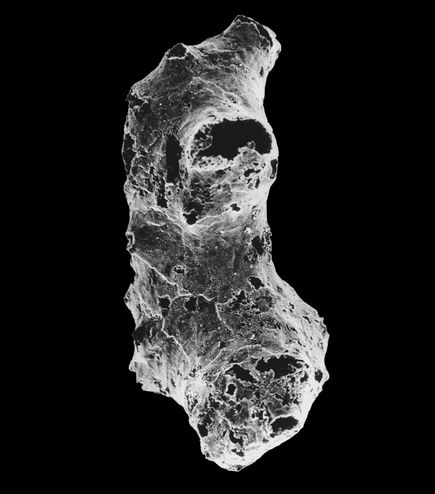
Otavia antiqua courtesy Anthony Prave, University of St. Andrews via NatGeo

Our earliest evolutionary ancestor may have been found in the form of microscopic sponge-like organisms recently discovered inside extremely ancient African rocks. If that turns out to be so, it would displace animal life’s previous earliest known ancestor (unremarkably, another sponge-like “metazoan”) by predating it by perhaps 100 million years.

The small organisms, known as Otavia antiqua, were found inside of a 760-million-year-old rock in Namibia and could very well have been the first multicellular animals to emerge on the planet, researchers say. That means all animal life--from the precursors to the dinosaurs to the dinosaurs themselves to modern humans--could potentially draw a line straight back to Otavia. It also means that animal life likely emerged tens of millions of years earlier than we previously thought it did.

Discovered by University of St. Andrews researchers, Otavia is thought to have lived in calm, shallow waters and fed on the bacteria and algae that was fairly abundant there. It was of simple design--a tubelike body that would draw food through its pores into a central space where it was basically absorbed directly into the organism’s cells.

Otavia didn’t evolve much, but perhaps it didn’t need to. The record shows that if the researchers are right, Otavia weathered at least two “snowball Earths,” periods when the global temperatures plunged and almost the entire planet was ice-bound. And the organism lasted for 200 million years by the best estimates, suggesting this potential ancestor to all things animal was a lot hardier than a lot of the larger multicellular species that have come into being since.

[National Geographic, PhysOrg]

17 Comments

"Otavia didn’t evolve much"

but

" That means all animal life--from the precursors to the dinosaurs to the dinosaurs themselves to modern humans--could potentially draw a line straight back to Otavia."

odd....

Bagpipes100,
If part of the establishment of life on earth came from falling asteroids, then this soup of history and branches of roots could come from many different directions, going back far enough and the stars above.

It is said by the Samarians too, that a heavenly, skyward being came to earth and created the annunaki and many other animals.

Even Christian, Jewish, Hebrew history says our Dear Lord came from above and created life on earth below.

So where did our true source of DNA come from. Well it depends upon what time period you speaking about and then it could have come from many different heavenly places too.

.............................
Science sees no further than what it can sense.
Religion sees beyond the senses.

i concur with your odd discovery sir bagpipes i had the same question and just to add a little it says
"Otavia didn’t evolve much, but perhaps it didn’t need to. The record shows that if the researchers are right, Otavia weathered at least two “snowball Earths,” periods when the global temperatures plunged and almost the entire planet was ice-bound"

if my sience class was right and survival of the fittest is key in evolution shouldent we all be sponges ?

WOW!, Some
Peoples Kids

S1165,
Aw, the missling link of the Sponge Bob with Square pants communties question! Where are these Sponge Bob communties now and why don't we all wear square pants?

..........................................
See life in all its beautiful colors, and
from different perspectives too!

space,
so sponge bob is more realistic than life itself

...............
WOW!, Some
Peoples Kids

I would like to address the logicless comment:
"Otavia didn’t evolve much"

but

" That means all animal life--from the precursors to the dinosaurs to the dinosaurs themselves to modern humans--could potentially draw a line straight back to Otavia."

odd....

You obviously haven't read the passage correctly, either that or your idiotic quote mining stems from miseducation of evolution.

Let me point something out. "Otavia didn't evolve much" means that particular species (Otavia Antiqua) didn't need to radically adapt. That doesn't mean that it never DID adapt eventually. Once it adapts sufficiently it can become a new species. Those animals can adapt further etc... evolution.

So the quote:
" That means all animal life--from the precursors to the dinosaurs to the dinosaurs themselves to modern humans--could potentially draw a line straight back to Otavia."

does not purport that Otavia never adapted.

Think before you post... You may end up confusing likewise uneducated readers.

Only a naturalists would be so insecure in their worldview to so excitedly jump in to defend their little fairytale from a harmless jest.

I understand what they meant. And in the context of a naturalistic worldview/religion it makes some(not complete mind you) sense.

But lets be honest it would take this critter a good deal of change to become something else.

For further discussion. What determines when there is speciation? Is there a clear generational mark? What is a working definition of species? If a phylogenic tree branches off....which branch maintains the original name? (Because its not likely any of them are nice neat genetic matches to the branch they are both coming off of.

From my research, there is a good deal to say about speciation, but embarrisingly little to say about how to even define species in a meaningful way.

@bagpipes100

There are just somethings in science that cannot be succinctly explained to you in a comment box. People spend a big chunk of their lives studying this and it is hard to give a satisfying answer to someone who hasn't formally been exposed to it in an academic setting. If you are truly curious, take a college course.

People who have not gone to University to study evolution can have an opinion on it, but please do not act as if you are an authority in the subject matter.

Trust me, reading articles online and Wikipedia is not research. There is a lot of junk out there. Start with academic journals.

@Bagpipes100

From what I understand, evolution is not a linear process. With each new offspring, there is a slight branching off due to DNA copying errors known as "mutations." Over vast stretches of time, all of those little branches add up, natural selection influences the branching process, and we wind up with the abundant variety of lifeforms that we do today. That's why monkeys and apes are still around and haven't evolved into sentient lifeforms similar to us: because they're part of a separate evolutionary branch. Splitting hairs over the definition of "species" that scientists are still trying to flesh out doesn't imply anything about evolution being a fairy tale, it just means that you're trying to poke holes in the dynamic process of the scientific method because you won't allow yourself to consider the possibility that life on this planet diversified through natural processes.

By comparing evolution to a religion and saying that naturalists are insecure, you're just looking at a mirror and criticizing your own reflection. You're not arguing about the plausibility of evolution, you're playing it safe by quibbling over rhetoric that scientists are still trying to clearly define. That's like calling the theory of gravity a fairy tale because astronomers recently reclassified Pluto as a "dwarf planet." You remind me of myself as I graduated high school and moved on to college: I was having doubts about my beliefs, but rather than admit and face my insecurities, I would pick verbal fights with naturalists and wouldn't allow myself to really listen to them and be receptive towards learning more about controversial science. As for evolution being a religion, well, all you're doing is ripping on the idea of religion because you're using it in a negative context. I think that says more about your feelings towards religion than it does about your feelings towards science. Look, I'm not trying to pick a fight with you, I'm just trying to point out that you might have some personal issues that you need to work out.

Mr. Paradox,

I find your comments to the readers who pointed out the questionable logic of the two sentences in the article a bit harsh.

As you put it…”You obviously haven't read the passage correctly, either that or your idiotic quote mining stems from miseducation of evolution.”

Perhaps so…but why not make the correction with out the vitriol?

Popular science is not a technical journal and it is open access to just about everyone with an internet connection. I would imagine that there are going to be people reading this article who are not well versed in matters of evolution.

One of the things I do from time to time is review articles for publication in technical journals. If I saw statements like those being discussed here in an article I was reviewing I would have suggested a rewording to avoid any ambiguity that could arise…as you could see it did.

Also I would have included the adjective “fossilized” in the first sentence.

“Our earliest evolutionary ancestor may have been found in the form of FOSSILIZED microscopic sponge-like organisms recently discovered inside extremely ancient African rocks.”

Otherwise it could be interpreted that this is some kind of primitive organism that lives in rocks.

@paradox13:

Before you make idle digs at the education of others, I would seriously review your own. It may very well be that a line of Otavia never evolved beyond a certain point and that a mutated form of Otavia branched off. That is what the article suggests. No one suggested that Otavia was not an an ancestor to other species, including the original two posters, you libel.

I suggest you read Riddle84s post. Then REREAD it until you get it. It puts the implicit aspects of the article into a more lucid framework quite nicely. Again, REREAD it until you understand where YOU went wrong in your "most erudite" correction of the "rubes".

I will add that natural selection DETERMINES WHICH mutations are passed down. Feel feel to flame, but has it ever crossed your mind that there may be more than one explanation for a thing. Do you know what speculation is. You might have done it yourself before you "knew it all".

Anyway, you come off as hidebound, rude and dare I state it... uneducated yourself. More precisely a little educated and cocky.

PS: If the 13 at the end of your handle is an indication of age, I take back the last statement. You are right where you should be mentally at that age. Still, be nicer.

There's always something that happened 100 million years before something else. Time had no beginning.

I agree with you, "Robot" and a couple other commenters. The way the article sounded, we all came from that sponge. The DNA that made that sponge did not make ancient or modern humans or animals...just modern sponges. Millions of DNA strands came to this planet and no one knows where they came from or when. To me, that means that we are not the only or the first intelligent life in this Universe. In fact, compared to the Universe, the Earth is still in its infant like state, and that means there are a lot of life forms closer to the big bang that is far superior in intelligence and abilities to us. A while back a scientist, I cannot remember his name, said that there are 9 stages of life in the Universe and we are just barely getting into stage one, and a being in stage 5 could actually have developed the ability to build life on this planet; he called it teriforming (sic).

It is not unusual that our small way of thinking cannot comprehend the mind and thinking of a being far superior to us or that formed on another planet or star.

This is a fantastic find! While it hasn't been widely circulated, it seems tentatively accepted. Indeed, they found hundreds of the putative fossils. If fact, it can upend earlier hypotheses about this period, including the hypothesis that the then global glaciations drove the later diversification in the Edicarian. In the paper the authors make a good case that it was these critters that caused, and easily survived, the glaciations by binding organics into sediments.

That said, it is tragic to see anti-science creationists comment on these remarkable finds. Indeed, it tells us that the molecular clock dates that speaks of animal differentiation of ctenophora and cnidaria (comb jellies and jelly fish) before the Edicarian is confirmed and threaten the "Cambrian explosion" creationist strawman.

@ Bagpipes100:

I don't know what you mean by odd here.

- The article is sloppy when it suggests a straight descent ("draw a line straight back") which is very unlikely. As I noted above the split was later, but O. antiqua was more probably a close relative.

- While species and related species (not easy to tell biological species in fossil species) can look like stasis, as here, there is new research that suggests similar species replace each other with the usual species lifetime turnover. In any case, there is no contradiction in having widely different evolution rates for different species and different environments, this is what is observed.

This is not a fairytale, btw, the fossils are there and then disappear (aka evolution btw).

As for your questions on evolution, you have to study up. It is a simple basis with a complex outcome (all of biology is based on evolution, natch).

Just let me point out that this comes out on species, which is fuzzy, depends on context (say, extant vs extinct aka fossil species) and have more than 26 different realizations.

@ S1165:

Evolution isn't "survival of the fittest", a pity characterization would be differential reproduction. If the environment (including other species) changes, species change.

@ thomowen20:

- Natural selection doesn't determine all the mutations that are fixed. Drift and bottlenecks does that as well.

- Parad0x13 and riddle84 are both right. Parad0x13 is morally right and put it more weakly than I would, creationists shouldn't post on science.

Moving on from evolution to astrobiology (my study interest):

@ Robot, allenehrl:

The universe had a beginning, and its time with this, as is well understood, observed and described by standard cosmology. Same with Earth vs planetary science.

Hence there was no life originally, while we observe life now. Hence we know there are natural processes that results in life. This, the existence of a process from no life to life, is an observable fact.

[Your proposals of magic isn't even an option, any actual magic _destroys_ application of science (if not the subject of science) and so gaining factual knowledge. And it goes against the natural observation above. Magic presupposes living agents even if "gods", so it can't explain life.]

The study of those processes has advanced so much that the last decades there is less emphasis on new ones and more on testing for paring down to the correct ones. This has long been doable, since the 80's when the first testable pathways from chemical to biological evolution were discovered. (Wäschterhäuser's surface metabolism et cetera.)

The origin of DNA is well understood and observed as a fact. The RNA world is independent of the chem to bio evolution transition, and is well evidenced in today's cell with the RNA core genetic and cell membrane transport machinery as well as the ribozyme catalytic ability of RNA that was in place before today's proteins.

@ JamesDavis:

Very poetic, but evolution has no "stages" or direction, more often than not complex species simplifies to parasites (~half the species). Society may well have stages, but that isn't all of "life".

We know that abiogenesis is extraordinarily simple and often happening since it happened so fast here, that transpermia had little likelihood to be first.

So little likelihood, that despite Mars coalesced ~ 30 million years before Earth and/or the Earth/Moon impactor restarted abiogenesis, we can safely but even today arguably conclude it happened here. The happenstance transport of Mars ejecta takes much longer on average than all currently known abiogenesis pathways.

Torbjorn Larsson_OM
It is you that introduces the word magic. I suggest life could develop naturally on earth over the course of time, plus life could have come from asteroids from outer space and I also point from past historic observation of different cultures and different religions earth has been visited from beings that come from above, down to earth and bread with humans. I suggest all these things had an effect on the biology of life on earth. I do not suggest magic at all.

Now you may not be religious and I am not suggestion you become religious to see my view point. I just pointing out from a historic point of view, past humans observe life come down from outer space, above and live about with humans and left a cultural experience. It was seen and observed that they had sex with humans and made offspring in culture and religious writings. Yes, the local cultures for themselves may have thought of this as a religious event and recorded it that way. My only point was they observe beings that came down from outer space, flew about in the sky and breaded with humans. This is not magic either. If anything, it’s closer to human observation and closer to being scientific and realistic.

The biology on earth could of influence by a multiple of different sources and that is all I suggest.

I see the biology of earth being natural for 4/5 of its time of existence and in the last 1/5 of its time has an outside alien influence. One the natural biology of earth became a stable and abundant oxygen planet, then the aliens influence our environment, destroyed the giant dinosaurs with natural large impacting influences, tweak and mingle with the biology that was left and created all the animals of earth now and tweak most recently with human DNA.

No magic implied, but real intelligent scientific influence from an outer space source.

.............................
Science sees no further than what it can sense.
Religion sees beyond the senses.

@thomowen20

I don't feel as though I need to defend my post, or the information in it. So I won't. I will say that your reply is pretty funny, and I don't mean that in an entirely condescending way. You seem to imply that I said bagpipes post said anything about 'not speciating' or anything of that sort, which I clearly did not. Then you go on to imply that I hadn't studied speciation enough, which is false (Not that I can really prove that to you)

It’s interesting that you feel threatened enough by my mean spirited response to bagpipes nonsense that you should rustle your feathers as well, and un-consequentially so. I chewed bagpipes out because his first post could be misconstrued (or even more probably just ‘construed’ as I’m sure his comment was meant honestly) by other posters, such as S1165. I do agree with matsci1 in that my mean spirited reply to bagpipes, and thusly referring to his slander as vitriol, was harsh. I did it to incite a conversation, which I did, to clear up the messy misunderstanding that he could have provided to other possibly unintentionally ignorant readers. Did I come across uneducated? I think not. I’m not trying to defend my post though, but I will say it was strategically harsh. Depending on my mood I would say possibly unnecessarily so.

But in the wise wise words of ‘thomowen20’, please “REREAD, and then REREAD once more” the posts you wish to attack.


June 2013: American Energy Independence

Five amazing, clean technologies that will set us free, in this month's energy-focused issue. Also: how to build a better bomb detector, the robotic toys that are raising your children, a human catapult, the world's smallest arcade, and much more.


Online Content Director: Suzanne LaBarre | Email
Senior Editor: Paul Adams | Email
Associate Editor: Dan Nosowitz | Email
Assistant Editor: Colin Lecher | Email
Assistant Editor: Rose Pastore | Email

Contributing Writers:
Rebecca Boyle | Email
Kelsey D. Atherton | Email
Francie Diep | Email
Shaunacy Ferro | Email

circ-top-header.gif
circ-cover.gif