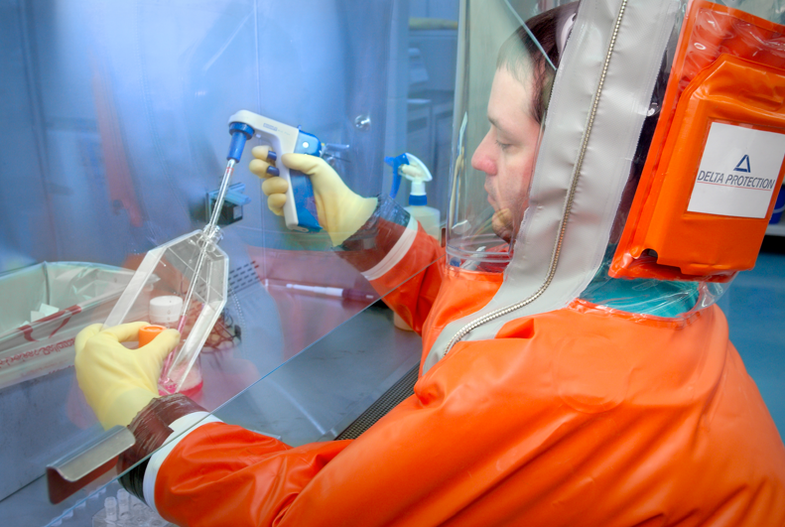
In an unusual move, an international coalition of flu researchers agreed last week to a hiatus on work surrounding a highly contagious, mammal-adapted version of the avian influenza virus. Research on transmissible H5N1 flu will halt, and two manuscripts describing how to modify the virus won’t be published, at least not yet.
The voluntary pause came a few weeks after an American advisory panel recommended censoring the research in the name of security. So it raises an interesting question — is some research just too dangerous to pursue? Not just for the scientists conducting it, but for the public in a post-9/11 world?
Voluntarily pausing science in the name of safety and public solace is certainly not common, but then neither is a potentially groundbreaking study into the mechanisms that could make bird flu more potent and more deadly. The decision, announced in Science and Nature, indicates influenza researchers want to quell public fears, but they also don’t want to censor their work.
Dr. Nancy Cox, chief of the Influenza Division at the Centers for Disease Control, said flu researchers will confer during the hiatus about how to proceed, including making modifications to security procedures or the biosafety requirements for labs doing this work. Flu is dangerous, but it’s not nearly as deadly as some of the other pathogens CDC studies, she noted.
“If you think of Ebola and Marburg, and some other pathogens with a high lethality, which are worked on in the lab and for which there aren’t antivirals and there aren’t vaccines, influenza falls into a little bit different category,” she said.
One of the two main labs at the center of this debate does not have a Biosafety Level 4 facility, the highest security level reserved for the most deadly pathogens. Issues like that will be a topic of discussion during the 60-day break.
“(The hiatus) is unusual, but because there was so much concern about the work, it was an appropriate action on the part of the laboratories that are involved in this type of research,” Cox said.

“There are always concerns about misuse of the products of research,” said Jeffrey Kahn, deputy director of the Berman Institute of Bioethics at Johns Hopkins University. “Think about nanotechnology as another example, or genetically modified food. We like the benefits of these new technologies, but we always worry about he misuse, the misapplication, or the unintended consequences. The trick is, how do we oversee and prevent problematic outcomes, while still realizing the benefits of the technology?”
The flu moratorium stems from two separate studies prepared by scientists in the U.S. and the Netherlands (the latter having been funded by the U.S. National Institutes of Health) investigating how the avian influenza virus could mutate and become transmissible among mammals, including us. The main paper is by virologist Ron Fouchier of Erasmus Medical Centre in Rotterdam, the Netherlands, who engineered the genome of H5N1 to make a version that easily spreads among ferrets, the closest animal model of the human response to flu. After 10 virus generations, the mutated virus became airborne, infecting healthy ferrets who were housed near a sick one. The work was important because it disproves a previous assumption that avian flu could not easily adapt to mammals, requiring drastic changes to the virus’ genetic makeup that would render it unable to reproduce.
In a manuscript prepared last year, Fouchier describes his methods and processes, hoping to shed light on the ways in which the virus could mutate naturally. A separate paper by virologist Yoshihiro Kawaoka at the University of Wisconsin-Madison and the University of Tokyo had similar results. The papers could help virologists look for vaccines or antiviral treatments. But some observers fear the work could create an extremely potent bioweapon, should the mutated virus escape from the lab — or should the work be replicated by someone with ill intentions. Interestingly, the moratorium letter (online here) does not address the latter concern, focusing instead on lab procedures.
“We would like to assure the public that these experiments have been conducted with appropriate regulatory oversight in secure containment facilities by highly trained and responsible personnel to minimize any risk of accidental release,” the letter reads.
The Asilomar Conference also led to a hiatus and had similar goals, as scientists sought to regulate themselves before government bodies did it for them. Researchers were able to shape their own rules, so when the National Institutes of Health did create an oversight committee, scientists thought it was legitimate, recalled Alexander Capron, a professor at the University of Southern California and co-director of the Pacific Center for Health Policy and Ethics. Capron was a participant at Asilomar and sees several parallels between that meeting and the flu debate, he said. Along with mitigating physical risks in the lab, scientists need to balance the risks of publishing their research with the risks of not publishing it, and the precedent that would set.“It’s much easier to ask what you can do to prevent physical risks from manifesting, than what you can do to prevent knowledge risks,” he said. “The only surefire way is to not disseminate the knowledge at all.”
But no one really wants that, said Kahn, who noted the public health value of understanding how H5N1 works.
“It’s really important to know that for the purpose of planning and preparedness, but it has all these potential risks associated with it,” he said. “If there weren’t any good scientific reason to do it, or good policy, we’d say, ‘It’s just mad scientist stuff.’ But it isn’t.”
Most researchers agree that after the moratorium, the work must go on.
“Understanding why some animal viruses jump into humans, and can be transmitted from human to human and others don’t, is one of the central questions we are trying to understand in the field of influenza,” said Cox, the CDC scientist. “There are probably multiple different pathways. Influenza is a very simple organism, but it’s also very complex in that it mutates very quickly, and with all those mutations come a danger. It’s a pathogen that really keeps those who study it on their toes.”
Five amazing, clean technologies that will set us free, in this month's energy-focused issue. Also: how to build a better bomb detector, the robotic toys that are raising your children, a human catapult, the world's smallest arcade, and much more.


Online Content Director: Suzanne LaBarre | Email
Senior Editor: Paul Adams | Email
Associate Editor: Dan Nosowitz | Email
Assistant Editor: Colin Lecher | Email
Assistant Editor: Rose Pastore | Email
Contributing Writers:
Rebecca Boyle | Email
Kelsey D. Atherton | Email
Francie Diep | Email
Shaunacy Ferro | Email
D13, do you have sources for your argument that viruses replicate via the body's genes? Last I checked, viruses invade a host cell (not a gene, which is made up of DNA contained within the cell). So your claim is quite the bold one.
Gene sequencing and gene therapy are real things, and have real purposes -- but they are not all-purpose. Mostly, they are used to determine and treat diseases and other problems, such as cancer or even alzheimers. However, I can't think of anything gene therapy would do to treat a virus, unless you're targetting the genes of the virus rather than the human body -- but that's a whole other ball game than what you're suggesting.
Big Pharma is greedy, make no doubt. But don't make the next (il)logical jump to say that these wildly powerful treatments to ailments exist but are just being kept secret for.. well, I don't know of any good reason, because if big pharma did have a quick and easy cure for these kinds of things, it would be a cash cow.
So your argument fails that:
Big Pharma is greedy
Big Pharma makes drugs
Big Pharma makes money from its drugs
Therefore Big Pharma has the cure to everything, but is withholding it from the public in order to make money.
The conclusion does not follow from the premise (non-sequitor).
By the way, Big Pharma doesn't have a monopology on medical research. It does conduct a lot of its research, and yes, a lot of their results are held privately, but publicly funded Universities also conduct the same research -- coindidentally, the research being discussed here is being done by a University.
And just to avoid confusion, the vast, vast majority of research done by Big Pharma that's held secret, are its failures, not its successes. If Big Pharma conducts an in-house research project with underwhelming, lacking, or negative results, it often will not publish it at all. But if they have a study that suggests a positive result, you can bet 99% of the time that study will be immediately published.
That is to suggest not that Big Pharma has the cure to everything, but that much of their treatments may not be as effective as they suggest (if you REALLY want the truth, always always compare pharma's results to independent studies done by University researchers.)
----------------
"Extraordinary claims require extraordinary evidence." - Carl Sagan
Canadian_Skeptic, please see the article here on PopSci titled, "New Genetically Modified Chickens Can't Transmit Bird Flu, Scientists Say". Doesn't cure it or even prevent the birds from dying from it but very interesting none the less.
D13, the scientist's name is Dr. Thomas W. Hodge.
Thank you for the reference skb-fxstc, it's an interesting study. It doesn't precisely contradict what I said, though. According to the article you referred me to,
"Vaccinated birds may not develop flu, but the virus can still replicate in their bodies and be transmitted to other unvaccinated fowl, he explained in a podcast with the journal Science, which publishes the study tomorrow.
The new genetic modification is basically the opposite — birds will still get sick and die, but they won’t pass on the virus to other birds, a major advancement for animals that generally live in very close quarters."
In my case, I was referring to the ability of the virus to replicate, which was a direct response to D13's claim. The genetic modification quoted makes no claim to prevent this. All it does is prevent the virus itself from being transferred from one bird to another. It will, however, continue to replicate inside the host body.
I can't speak for everyone, but personally if I received, say, H1N1 or some other virus, I wouldn't be satisfied knowing the best treatment simply prevented it from spreading from me to another person. I'd want to be cured myself (though, obviously I wouldn't want to spread it, either -- a cure has to accomplish both).
It also makes no claim that this process/prevention treatment can be replicated in humans, which D13 claims it does (I'm not saying it can't, either; I'm only making the claim that it hasn't *yet*, to contrast D13's claim that Big Pharma already has this technology).
So at best, this article makes an argument for vaccinations and gene modification working in tandem, not either/or. But, I concede, gene modification can certainly have a role in the conversation -- even a very large role. Thank you for that, skb.
D13, boy I sure rang your bells today. I think somebody didn't get his cookies.
I'll give you a tip: the best way to prove you can back up your information, is to provide sources.
I'll take note of a contrast between you and I. You waste your words telling people you can back up your claims. I spend my time providing sources. Personally, I prefer my method.
Don't tell me you can back up your claims, *actually back up your claims*. Your promise that you really know what you're talking about really means nothing to me -- I know nothing about you.
And actually here I was thinking my arch nemesis was ALH. At least, that's what he also told me. My thoughts? I'm just here to try and get people to always look for the sources and think critically about that source.
Secondly, I aim to provide interesting comments. I'm not actually talking with or at you, D13. Im talking for all the people reading your comment and mine.
I hope others enjoy what I have to say -- frankly, I could care less if you do.
----------------
"Extraordinary claims require extraordinary evidence." - Carl Sagan
D13, if you are truly concerned about the status of Dr. Hodge's research then why don't you send him an email asking him about it? I'm sure you can find his email address on the university's website.
I'm good, but thanks for the suggestion. Seems you're the one more concerned by all this. I'm actually happy as a pig in.. well, you know.
----------------
"Extraordinary claims require extraordinary evidence." - Carl Sagan
D13, yep you obviously had the first name wrong. You were right about his research though. It's called gene trap technology. Sounds promising. Just a tip for you, sometimes you come off as a paranoid, conspiracy nut. Tone down the crazy and I'm sure people like Canadian_Skeptic wouldn't give you such a hard time.
I never said you were wrong, D13, nor did I actually call you a paranoid conspiracy nut. I simply stated that sometimes you come off that way. The truth is usually always found between extremes, in the middle. Have a nice day. I'm out.
+1 skb, brilliant response. Tone down the crazy, and I'd actually have very little to be concerned with in D13's post.
D13, I absolutely agree with you that Big Pharma is greedy as hell. I have no love for them at all. I'm also saying nothing at all against Dr. Hodge's work. Kudos to him and I hope he keeps up the great work.
But keep in mind, let's say this gene therapy proves to be the holy grail, "cure everything" wonder-treatment you seem to say it will. Just who do you think will buy up, patent, or otherwise own that treatment?
Big Pharma.
No profit would be lost because the new technology would be owned by the same people that owned the previous technology. Modern corporate entities don't just die out because the new kid on the block has a new toy -- they either buy the toy, or buy the kid with the toy.
And let's say Big Pharma does die. The world doesn't magically right itself. Suddenly, Dr. Hodge (or whomever) has a corporate monopoly on the new wonder drug of the age, and can charge whatever he likes for you to have access to it.
The social problems don't go away.
If you want to fight the real issues around Big Pharma, support open source dialogue between scientists, promote the publishing of negative results of treatments as well as positive results, and lobby to keep independant, publically-funded scientists off Big Pharma's payroll.
In short, transparency, transparency, transparency. Not conspiracy mongering (you can't fight lies with delusion, no matter how much you think they're after you).
By the way, you can't insult me for not being familiar with one particular scientist, especially when he was *your* source material and you didn't even know his name. That speaks much more about your knowledge of the area than mine.
Next time, try to get the name right at least, eh?
P.S.
"Im not getting in a nerd battle with you silly person. "
Good to see you're a man of your word.
----------------
"Extraordinary claims require extraordinary evidence." - Carl Sagan
By the way D13, you're gonna love this.
So I did a little digging. Turns out, Dr. Hodge left the CDC (government, where his research would be public information), to join Zirus, a private company whose mission is to "provide a unique and extensive platform of host targets and an efficient process for finding additional targets and drugs to treat viruses for which we do not have effective vaccines."
He's now the Chief Scientific Officer of Zirus.
http://www.zirus.net/zirus_nation_022.html
I guess about the time Dr. Hodge stopped "publishing" material was probably the time he joined a big company. He wasn't silenced by Big Pharma; he was bought. I guess I was right after all.
Don't worry, though; you can send your resignation letter to my secretary. Located under the granite statue of myself.
Thanks.
I tried to read everything to have a salient response, but man do you guys write a lot. First, retroviruses insert themselves into a cells DNA to replicate. That is why it can lay dormant for years in your body. Most of the viruses D13 listed are retroviruses. Second, big pharma isn't really the issue. The trouble is that big pharma wants to be profitable. A lot of stuff they find has no market that would make back the initial cost. I read an article a while ago talking about how anti-venom certified for use in the States is not being made anymore because it is not cost effective. Other countries use a anti-venom(thats cheaper to manufacture) not certified in the States. Eventually the States won't be able to treat snake bites once the stockpile runs out or expires.
Yeah, I can definitely agree with big pharma not being the real issue -- the profit driven model (rather than the human-first model) is the problem. Though, really, I think we're arguing semantics at this point. Ultimately it boils down to greed, and an improper disclosure of information.
Thanks for your perspective, Demo.
----------------
"Extraordinary claims require extraordinary evidence." - Carl Sagan
Too much conjecture. Getting nose bleed.
One point, "Now, HE DID turn the genes off in the human cell cultures with his technique/drug."
This in itself isn't proof of a cure; cures are far more complicated. It says nothing about viability in a full human system, nor of side effects or other problems. Lengthy clinical trials and other procedures are required to make a claim of "cure found."
Having said that, knowing nothing else about his particular treatment, I'm happy to agree it would be nice to see more research done in the area.
Now, to the point, how about we just agree that the current profit-driven model is ineffective when it comes to medical research and the overall wellbeing of human beings?
I'm not personally willing to go much beyond that statement, and you're not willing to stop the train; but at least we have common ground here.
Again, I think my primary conflict with you here is the conspiracy stuff, not the sciency stuff. I'm totally down with the sciency stuff. Like, way down.
----------------
"Extraordinary claims require extraordinary evidence." - Carl Sagan
cures don't have massive profit. lifetime treatment does. where do u think their priorities are?
as for the article, nightmare situation, h5n1 natural mutation appears in china. slow burning at first then extremely aggressive and resistant to treatments. if no symptoms show for 5-7 days before infected and its contagious on the 5th day. it could easy spread across the globe into major cities within the first month. watch "Contagion" for a realist view of this....or if u want a (possible)exaggerated view of this watch "the stand".
what scares me? an ecoterrorist group that believes humans are killing the world and they need to die off. they gene splice the flu with something like smallpox or ebola or hiv. they go to places like airports or subway stations and wipe surfaces like hand rails with the virus. anyone remember watching "12 monkeys"?
slightly paranoid? sure. doesn't mean i shouldn't be. i'm just glad its not one of the zombie viruses they've discovered in insects
my roomate's aunt makes $83/hr on the laptop. She has been without work for 8 months but last month her pay was $8682 just working on the laptop for a few hours. Read more on this site...Nuttyrich . com
Hello all:
I am the scientist that you are discussing about gene-trap. Some of what you said is true and some is not.
The facts are these:
The CDC did in fact shut down my research because it was felt that 'this is not what they do'. Go figure. The CDC is tasked with tracking disease and not finding a cure. That is in the realm of NIH.
About a week after I was told to terminate my research, a philanthropist stepped in and offered me a $1 MM gift to take my work elsewhere. I chose the UGA college of vet medicine to continue the work.
After two years there, another individual stepped up and offered a significant amount of money to start Zirus.
The work here culminated in finding nearly 1500 host genes associated (required) for viral infection. Many of these were confirmed using siRNA.
Probably the most interesting is that many of the proteins produced by these genes already had FDA approved drug antagonists. Some of these were tested and found to be effective in controlling viral infection. One of these, a mTOR inhibitor worked pretty well for flu and is reported in this month's Journal of Antiviral Chemistry and Chemotherapy. In addition, it was reported this week that another drug (also one which we found) called Gleevec was effective at stopping Ebola. As our lab at Zirus was classified as a Biosafety level 3, we were unable to test this drug against this particular pathogen.
It is noteworthy that many of the drugs we found are used to treat cancer. Thus, to go after flu or other viruses that are self limiting with these rather toxic antagonists is not realistic unless people are dropping dead in the street.
In a sense, I did sell out not so much for personal gains but because the opportunity to move more quickly with the research presented itself. The company is now in virtual mode since the system has been saturated and most if not all of the genes and/or pathways have been identified. The targets are patented so if a drug company finally decides to utilize the target to inhibit viral replication they will have to talk to the investors.
twhodge
Did the CDC cause this Influenza Epidemic? It seems they did, because they Fund all these Drug companies to experiment,to create all these different Viruses. It is very funny, that we had nothing of a Flu virus,last year, and they sold very little vaccines, and this year, we have this mess and a lot of children are being killed by this virus.
It is time there be a full investigation, of the CDC,There work and their connections to the Drug Companies and there Lobbyist organizations. Also the Secretary of Health & Human Services. This article along is enough proof.
The Medical Industrial Complex is a 8 trillion dollar a year operation, and nobody is watching what they are doing.
I am going to contact my Senators and Congressmen To start to handle this.