Building a Vertical Farm in an Old Chicago Meatpacking Plant
Growing kale and tilapia--and brewing beer--in an abandoned stretch of Chicago
Recently I had the opportunity to visit The Plant, Chicago’s first vertical farm. This claim depends on your definition of vertical farm, of course, because The Plant isn’t the sort of futuristic vegetation-filled skyscraper you might expect, and it isn’t solely agricultural. While food will be grown there, the space will also house small food-related businesses, breweries and bakeries and the like, so it might be more accurate to classify it as a “food business incubator.” Whatever you call it, The Plant is definitely an example of innovative green food production, with the ambitious goal of being net-zero energy and net-zero waste by 2015.
An anaerobic digester, the giant, mechanical version of your hippie neighbor’s backyard compost pile, will consume all of the building’s waste, as well as waste from nearby food manufacturers, and combine the materials’ carbon with hydrogen to form methane which can then be burned as a gas to power The Plant’s projects.
Click here for a closer look at the inside of The Plant.
I went to an event at The Plant put on by a group called the “Young Aggies.” It was the sort of night that consisted mainly of standing around drinking cheap Mexican beer, eating beans and watching a documentary about colony collapse disorder, which, due to my irrational fear of bees, left me in a state of heightened anxiety for the duration of the film.
But before I watched people reenact my worst nightmares on-screen–a man brushing bees off a honeycomb with his mustache, for example–we got a tour of The Plant itself from one of the regular volunteers (The Plant’s founder, John Edel, was not present). It’s housed in an old meatpacking plant in Chicago’s Back of the Yards neighborhood, so named because it’s snuggled right up next to the old stockyards, in a creepy part of town that caused my roommate to posit that this would be a good place to lure young people with the promise of an urban agricultural event and then murder them.
A small staff of three employees and a team of volunteers have undertaken the daunting task of gutting the building and preparing it for its eventual net-zero glory. The input and output loops will all be closed, we’re told, which means byproducts that would otherwise be wasted will instead be funneled into one of the building’s many other processes.
We wandered on our tour from room to half-finished room, through sliding metal doors and past partly-demolished brick walls that look like Montresor from “The Cask of Amontillado” just gave up halfway. Not all the ghosts of the building’s former purpose had been exorcised just yet–there were still tracks on the ceiling that used to carry dangling carcasses, empty shells of smokehouses and ammonia chilling tubes in a room our tour guide informed us used to be a refrigeration space. Without any heat, in the dead of Chicago winter, it still felt like one.
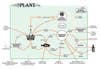
The Plant Waste and Energy Diagram
The empty concrete shells we passed through are some of the cheapest industrial space in the city. One of them will eventually be home to the New Chicago Beer Company. Boiled grains from beer production only lose 20 percent of their nutrients, so The Plant will reuse them in a variety of ways, notably feeding them into the anaerobic digester. On Jan. 19, The Plant announced that they had signed a contract with the Eisenmann Corporation to produce the anaerobic digester, which should be ready by summer 2013.
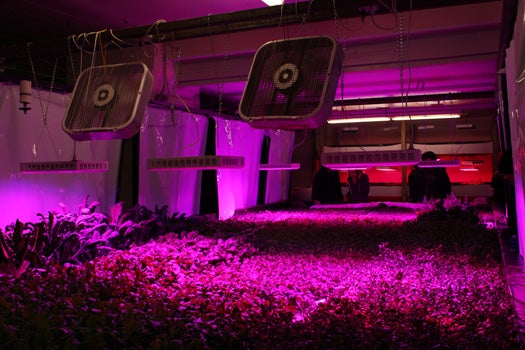
The real action on this tour was in the basement, where we got to see some of the much-discussed closed input and output loops in action. There was a hydroponics bed filled with leafy greens hooked up to tanks of tilapia referred to by our tour guide as “love nests.” The nutrients in the tilapia’s waste water get filtered out by the plants, and the fresh, clean water is sent back up to the fish. Compared to the rest of the building, the room was downright toasty (warmed by just one heating coil, we were told) and the glowing purple lights and tanks teeming with fish gave a small glimpse into what The Plant will be capable of once the rest of the building is finished in 2015.
Demolition
Space For Sale
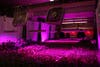
Hydroponic Growing Area
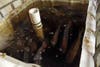
Tilapia Tank

Purple Plants