Video: New Quantum Dot Tech Could Boost Current Optical Fiber Band Tenfold
Current optical communications schemes rely on a narrow 1.55 micron wavelength band of about 10 terahertz, a band in which...
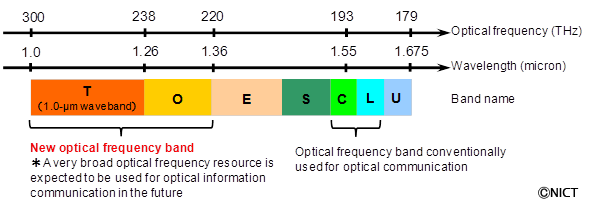
Current optical communications schemes rely on a narrow 1.55 micron wavelength band of about 10 terahertz, a band in which optical signals can be well controlled and loss of signal/data is fairly low. But to open up optical networks to the high data load of the future, we need to open up the span of available wavelength. And using a novel quantum dot technology, researchers at the National Institute of Information and Communications Technology (NICT) in Japan have done exactly that, to the tune of a roughly tenfold increase.
They did so by creating a whole new process of quantum dot formation involving what’s called a “sandwiched sub-nano separator structure.” Conventionally, crystalline quantum dot structures are grown directly on a silicon surface, which leads to a somewhat uneven, disordered layer of dots. But by inserting an ultra-fine, sub-nanometer-thick separator structure in between the silicon and the quantum dots, the dots grow in a far more dense and ordered structure, leading to a layer of very high-quality, more uniform quantum dots.
The result is a quantum dot light source that is highly stable with a communications-worthy optical frequency band that covers about ten times the width of the current communications band. That opens up optical fiber networks to a lot more usable light, which in turn could speed optical communications and boost capacity. Moreover, the new wavelength band includes light that permeates skin, so there’s an interesting medical imaging aspect to this technology to explore as well. A more thorough visual explanation resides in the video below.

[NICT via DigInfo News]