A Tiny Transistor Hooks Up To Individual Proteins In Human Tears
Listening to lysozymes with one of the smallest transistors ever made
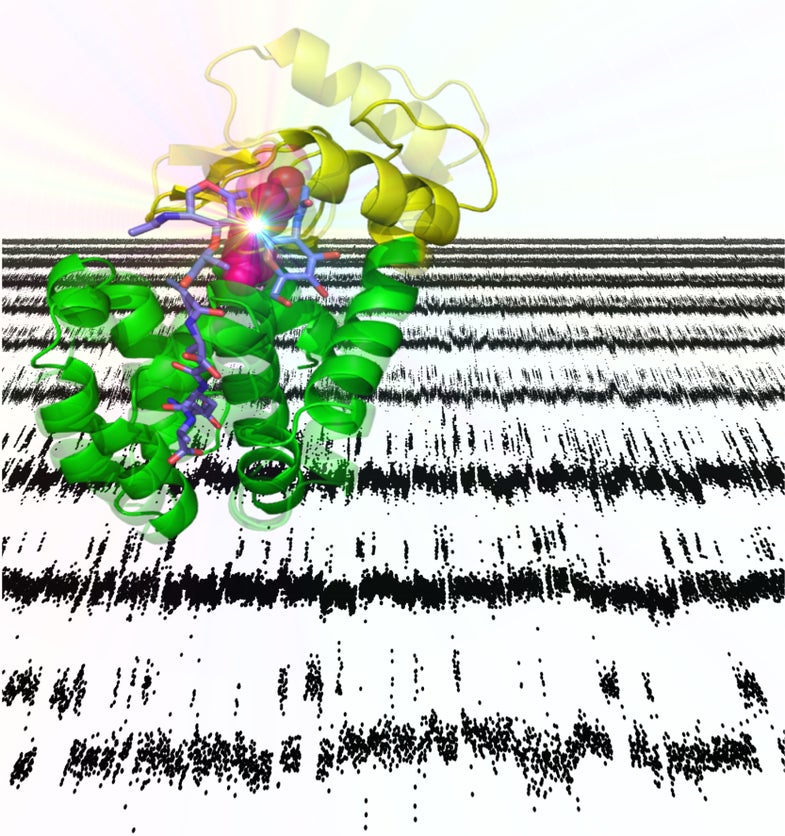
Wiretapping an enzyme and listening as it unfolds could shed new light on the way proteins work, allowing researchers to monitor structural changes over a longer period of time than was previously possible. To do it, scientists tethered a nanoscale transistor to a molecule found in human tears.
Understanding how proteins fold is a key challenge in biology — making synthetic versions is about much more than their molecular contents. Enzymes change their shapes when they bind their molecular targets, and the way in which this happens has some bearing on the way the proteins work. Researchers have even turned to online games to look for novel folds and structures that could be used in drug discovery and other uses.
Biochemists can glimpse these structural changes, but not over long enough time scales to really get a handle on the folding action. Now researchers at the University of California-Irvine say their wiretapping method provides a long-term window into the kinetic behavior of a specific protein.
Yongki Choi and colleagues worked with an enzyme called lysozyme, which is found in human tears and is particularly effective at neutralizing bacteria much larger than itself. They attached the enzyme to a single-walled carbon nanotube, and put the enzyme to work in a reaction assay. The folding and twisting motions induced teeny changes in electrostatic potentials, which the carbon nanotube could detect. Amplifying these signals gave the team a glimpse of the movements the enzyme was making. The team measured these changes in various conditions and over different time scales, they report in their paper, published online today in Science.
“It’s just like a stethoscope listening to your heart, except we’re listening to a single molecule of protein,” said Philip Collins, a co-author on the paper who typically studies physics and astronomy.
Tiny nanotube field-effect transistors have also been used to listen to cells in action.
The team was able to compare the signals to other measurements made with a technique called single-molecule fluorescence resonance energy transfer spectroscopy. They found the enzymatic actions looked pretty similar between the photon signals and the electron signals — nice confirmation.
This is encouraging because the same technique could be used to study many other molecules, the researchers say.