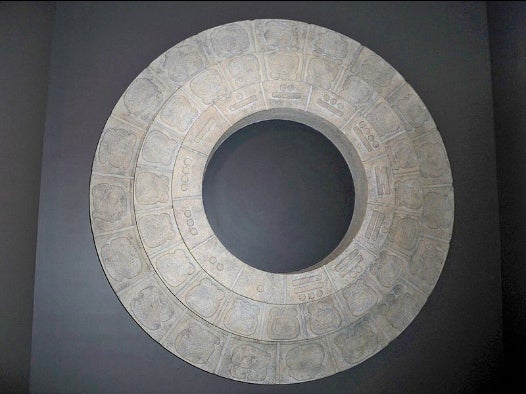
The Mayan Calendar If you squint, you can clearly see the part where it says the world will end in 2012. That's right, keep squinting . . . Smithsonian via Wikimedia

As the calendar turns over to a new year, a couple of researchers over at Johns Hopkins University are rethinking the way we tick off the days during our annual trip around the sun. The duo has devised a new yearly calendar in which each 12-month period is identical to the one before--meaning if your birthday is on a Monday one year, it’s on a Monday every year--until the end of time.

The Hanke-Henry Permanent Calendar--named for Richard Conn Henry and Steve H. Hanke at JHU, the researchers behind the reformed calendar--isn’t just a realignment of the way we count days, but a simplification of the overall economic rhythm of the world. All the time and effort spent adjusting calendars and schedules every year to accommodate shifting days of the week could be saved, they argue. The man hours and money saved by a uniform year would be tremendous.

The calendar consists of the same12 months as the current Gregorian year, but the months have been adjusted subtly to make each quarter exactly 91 days long--two 30-day months and one 31-day month. That means September, June, March, and December would become the long months, while February would gain a couple of days.

Speaking of February, leap years would be dropped from the calendar completely. To make up for the remainder days (each Earth year is 365.2422 days long, and that remainder must be accounted for to keep the seasons from wandering out of sync with the months), Hanke and Henry propose adding a week to the end of December every five or six years to bring everything back into alignment.

In doing so, they wouldn’t disturb the carefully curated order that keeps days of the seven-day week aligned with the same dates each year. That’s key, they say, because most attempts to reform the calendar have failed because of objections to breaking up the seven-day week (it doesn’t matter what Sabbath you celebrate, you still have to keep it holy--therefore, you need that traditional seven-day week).

For all of its perceived benefits the Hanke-Henry calendar still doesn’t explain why the NCAA Football Championship always falls on a Monday night, but nobody’s perfect. There’s a lot more about the concept calendar here, including a proposed timetable for its adoption (the proposed date is Jan. 1, 2017) and an argument for switching to a universal clock that dispenses with time zones, daylight savings, and the like.

40 Comments

That would suck if your B-day was on a Tuesday until the end of time. It would be cool if your b-day was on Friday though....

Or you could make every month have only 28 days and add an extra month. 364 / 28 = 13. Then use the extra day and the leap year to make an extra week from time to time.

since thanksgiving always falls on the fourth thursday of november, that number of day will finally stay the same so it will be easier to predict.
that always confused me. most of every thing has a certian number day to be placed on rather than a certain day of the week.

me likes this new calendar :)

Having my bday on a Sunday to the end of time would really suck too. No thanks. Leave well enough alone. Imagine the difficulties it would be for seniors to re-adapt to a new calendar like this when they have troubles enough with the old one because of dementia and alzheimer's. It's just not a good idea!

"extra week in December"? Isn't that the whole point in leap year with Feb? And I agree with you gizmowiz

I'm a little confused by the "leap week" concept every 5 or 6 years. Currently we add an extra day every 4 years to correct for the .2422 offset (which I guess is really the loss of .7578 of a day every year). Correct me if I'm wrong, but under a leap week system wouldn't you have to add the extra week every 28 years to correct the offset? That is, wouldn't adding an extra week every 5 or 6 years be too much?

@biggin65409

There are 365.2422 days in a year. The way we count it is by accounting for 365 days for three years and 366 days for a leap year. Your math is a little off on account of the Earth's orbital period.
--

Gotta say, I'm not a fan of this idea. The shift of days per year can be inconvenient for scheduling, but the fault falls more in people who go off days of the week rather than specific dates for accountable days. Example: Christopher Columbus landed in the Americas on October 12, 1492. However, each year Columbus day shifts a date based on the day of the week, meaning it could be the anwhere between the 9th and the 11th these days. Christmas is always December 25th but Thanksgiving is not always November 25th. See how confusing that is. Certain days are to be acknowledged by day and others by date. If you know which is which you have less confusion but still must deal with the day shift. The beauty in this is, every other few years you get the opportunity to experience these noteworthy dates on a new day and vice versa.

As for Universal time observance, that is only possible if a Time zone can be universally agreed upon by the rest of the world as the center of time. Greenwich, England could remain the UTC center of the world or it could be something else, something more convenient for the heavier hitting shot callers of the globe. Plus it would involve the surrender of following standard time of day markers. We associate hourly counts with times of day 6am to 7am to wake up (for those of us that work full time), 11pm to 12pm lunch time, 4pm tea time (for the britons out there), etc. Hourly count would be centered to one place of the world, and that would most certainly throw things off before any real normalcy sets in. Such a concept would also create the notion of a light and dark side of the planet. The light side being the side with the UTC mark of the most standard time setting, and the dark side being the non standard off shot time setting area. A universal time is something ample for a spacefaring race with no concept of a rotating planet for the relativistic concept of day and night.

Never mind, as usual I forgot something, since this new year is 364 days long you're really losing 1.2422 days each year 1.2422 x 5yrs = 6.211 and 1.2422 x 6yrs = 7.4532

Just thinking out loud here, but why not just refactor the whole concept of a second is? I mean, wouldn't it be easier if we wanted to keep 365 days a year as well as 7 days a week as well as keep the months static to simply make the second ever so slightly longer? We're only talking about 16.289 seconds a day to absorb. If we change the second to be just slightly longer, approximately .000165 seconds longer, the year/calendar system would be completely static, no need for leap years.
---
In space, no one can hear a tree fall in the forest.

@D13: I agree with your post completely. A universal calendar should be created to commemorate our commitment to the exploration/colonization of space. Maybe we could even derive it from the rate from which we are being expelled from the center point of our universe.

@GMarsack I agree with you on that for sure. Not only would it be imperceptible to any ordinary person (most people don't even know how many seconds are in a day anyways), it would solve this problem in the easiest way of all. That is, if you neglect to account for @D13's comment. If we were to ever leave this planet with the intention of colonization, those people would definitely have to find a way to have a time that does not change and is universally accepted, so that time is not based on rotation, but instead on time itself.

The 28 days for 13 months gives 364 days for a year. If you read the article it also gives a 364 day year. 8 months at 30 days equals 240 days and 4 months at 31 days equals 124, then adding the two together you get 364 days. You then either have one extra day every year with another every 4 years or bundle all of those extra days together every couple of years into a week as described in the article. No matter how you look at it even with the current calendar you do not get perfectly even days per leap year. The 0.2422 combined every four years still falls short of 1.0000. The Earth's rotation is slowing at a rate that none of us should be able to worry about the day the Earth's rotation is 365.2501 days per year. By that time we will have invented some crazy technology to change the rotation of the Earth anyways to be exactly one 24 hour period of time and altered the revolution around the Sun to exaclty 365 or 364 which every suits our current political system of the day.

@GMarsack @witstab1

if you increase the length of a second by 0.000165 you increase a 24 hour day by 16.289 seconds as you state. this solves the leap year issue but you have to account for the earth's orbit around the sun (a year) whilst also accounting for its axial rotation (a day). after just one year, midnight on 1st january will have moved by 5945.485 seconds relative to the previous year, or 99.091 minutes (1 hour 39 minutes). after seven years, midnight on 1st january will be 11 hours and 34 minutes (give or take) later than it was seven years previously at the start of your adjustment. it is now midday for all intents and purposes - the sun is roughly at its zenith in the sky, and yet our clocks tell us it is midnight. that is why adjusting the length of a second is not suitable for compensating the discrepancy of an orbital year. you get me?

@roobs12345 ok. that actually makes a lot of sense and i see exactly what you mean. When @GMarsack posted i only read it and thought it was reasonable. I'm glad somebody here isn't as lazy as i am, or we'd b having midnight at midday. next time i'll start actually checking what i'm agreeing too.

I have this incrediable desire to spin that wheel and see if how lucky I can be!;)

.............................
Science sees no further than what it can sense.
Religion sees beyond the senses.

Oh I GET IT! YOU ALL WANT TO REPROGRAMM A COUPLE OF BILLION COMPUTER BIOS's??? How the FFFF are we going to get around that? The current system works and no-one cares simply because it WORKS!!! Dont you get it??? It doesn't WORK changing the calendar. Because you cant FIX something that ISN'T BROKEN!

On a side note:
I have heard it said that the same culture that made this Mayan calendar also did not possess the technology of the wheel. I wonder how long it took for Mayans\human-mind to connect the dots in their minds of the usefulness of the wheel as they staring this calendar.

Obviously they knew how to make a round object.

There are tools and then there is the knowledge of creating the tools and how to use them.

Those who made the great pyramids around the world had the knowledge and the tools and as they left society, they took their knowledge and tools with them.

.............................
Science sees no further than what it can sense.
Religion sees beyond the senses.

Before debating about Pros and Cons of this proposal the US should make up their mind and change their obsolete system of miles, inches, ounces and 12 hour time system to save billions of dollars spent for annoying conversions into the SI system. If done earlier they could have avoided a mars probe crashing by flying too low due to a unit conversion issue … (ROFL)

I actually really like the idea. I don't care what day of the week my bday is. I always celebrate it on the weekend before or after, whichever is closest. For me, the real benefit is that scheduling becomes way easier. If my bday is always Tuesday, then I know I'm celebrating my bday on May 29th, always.

I do this with all holidays and bdays currently. Also, events, like conventions or rallies, that are held around labor day or memorial day weekends can be fixed in place. Most of these events are held on "friday-sunday/monday of the closest weekend to the holiday".

I like simplicity. And if my calendar is more easily managed, and I don't have to clone my bday/holiday calendar events to match weekends every year - I just use the same calendar that I used last year... Then I'd be happy camper.

That said, I do understand your points of view. But I'm ready to jump on this bandwagon!

Makes Alot of sense, but then again... so does the metric system and us americans have been unwilling to change to that for decades.

I had this idea of a 13th month system. The first 12 months would have 30 days each, and the 13th month would be the remaining days plus the error of our Earth's leap years. The 13th month could be used for something like prepping for the new year.

*I just realized this now, people tend to think 13 is an unlucky number.*

Its simple really, let stupid be stupid, the better will prevail the other go extinct... :D

Any of these suggestions would be an improvement (personally I would like the 13-month calendar, anyone who doesn't like the number 13 is unamerican). But the problem would be how to make the transition. It seems like we should be able to reprogram all the computers, since we have to anyway every time Congress changes daylight savings time.

Speaking of 13 as an unlucky number, did anyone notice that according to this calendar, there would be four "Friday the 13th" days every year, to include one every October?

I have long wished for a "Deca-time" system.
1.Divide the true earth day (point where some earth location is lined up to some other point, for instance, Greenich to the Sun)into ten equal periods, for a "true" hour, divide that by 100 for the new minute, and that by a ten or 100 for the new second.
2. Think of the time per manhour calculations that could be easily translated. How about seconds per dollar?
3. This would enable a true metric latitude/longitude
co-ordinate system for navigation, on this planet, and on any other heavenly body.

I'll be the IDEA MAN, someone else has to be the DO GUY.

Time isn't constant, it is relative and is affected by velocity and gravity time dilation, which is why I suggested it to be based on the rate of universal expansion.

But since the reasons for an accelerated universe is still a mystery(dark energy, anti-gravity, or whatever). I guess we still needed a broader understanding on particles (such as the Higgs Boson) and how they interact with each other, before we can create a definitive set of rules to govern relative time frames.

Or maybe we could just base UST by gauging the radioactive decay of stable isotopes.. whichever is most applicable.

cr4p. I just noticed I wrote 'stable' instead of 'unstable'.. My bad.

What if as you read this calendar, rather than read it clock wise, we are suppose to read it counter clock wise or maybe from other device to augment the calculation of the days?

How do they know what day was the 1st day?

Does another piece fit inside the center of this calendar and they have not found it yet? Sure took a lot of effort to carve out a circular center.

Why care about time any longer than one life time? What is the purpose of making a calendar that can project so far into the future, if the originator\creator of this calendar will never experience that time frame? Why does the originator\creator of this calendar believe we need to know about these important dates in the future?

Why didn't they make much more of these types of calendars? What is the significance of the location of this calendar?

At the time frame this calendar was created, what other cool things did they make too?

..........................................
See life in all its beautiful colors, and
from different perspectives too!

I don't agree with 28 years between leap years. This will cause more havoc than anything saved by the "equal year" concept.

biggin65409 has got it right. There should be 13 months of 4 weeks each with leap years as already established. If you really wanted to maintain the day of week issue, then Leap Day would be special, not any of the normal Sunday to Saturday names and it could be a special holiday so it doesn't interfere with normal work schedules.

When did the Mayan Calendar start? or what was the inception of the Mayan calendar?, Can someone tell me the inception year in BC or AD. Gracious.


June 2013: American Energy Independence

Five amazing, clean technologies that will set us free, in this month's energy-focused issue. Also: how to build a better bomb detector, the robotic toys that are raising your children, a human catapult, the world's smallest arcade, and much more.


Online Content Director: Suzanne LaBarre | Email
Senior Editor: Paul Adams | Email
Associate Editor: Dan Nosowitz | Email
Assistant Editor: Colin Lecher | Email
Assistant Editor: Rose Pastore | Email

Contributing Writers:

Kelsey D. Atherton | Email
Francie Diep | Email
Shaunacy Ferro | Email

circ-top-header.gif
circ-cover.gif