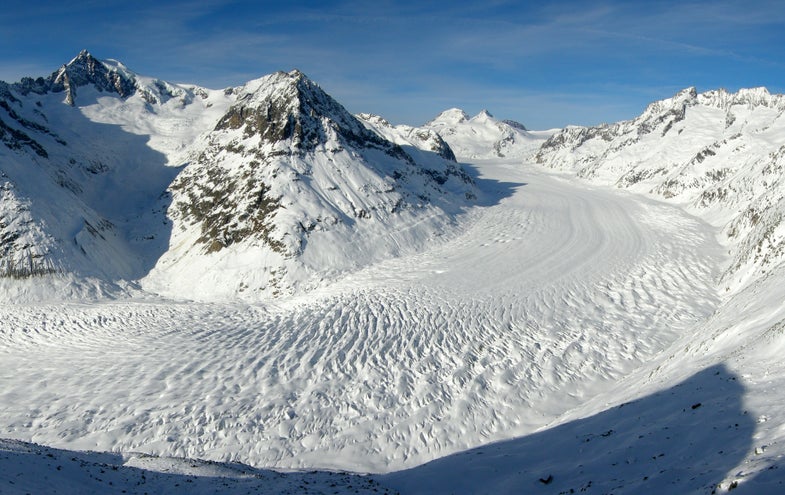
Earth could be entering a new Ice Age within the next millennium, but it might not, the deep freeze averted by warming from increased carbon dioxide emissions. Humans could be thwarting the next glacial inception, a new study says.
Even in the comparatively long time scales of Earth history, we’re kind of overdue for another ice age — our current Holocene era has lasted about 11,600 years, roughly 600 years longer than the average interglacial (between-ice-age) periods of the past. If atmospheric CO2 levels were lower, the next ice age might have started sometime within the next 1,000 years, according to researchers from University College London and Cambridge University.
Their conclusion is based in part on abrupt temperature changes in the overall temperature contrast between Greenland and Antarctica, according to a Cambridge news release. The North Atlantic would cool rapidly while Antarctica warms, fluctuations that would only happen if expanding ice sheets were calving icebergs huge enough to impact ocean circulation. These temperature see-saws can therefore be used to pinpoint the activation of a new ice age, a “glacial inception.”Chronis Tzedakis from UC London and colleagues examined our present conditions, including temperature averages and solar radiation strength, and found a close analogue to the present, an era called Marine Isotope Stage 19, or about 780,000 years ago. The eras have a similar astronomical configuration and climate, although their CO2 trajectories are pretty different (ours is on the rise).
A phenomenon called insolation was a key factor here. Insolation is the seasonal and latitudinal distribution of solar radiation, which changes a tiny bit over tens of thousands of years due to tiny variations in Earth’s orbit around the sun. These little differences are one of the factors that can help trigger a cooling event, cascading toward an ice age. The insolation minimum in the MIS19 era was similar to our own, so it’s a valid analogy, the researchers say.
The team applied their glacial inception fingerprinting method to MIS19, looking at ice core samples, plankton remains and debris that would have floated on the encroaching ice, and determined at what point the glacial inception would have started. Then they compared that time frame to the Holocene time frame.
“Taking the [current era] to MIS19c analogy to its logical conclusion implies that the current interglacial would be nearing its end,” the researchers write. If, that is, atmospheric CO2 levels were comparable to the MIS19 era. Which they aren't. This shows that while insolation is an important ingredient, apparently it’s not as potent an ice age determinant as CO2.
“The current insolation forcing and lack of new ice growth mean that orbital-scale variability will not be moderating the effects of anthropogenically induced global warming,” the authors conclude.
The paper is published in the early online version of Nature Geoscience.
Five amazing, clean technologies that will set us free, in this month's energy-focused issue. Also: how to build a better bomb detector, the robotic toys that are raising your children, a human catapult, the world's smallest arcade, and much more.


Online Content Director: Suzanne LaBarre | Email
Senior Editor: Paul Adams | Email
Associate Editor: Dan Nosowitz | Email
Assistant Editor: Colin Lecher | Email
Assistant Editor: Rose Pastore | Email
Contributing Writers:
Rebecca Boyle | Email
Kelsey D. Atherton | Email
Francie Diep | Email
Shaunacy Ferro | Email
of course the University College London and Cambridge University, NASA, NSF, NOAA, and every national scientific institute on the planet are wrong...cheers
Seriously drchuck1, you can't expect science to stop just because a particular view is politically popular. There isn't now and never will be "settled science". All ideas are subject to new observations and new proposals. This one is just one interpretation of the data, just like AGW, and all ideas have to stand on their own and will one day fall. It's a feature, not a fault of science.
One volcanic eruption can generate more C02 than the total human CO2 output in a year. We cut down on our CO2 and a couple volcano's erupt and there goes all of our hard work... I feel like it is pointless to even try...
^^Nvm my above comment...
CO2 is NOT a green house gas. I am sick and tired of articles coming from supposedly a reputable publication but as time passes it is CLEAR Popsci is NOT!!!
CO2 is a greenhouse gas. Current greenhouse gases in Earth's atmosphere are CO2, nitrous oxide, methane, O3 (ozone), and water vapor.
and other study will contradict this one in 6 months
"BrianKeithY", I neither think that CO2 is a greenhouse gas; it is food for our vegetation, but when you mix CO1(carbon monoxide) and other noxious chemicals from burning a great abundance of fossil fuel like we are doing now, that makes it a greenhouse gas and it should be called something else other than just CO2. If we had as much CO2 in the air as the political incorrect GOP say we do, then we should have an incredible amount of vegetation and the trees should be ten, maybe 20 times bigger than they are now.
We humans are altering the natural cycle of the Earth with the burning of fossil fuels and we will pay a terrible price for doing so. If the Earth cannot go into another ice age and heal itself, then we humans will pay the price.
seriously caricue, i doubt that nearly the entire scientific comunity that sees this as being caused by human activity has stopped studying climate change, oh, actually they haven't...anyone that thinks CO2 is not a greenhouse gas needs to take a basic science course, cheers
First off, CO2 is definitely a greenhouse gas, however it's a minor one as water vapor represents over 95% of total greenhouse gases.
CO2 exists in the atmosphere in such small quantities, that the very idea of man made CO2 being a major driving factor in climate change is absurd on its face. Water vapor comprises 95% of all greenhouse gasses (clouds, humidity etc) CO2 represents well under 5% by comparison. CO2 accounts for only half of one percent of our entire atmosphere. The man made portion of that CO2, coming from our use of fossil fuels however, only represents about 4% of total CO2. That means that the amount of man made CO2 in our atmosphere is roughly 16ppm, or one part in 62,500. It’s simply absurd to think that such an infinitesimal amount of a beneficial trace gas is in any way a threat to our planet.
But the fact is that CO2 is not a pollutant, it’s plant food, and without it nothing would be green. Can too much of it be harmful? Of course it can, anyone who saw the movie “Apollo 13” knows that it can, but are we anywhere near approaching that point? The answer is no. With a current atmospheric CO2 concentration approaching 400ppm (parts per million) we’re not even close. Crowded nightclubs and submarines routinely have CO2 levels approaching 8,000ppm, a full 20 times the levels in our atmosphere.
The truth is that temperature change drives CO2 concentrations, not vice-versa as the climate alarmists claim. The primary cause of climate change is the constantly changing cycles of solar activity: In other words: It’s the sun stupid!
The ultimate irony of this nonsense is the fact is that Warming is good!
Think about that for a moment. Throughout human history, man has always thrived during the earth’s warm periods, and suffered and starved during the earth’s cold periods. Why? Simple, because crops don’t grow well when it’s cold. While we’ve warmed up somewhat since the end of the Little Ice Age, the earth is still relatively cool in relation to the actual temperature history of the last ten thousand years. The truth is that there’s absolutely nothing whatsoever unusual about our current climate. In fact contrary to the claims of the climate alarmists, we’re entering what promises to be a somewhat extended cooling period that threatens to be significantly colder than the 35 year cooling period from the 1940’s thru the mid 1970’s, during which, parenthetically, our use of fossil fuels was increasing at the greatest rate in recent history.
fs
like people have been saying, there is really next to no point to discuss global warming finds because they are always contradicting themselves within the next few months.
As humans we strive to know everything, and being that we cannot understand the nuances of nature, we will constantly be thinking we understand, then finding out we were wrong.
Just pay your carbon taxes. Al gore will save the polar bears.
I love this "study"! Climate scientists readily admit that they don't know why or how ice ages happen, and they have no mechanism for predicting the next one, but now these scientists say that we're delaying the next ice age. Proof yet again that global warmists not only do bad science, they pervert science to suit their agenda. Good stuff.
It's a good thing Swemson is here, I was a little worried there for a second.
After all it's silly to think that humanity could ever affect the environment in any way. It's probably silly to think that an environmental change towards warmer or cooler will bother us. I mean there maybe a small adjustment, but who would notice a percent or two out of 7 billion. I mean that's only 70 million maybe 140 million dead, tops.
Swemson's right. We're being silly for even contemplating the effects of climate change.
It is pretty well established that the obliquity of the earth's orbit triggers the end of glacials although not every 41000 years. Recently (past million years) only about every third nudge from obliquity has ended a glacial period, probably as the ice is finally thick enough to be unstable and to have accumulated a large enough load of clathrates to trigger a run away warming once melting has started. In the interglacial, carbon sinks, not the least of which is the accumulation of a hundred meters or so of coral, remove Carbon from the atmosphere. We then slide into a glacial. The worry today is that we will have a rather sudden warming jump as masses of methane clathrates disintegrate. This will shift the growing areas of our major grain crops. No problem for Giya but human populations will experience epic starvation. It is pretty certain that our carbon emissions have put off the slide into a glacial but too much would also cause huge disasters.
Since ~1971 leaders of nations and experimental sciences compromised observations in an attempt to control reality. Like us, they can only change things inside their own ego cage: Cause-and-effect controls things outside - in reality.
A few of many experimental observations that undercut AGW claims:
Earth's heat source is variable: The pulsar remains after making and spitting out fresh and highly radioactive debris from the supernova explosion that gave birth to the Solar System five billion years (5 Gyr) ago [Phys. Rev. Lett. 4, 8-10 (1960); ibid, 351-354 (1960); Nature 187, 36-38 (1960); Science 174, 1334-1336 (1971); Nature 240, 99-101 (1972); Trans. MO. Acad. Sci. 9, 104-122 (1975); Science 195, 208-209 (1977); Nature 270, 159 - 160 (1977); Science 201, 51-56 (1978); Geochem. J. 15, 245-267 (1981); Meteoritics 18, 209-222 (1983); Astron. Astrophys. 149, 65-72 (1985); Meteoritics Planet. Sci. 33, A97 (1998); ibid., 33, A99 (1998); J. Fusion Energy 19, 93-98 (2001); 32nd Lunar Sci. Conf., paper 1041, LPI Contribution 1080, ISSN No. 0161-5297 (2001); J. Fusion Energy 21, 193-198 (2002); National Geographic Magazine, feature story: "The Sun: Living with the Stormy Star (July 2004)].
With kind regards,
Oliver K. Manuel
Former NASA Principal
Investigator for Apollo
Swemson, can I get your source for water vapour being 95% of the atmosphere's greenhouse gases?
According to the wikipedia page:
The atmospheric concentration of vapor is highly variable, from less than 0.01% in extremely cold regions up to 20% in warm, humid regions.[50]
As well as:
The average residence time of a water molecule in the atmosphere is only about nine days, compared to years or centuries for other greenhouse gases such as CH4 and CO2. Thus, water vapor responds to and amplifies effects of the other greenhouse gases.
Which seems to suggest the prevailance of water vapour only adds to the impact of CO2 and other greenhouse gases. It's more like a catalyst, rather than a reactant itself.
But again, I'm just curious about your source -- do you have one in particular?
I also want to know your evidence that the sun is going through a warmer period now. From what I understand, the sun is actually going through a cooler period, rather than a hotter one.
Here's my source:
http://www.skepticalscience.com/solar-activity-sunspots-global-warming-advanced.htm
Exerpt:
Therefore, the solar forcing combined with the anthropogenic CO2 forcing and other minor forcings (such as decreased volcanic activity) can account for the 0.4°C warming in the early 20th century, with the solar forcing accounting for about 40% of the total warming. Over the past century, this increase in TSI [Total Solar Irradiance, or energy output] is responsible for about 15-20% of global warming (Meehl 2004). But since TSI hasn't increased in at least the past 32 years (and more like 60 years, based on reconstructions), the Sun is not directly responsible for the warming over that period.
Foster and Rahmstorf (2011) used multiple linear regression to quantify and remove the effects of the El Niño Southern Oscillation (ENSO) and solar and volcanic activity from the surface and lower troposphere temperature data. They found that since 1979, solar activity has had a very slight cooling effect of between -0.014 and -0.023°C per decade, depending on the data set (Table 1, Figure 3).
----------------
"Extraordinary claims require extraordinary evidence." - Carl Sagan