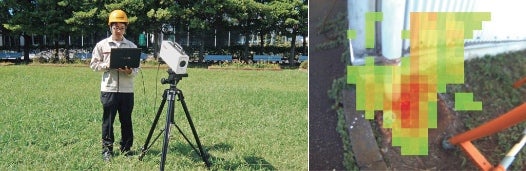
Tracking down radiation hotspots is tricky and time consuming because it’s hard to see where the problem areas are. Radiation doesn’t spread itself evenly over an area, and as such it can be hard to find the spots within a contaminated area that require cleanup and differentiate them from the places that do not (typically this is done by walking around waving a handheld meter around, a process that is really, really slow). To simplify the task, Toshiba has developed what it’s calling a Portable Gamma Camera that mashes up gamma ray data with image data to create visual radiation heat maps on the fly.
The camera itself is the size of a large camcorder and records both image data through a normal camera sensor and radiation data via embedded semiconductor detection elements built into the camera. Then, via a signal processing device, it combines the two into a single image that superimposes the radiation data onto the visual image on the camera’s display.
Color coding like a weather map (red for “danger” down through oranges and yellows to greens for “okay”) tells the user where radiation is the highest and how high it is, allowing workers to quickly survey an area and mark it for cleanup. It also serves as a fast and efficient way for cleanup crews to check their work and make sure they’ve completely cleared an area of all radioactive hotspots before moving on.Toshiba will field trial the Portable Gamma Camera in collaboration with Fukushima City in Japan this month. If all goes well, the camera could go into regular use within Japan’s central and local governments early next year.
[Tech-On]
Five amazing, clean technologies that will set us free, in this month's energy-focused issue. Also: how to build a better bomb detector, the robotic toys that are raising your children, a human catapult, the world's smallest arcade, and much more.


Online Content Director: Suzanne LaBarre | Email
Senior Editor: Paul Adams | Email
Associate Editor: Dan Nosowitz | Email
Assistant Editor: Colin Lecher | Email
Assistant Editor: Rose Pastore | Email
Contributing Writers:
Rebecca Boyle | Email
Kelsey D. Atherton | Email
Francie Diep | Email
Shaunacy Ferro | Email
Excellent! I hope Japan does get all cleaned up! Seems like awesome useful technology!
An interesting innovation, but I dont see how this would speed decon up in any considerably.
Because this camera directly detects the radiation at the same location as the lens (based on the article), the camera itself has to be close enough to be in a measurable radiation field. that places the worker on the ground with the camera, looking for hot spots.
I would see more benefit in this tech as a follow up tool to traditional surveying equipment. Find an area with elevated doses using your GM (Geiger Mueller) and use this camera to quantify the hot spot at higher resolution using the camera. As the linked article mentions, a big plus is verifying a reduction in contamination after decon.
this is a big step up from gieger counters.
@iambronco The Toshiba device looks like a pinhole type imager, thus probably does not have high sensitivity.
The GammaCam (www.GammaCamNow.com) is currently in the field at Fukushima also. The GammaCam uses a different architecture and is much more sensitive. Depending on the strength of the sources, the camera can operate at virtually any distance from the source. A typical scenario might be to image an area at a distance of 20 meters to identify the locations of the hot spots. The key difference in operation as opposed to a point sensor such as a geiger counter, is that the camera (and the operator) are positioned away from the source and do not incur the accumulated dose that someone surveying the same area with a point sensor would get.
Using the GammaCam as a precursor to a conventional survey has been shown to dramatically lower man-rems (and dollars) in a decon project. As an example, Main Yankee used the GammaCam in their Hot Spot reduction program and reduced total project exposure by 150 person-rem.
Maybe this could be a step towards creating the means to interrupt different areas of the waves of radiation, yielding possibly better shielding, or maybe something like counter wave emitters.