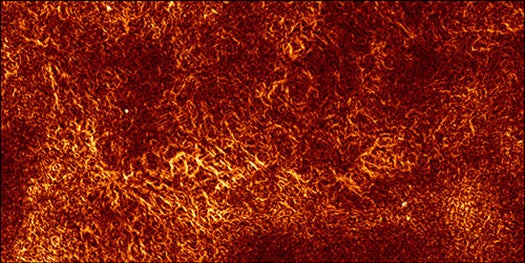
This chaotic image, published in the journal Nature, has been described as a "pit of writhing snakes." Using the Australia Telescope Compact Array, researchers studied the interstellar regions in the Norma constellation, 10,000 light-years away. "This is the first time anyone has been able to make a picture of this interstellar turbulence," says lead author Professor Bryan Gaensler of University of Sydney. The image shows that the space between stars is actually full of continually churning gas.
The telescope picks up radio waves, and the data used to create the image is actually 12 years old. The unpolarized radio emissions from the region give a normal picture of the Milky Way disk, with bright areas around forming stars caused by cosmic rays and magnetic fields. "But when we studied the polarized emission, we saw structures that were completely different from the pictures that have been done before," says Professor John Dickey of the University of Tasmania. "It took several years for us to understand the physical processes that shape the linear polarization at radio frequencies."
Five amazing, clean technologies that will set us free, in this month's energy-focused issue. Also: how to build a better bomb detector, the robotic toys that are raising your children, a human catapult, the world's smallest arcade, and much more.


Online Content Director: Suzanne LaBarre | Email
Senior Editor: Paul Adams | Email
Associate Editor: Dan Nosowitz | Email
Assistant Editor: Colin Lecher | Email
Assistant Editor: Rose Pastore | Email
Contributing Writers:
Rebecca Boyle | Email
Kelsey D. Atherton | Email
Francie Diep | Email
Shaunacy Ferro | Email
Well this picture colors and scary snake like pit is perfect for this month with Halloween coming up soon! Creep and spooky! Woooo...
Attention folks. This is your Captain speaking. We're just under 1.3 parsecs from our final destination. We've just lost our primary buffer panel on our pulsar pass so we might experience slight to stellar turbulence then explode.
Firefly!
I adore that series.
I am sad it ended so quickly.
I guess we really will be needing those deflector arrays in the future after-all. Scotty to the drawing board!
Some people see snakes.
To me it’s just looking into deep into a giant pot of tomato sauce and spaghetti, yummy!
I think, I will go to the kitchen now and see what’s in the cabinet, bu-bye.. ;)
I don't see any snakes. To me it's just looks random.
Every time I read this article, I get that "Ut-O! Spagettos" jiggle going in my head, lol.
Seriously, it is just fascinating that data used to create the image is actually 12 years old. They also went on to say,"... it took several years for us to understand the physical processes that shape the linear polarization at radio frequencies...”
I really appreciate the patience and tenacity of these scientist, researchers and professors!!!!
WELL DONE SIRS!!