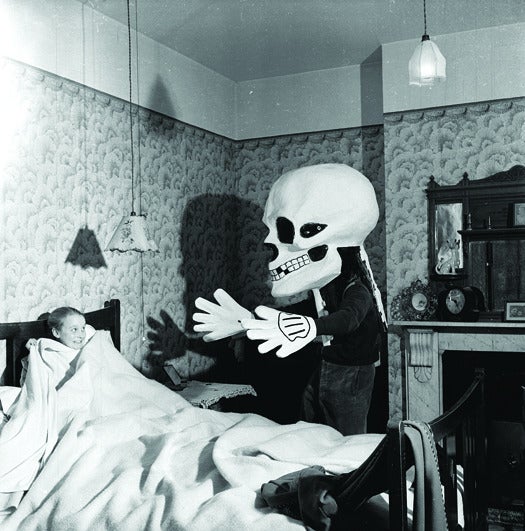
For the same reason cats fluff up when they’re threatened. “The general principle is, if you are going to be attacked, try to look as big as you can,” says David Huron, a musicologist at Ohio State University. People don’t have as much hair as cats, but goose bumps are a holdover from when we were furrier.
Hair-raising itself began as a response to cold. When hair stands on end, it traps an insulating layer of air around the body. But at some point millions of years ago, one of our chilly, puffed-up ancestors scared away a would-be attacker, and hair-raising was slowly established as a useful defense mechanism. The heritage of this physiological response explains why fear is associated with cold. Puffing up was a matter of temperature first and fear second—but you can still get shivers down your spine when you’re scared, Huron says.
The upending of our expectations can give us chills, too, Huron says. And shivers can crop up when we feel any sort of surprise or intense emotion, even in music: a change in volume or the moment a singer begins singing. People usually get the chills at tonally “sad” passages, says Jaak Panksepp, a neuroscientist at Washington State University. He also hypothesizes that certain tones in music mimic a “human separation cry,” and that shivers result from the perception of losing a loved one. The same moment in the same song can give someone chills over and over again—the response resists habituation, Huron says. “The brain can tolerate thousands of false alarms in order to protect us from the one occasion when the alarm is real,” he says.
Which is why when we know we are safe—at a scary movie, for example—those false alarms can be a source of pleasure. “One part of your brain is saying, ‘Oh my god, I’m gonna die!’ ” Huron says. “But the conscious part is saying that everything is OK. Which makes shivers feel good.”
Have a science question you've always wondered about? Send an email to fyi@popsci.com
Five amazing, clean technologies that will set us free, in this month's energy-focused issue. Also: how to build a better bomb detector, the robotic toys that are raising your children, a human catapult, the world's smallest arcade, and much more.


Online Content Director: Suzanne LaBarre | Email
Senior Editor: Paul Adams | Email
Associate Editor: Dan Nosowitz | Email
Assistant Editor: Colin Lecher | Email
Assistant Editor: Rose Pastore | Email
Contributing Writers:
Rebecca Boyle | Email
Kelsey D. Atherton | Email
Francie Diep | Email
Shaunacy Ferro | Email
Shiver me timbers, I feel a tickle and a giggle after being spooked?
The article suggests my goose bumps are an angry response defense mechanism and millions of year ago would scare away the monsters. Um, my teeth can be scary, my hands with a weapon can be scary, my hands if I am strong can be scary too. Goose bumps and hair standing up are considered scary? I do not think so.
I suppose, if I am having a bad hair day, I can scare away a date.
@Q Anthropologically speaking yes, appearing larger is generally a deterrent, look at all the examples in the animal kingdom, not just hair, some snakes puff up before they attack (i'm think King Cobra), etc...
This article actually puts a lot of things in perspective for me. Also explains why I don't like those scary false alarms, my consciousness is very good at forgetting itself, but it makes it wonderful in music. I wonder what tones the author is speaking about when mentioning the separation cry. More info please?
All this time i thought it was to heighten the sences of touch.
jmadrigal12,
No, actually you are a dangerous goose bumpy monster getting ready to terrify the neighborhood with your big fuzzy crazy hair!
great article. i did not know that.
_________________
The people of the world only divide into two kinds, One sort with brains who hold no religion, The other with religion and no brain.
- Abu-al-Ala al-Marri
This totally makes sense. Lets use the cat example. When they arch their backs, and their fur stands up, how many people with common sense would reach out to pet them? Our natural instinct is to pull back, because we "know" that if we continue, our hands might look like ground meat when we pull back.
So if we had more hair, like the caveman was thought to have, when they got their goose bumps, their hair would stand on end, thus warning potential enemies that they might not come back whole if they pursue their actions.
This article is at best a weak explanation. Why on earth would we keep a defense mechanism that has been utterly useless for all of recorded human history?
Goosebumps are known to occur when a person is cold or experiences fear, nostalgia, pleasure, awe, admiration, sexual arousal or other strong emotions. When we experience any of these, adrenaline is pumped through our body and effects virtually every tissue in it.
When we are scared, the expanse in muscle tissue caused by adrenaline does far more to make us appear larger than the resulting goosebumps. Adrenaline causes a subdermal reaction (the expansion of muscles) as well as an epidermal reaction (goosebumps). Its the subdermal reactions that have the larger consequences - the expansion of muscle tissue is the defense mechanism, not the goosebumps.
But this is all obvious! Why people insist on throwing out sensible explanations so they may replace them with evolution nonsense I care not to know.
Sorry to be the arrogant arse of the group, but someone has to do it.
@NoOneYouKnow
What you say is true, but in a organism such as ourselves that have little to no muscle compared to that of wild animals, a slight increase in muscle size wouldn't do much to deter, say, a cougar. However, if we where to double our body size with fur I'm pretty sure said cougar would think twice.