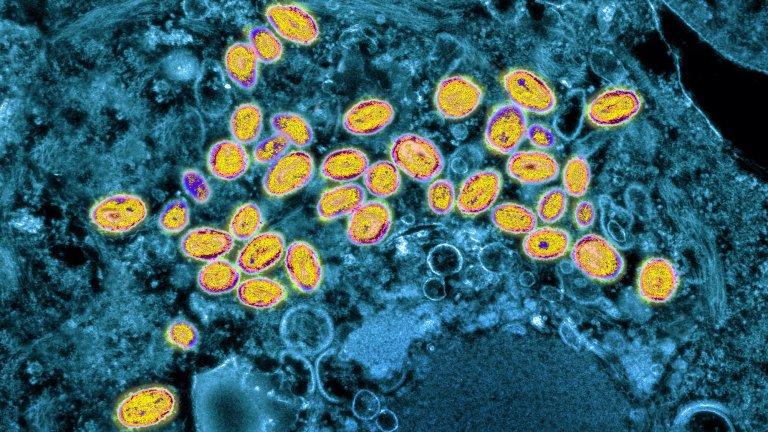
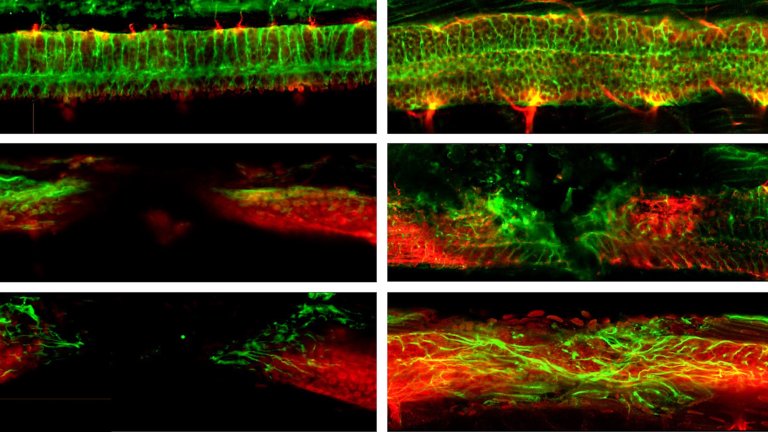
Virus Therapy In the left set, rhinovirus (the common cold virus) kills untreated human cells (lower left), whereas DRACO has no toxicity in uninfected cells (upper right) and cures an infected cell population (lower right). Similarly, in the right set, dengue hemorrhagic fever virus kills untreated monkey cells (lower left), whereas DRACO has no toxicity in uninfected cells (upper right) and cures an infected cell population (lower right). MIT

A new broad-spectrum treatment for viruses could be as effective as antibiotics fighting bacteria, MIT researchers report. The method uses cells’ own defense systems to induce invaded cells to commit suicide, preventing the spread of the virus. In lab tests, the new drug completely cured mice that had been infected with influenza.

Viruses work by inserting themselves into a cell and hijacking its machinery for its own use. The invaded cell then creates more copies of the virus, which involves creating long strings of double-stranded RNA — which contains the virus’ genetic material, like DNA contains ours.

When the virus is done copying itself, its hostage cell usually dies, from the virus bursting through its walls (lysis), changes to the cell’s outer membrane, and from apoptosis, or programmed cell death.

Human cells have plenty of defenses against viral invasion, including proteins that attach to the double-stranded RNA, preventing the virus from replicating itself after successful invasion.

This new drug therapy combines those dsRNA proteins with a protein that induces apoptosis. It’s called a DRACO, Double-stranded RNA Activated Caspase Oligomerizer.

When one end of the DRACO binds to dsRNA, it signals the other end of the DRACO to induce cell suicide, an MIT News article explains. In this way, the cell is killed before the virus can take over and eventually kill it anyway. If there is no dsRNA, the healthy cells are left alone.

“In theory, it should work against all viruses,” said Todd Rider, a senior staff scientist at MIT’s Lincoln Laboratory who invented the new technology.

A handful of drugs can target specific viruses by interfering with their replication process, through addition of modified DNA building blocks or the blocking of enzymes the viruses need to stimulate the replication process. But viruses are wily bugs, and they can evolve to resist these treatments.

The DRACO therapy could be effective because it targets the host cell, not just the virus.

Rider and colleagues are testing DRACO against more viruses in mice, according to MIT. Rider hopes to license the technology for trials in larger animals and for eventual human clinical trials, too.

[MIT News]

17 Comments

Very interesting.

They'll research it for 20 years and then some company that makes an expensive AIDS drug will buy the licensing and the public will never see it.

@corwinb

I wish I could disagree with you...

Amazing, something that should be fast tracked. And then stockpiled at various places in case of ebola, etc. Trick is to get it in you soon enough.

@corwinb
It is sadly true. Patents on drugs should be modified or regulated somehow. We need a better payoff for the researchers to continue while making the drug available quicker and cheaply.
Either way the past decade or so has made some outstanding advances in medicine. I believe we are nearing a new era where (at first the rich) we have little illness or disease in the world. Got a genetic deformity? There is a pill for that. My only question is are we actually ready for this era as a civilization.

This is awesome! Any advances in improving people's health is great! Whatever helps to eliminate diseases or disabilities is awesome! My little brother had a stroke while he was in my mothers womb. It caused him to have very limited use with his left side. It also affected him mentally too. Another complication the stroke brought is that he gets extra sick whenever he gets sick. Something like this seems like it would help him out in not getting as sick. I mainly wish though that something could be made/discovered to allow him to use his left side more/completely and to reduce his mental disability if not eliminate it!!!

if a virus can become resistant to new treatments, then cant the cell also become resistant after a period of time?

This is interesting but I am curious to know what it would mean to the evolution of mankind? We have been mutating through viral infections as well as erroneous copies of our DNA. Nevertheless, viruses have contributed greatly to our evolution. If we kill off infected cells before they have the chance to rewrite our DNA will it be beneficial to our future or will it slow down evolution? Would we evolve into one species or another whether we take the treatment or not? Or will we have transformed ourselves into cyborgs with the help of nanotech well before we have the time to undergo noticeable mutation into another species?

It's amazing how every other time scientists make another leap forward with biotechnology, it's based at least in part on what nature has already engineered. Makes me wonder what else we'll find as we gain the ability to look even deeper into how nature works. Wouldn't it be ironic if our most advanced robotics in the future were based upon natural, organic mechanisms?

@extremechiton

I wouldn't think so, seeing as it's using the cell's own built-in defense mechanisms to make the treatment work. Unless our own DNA mutated to change how the cell defenses work, this should continue to be an effective process.

@Ruce007

Isn't evolution mainly the result of mutation, though, not of having our DNA be partially rewritten by viruses? Besides that, I don't see where evolution really matters to the survival of the human species. Our ability to survive will hinge upon our mechanical adaptability, not our pure biological adaptability. That's what makes us human. Or cyborgs. LOL

This reminds me of a documentary I watched the other night on Netflix, "Transcendent Man". Ray Kurzweil talks about approaching the human genetic code was we would any computer code. When you look at the human genetic code as a program, you realize that modern society is evolving faster than our genetic programming can keep up with. Technology is evolving so quickly because we are constantly looking for ways to increase programming and hardware efficiency; all the while humans are forced to keep running on outdated software. He goes on to demonstrate some pretty astounding figures that shows human evolution vs computer evolution. If you are an avid fan of articles and discussions here, I would highly recommend you check it out.

the way i see it is, the drugs that are truly good for us never see the selves or the light of day. but the drugs that make us walking zombies and addicts are gonna always be there and sadly we keep buying them for the rest of our lives. im talking bout drugs like Zoloft, Ritalin, Prozac etc.

@RobWiki

thanks for the insight i will surly check the movie out.

T-Virus?

It's doubtful that this kind of treatment could be restricted the same way that other technologies are. China, India, and Brazil have already demonstrated that they are willing to break patents when drug companies charge exorbitant fees that their citizens cannot even remotely afford, and the alternative is that many people in their countries will die. A treatment like this, already publicized by MIT Lincoln Labs, therefore would likely be something that others could easily and even cheaply replicate.

BTW, I hope it's as effective as they claim. I suspect that it won't be because I suspect that not all viruses will affect the host cells in such an obvious way that they can be targetted by DRACO. However, I do suspect that some viruses will be treatable with this approach, and this should shift the advantage back into mankind's court for a while.

As far as evolution being a result of viruses, yes there is plenty of evidence of viral dna within our genetic code, though that is still not considered the primary mechanism of evolution. I suspect that treatments like DRACO will only be partially effective, so there will still be some genetic changes occurring due to viruses. I agree with other posters that humans are beyond the point where they can rely upon natural, biological evolution to solve their problems, however. We will be engineering genes far faster than they could ever evolve naturally.

This was the only mention i could find of him during research
i not sure its him though

www.monashinstitute.org/centres/crd/personnel.


June 2013: American Energy Independence

Five amazing, clean technologies that will set us free, in this month's energy-focused issue. Also: how to build a better bomb detector, the robotic toys that are raising your children, a human catapult, the world's smallest arcade, and much more.


Online Content Director: Suzanne LaBarre | Email
Senior Editor: Paul Adams | Email
Associate Editor: Dan Nosowitz | Email
Assistant Editor: Colin Lecher | Email
Assistant Editor: Rose Pastore | Email

Contributing Writers:
Rebecca Boyle | Email
Kelsey D. Atherton | Email
Francie Diep | Email
Shaunacy Ferro | Email

circ-top-header.gif
circ-cover.gif