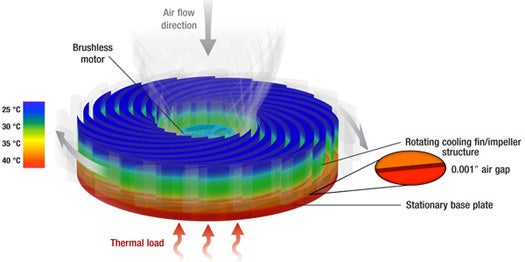
The Air Bearing Heat Exchanger Jeff Koplow, Sandia National Labs via New Scientist

Heat exchanger technology--the cooling machinery that ferries internal heat away from your PC, your computer, your air conditioner, and other appliances--hasn’t changed too terribly much for decades. That’s led to some limiting problems: For instance, more powerful computer chips can’t be run at their full potential because they might overheat. But a new kind of heat sink developed at Sandia National Labs could change all that--and potentially shave seven percent off US electricity consumption.

Conventional heat exchangers have a few primary components: a solid disk or plate that absorbs heat from the source (like a computer’s processor), a bank of metal fins that help ferry the heat away from that disk (the heat sink), and a fan that stirs up the air around the fins to facilitate the outward movement of heat.

This design is pretty standard, and hasn’t changed much in half a century. Moreover, it’s fraught with inefficiencies, most glaring perhaps being the fact that only about five percent of the energy produced by the fan produces a cooling effect. A layer of stagnant air tends to cling to the fins of the heat sink, insulating them to the flow of air around them and retaining heat. Driving the fan at faster rates helps some, but it’s also noisy--making our appliances and computers more obtrusive and annoying.

The Sandia design overcomes this problem by combining the heat sink (the finned surface) and the fan into a single component that sits atop the solid disk, separated from it by a thin cushion of air. This approach improves upon several shorcomings in the conventional design, but primarily it gets right at the problem of that insulating boundary layer of air. By rotating the Air Bearing Heat Exchanger (as it is known) at high RPM, the centrifugal forces reduce that boundary layer by something like a factor of ten.

That allows it to move much more heat more quickly and with less energy expended than a conventional cooler. Which in turn means a computer processor can generate more heat without overheating. Which means it can conduct more operations at higher speeds.

Extrapolate this to to refrigerators, air conditioners, etc. across the entire United States. Jeff Koplow, the Sandia researcher behind the redesigned heat sink, thinks it could cut the national electricity consumption by seven percent while allowing processing power to run free, unrestrained by heat limitations.

The grittier details are here (PDF).

[New Scientist]

23 Comments

So I don't need to liquid-cool my gaming rig anymore?

Oh God, you just said "centrifugal force". Now a bunch of people that just took a high school physics course are gonna come in here and try to teach us about "centripetal force".

ROFL That's the first thing I thought of when I saw him use the phrase "centrifugal force". Sad but true.

Anyway, I wonder if there's any element to this design that would cause it to be more expensive to produce than a traditional heat sink, or if it's just a really smart design that takes the same materials and makes them work better. Hopefully it's the latter case.

@ frong... I'm assuming the arrangement of the blades might add some cost. It also says "separated... by a thin cushion of air." I don't know but this might be sitting on a magnetic bearing, which could add cost. But considering the fan in any standard computer costs next to nothing to make, we shouldn't be talking about too large a price increase at the retail pos.

Well its not as bad as all the times he confused energy with power.

The suckiest part is this researcher will see no financial gains for his invention... seems a bit unfair. He should def. get something. Had he invented this in his garage he'd be on his way to the billionaire club. Instead, the government will sell it for chump change to the first company to come along and buy it (which I'm sure has already happened).

What if the system worked like this:

You could work at Sandia, invent something. The government then allows you the exclusive right (which you could sell) to form a corporation to either build and sell the finished product or license that product to other corporations. You make big money, the government gets a return on its investment, and everybody is happy...

The problem with that idea is that there were more people working on the project than just this guy, which I'm going to assume even with such a simple invention. If there are more people working on it then how does the government decide which person should get the right to it.

Even though I only talk about "one guy" I am referring to the whole group of people that had a meaningful role in this invention. Just speaking metaphorically at the time.

Very cool technology (no pun intended). Hopefully it's relatively cheap because that would be a very nice addition to most desktops if it could be made to work. My new laptop (in the mail on its way now) is a quad core that goes up to 2.9 GHz, but I don't know how much I could run it like that... I'm having to design a cooling pad for it simply because there's no way heat like that is escaping on its own in any reasonable fashion (and I haven't found a cheap cooling pad that's large enough). So far, I'm leaning towards just using a USB port, but they don't give too much, so I may end up using a couple ports to get enough power. A wall wart is an alternative I suppose and I may end up doing that anyways...

Anyways, it's cool to see tech like this. More powerful computer=happier Volt.

Awesome it cools my PC and my computer!

Speaking to lawsonrw's comment,isn't liquid cooling just as,or even more efficient at cooling? At least for computer chips,that is.No moving parts saves money right off the hop,and to add to the cooling power of the fluid,maybe pump fluid over the chip? Just sayin..

The major drawback to the design is the use of an air bearing to create the small gap between the fan and the base plate reducing thermal resistance and friction (the assembly is driven by a brushless 3 phase motor). The pressure for the bearing is supplied from an outside line which will create the need for an extra air pump to also be installed with the system, reducing energy efficiency etc...

Regardless, a great idea that shows a lot of promise and is probably be one of those designs that changes the way our society keeps things cool.

Very interesting ,i am not sure if he means the solid disk is the processor? , and not enough info about the space between the fan and what? ,but it would use less materials ,for less power usage they could have a Piezo fan, with Ha! no moving parts , if you want it cooler than air cooled ,use what the phone company used years and years ago =(Nitrogen)they used on thier land lines to speed the signal, u remember the tanks tied to the utility poles was nitrogen to cool the phone lines .

newbeak5:

I'm a fan of simplicity. Liquid cooling systems have pumps, radiators, tubing, etc... over time, too much stuff to go wrong for me and though provides superior cooling (for now), I'd happy go with a simpler method if it was comparable.

@lawsonrw

Yeah, you're definitely right about how simplicity is good. The more moving parts (and the more parts, period), the more chances for something to break. The other problem I see with liquid cooling is simply that it involves liquids at all. What happens if an internal pipe leaks? Congratulations, you've now got liquid all over the inside of your computer. Not a pleasant thought. I'll stick to this new design, thanks.

I think "centrifugal force" just needs some rebranding to be acceptable to both scientists and laypeople. I say we start calling it the "centrifugal effect" instead. Average folks who've heard the *other* term will still know it means, and the sciencey types can stop complaining about the misuse of the term "force".

@lawsonrw: The thin cushion of air is probably just the fact that the heat sink is no longer in direct contact with the heat source and is probably created by a spacer or something.

How is this better, more efficient, than liquid cooling?
It could, perhaps, replace the traditional radiator in a water cooled system.
The big drawback (?) is that most CPU's are vertically oriented... will the air bearing work in that config?

Is it just me, or does the illustration of the airflow look backwards relative to the direction of the blades?

frong: The liquid cooling systems I am thinking of use mineral oil.The computer is submerged in the stuff!

For the air gap to work it would need a super dust free environment..
to maintain that far more power would be needed then saved...
════════════════════════════════════════════
why, mr. Anderson, why, why do you persist?
Because I Choose To...
Regards
════════════════════

The major drawback with LC (=liquid cooling) is that it's really not that suitable for laptops and other mobile devices.

Someone mentioned the multiple potential points-of-failure in LC. True, to some extent. But in reality this is not a problem, as long as you check the equipment every now and then. And leak isn't something that just "happens", it's result of bad assembly.

In my experience, LC is the best way of transferring heat from the source of origin out from the casing. With air-cooled systems, you get all kinds of problems with heat buildup in the casing, which in turn affects the efficiency of the heat sink which in turn adds to the heat buildup etc... Even if the CPU is relatively cool, the rest of the components go hotter than they should, which reduces their lifetime.

That said, LC is not suitable for a wide range of applications, and I believe this innovation will solve some of the current problems in cooling efficient but small devices.

i love these "why didn't i think of that" solutions, things so simple, you would think they would have been discovered a while ago.


June 2013: American Energy Independence

Five amazing, clean technologies that will set us free, in this month's energy-focused issue. Also: how to build a better bomb detector, the robotic toys that are raising your children, a human catapult, the world's smallest arcade, and much more.


Online Content Director: Suzanne LaBarre | Email
Senior Editor: Paul Adams | Email
Associate Editor: Dan Nosowitz | Email
Assistant Editor: Colin Lecher | Email
Assistant Editor: Rose Pastore | Email

Contributing Writers:
Rebecca Boyle | Email
Kelsey D. Atherton | Email
Francie Diep | Email
Shaunacy Ferro | Email

circ-top-header.gif
circ-cover.gif