Is this the beginning of the quantum Internet? UK researchers have shown that quantum and classical data streams can be interwoven within traditional fiber optics networks, enabling the distribution of quantum information to the home on existing cable. That means quantum key distribution (QKD) can work alongside traditional, classical data channels, a development that essentially lays the groundwork for a quantum Internet that exists alongside the classical one we have now.
The team, from the Tyndall National Institute at University College Cork in Ireland, has demonstrated in a new paper how qubits--the basic blocks of quantum computing--can travel over standard fiber optics networks. This has been shown before, but not in a real-world kind of way. In other words, you can move qubits over fiber optics in theory, sure. But to feasibly do so--especially alongside traditional data streams--is a huge step forward.
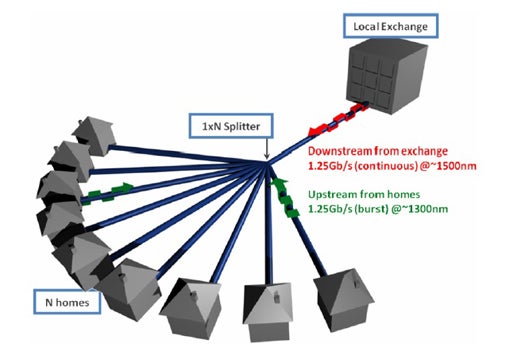
The problem has always been one of interference. Qubits are carried by single photons, while traditional data packets are carried by strong laser pulses. Those pulses flying throughout a network result in spontaneous Raman scattering of photons within the optical fiber, and that in turn interferes with the quantum channels, causing a rate of error that’s high enough to be prohibitive.So the Cork team figured out how to squeeze the qubits in there in between the Raman scattering. When the pulses of laser light are moving through the optical fiber, the interference pulses along with it--that is, there are quiet moments in between bursts of Raman scattering that lead to interference or crosstalk on the network. By carefully controlling the timing and wavelength of the quantum data, the researchers showed that they could slip quantum data generated by a QKD scheme in between the noise areas, where they can travel untouched by the interference.
All that is key if we’re ever going to practically begin a shift over to widespread quantum computing (first we’ll need some good quantum computers of course, but it never hurts to be prepared). It would be really expensive to build a second quantum network alongside our existing classical data networks. Using this scheme, it appears you could get classical and quantum streams running alongside each another, making quantum IT more commercially viable.
[PhysOrg]
Five amazing, clean technologies that will set us free, in this month's energy-focused issue. Also: how to build a better bomb detector, the robotic toys that are raising your children, a human catapult, the world's smallest arcade, and much more.


Online Content Director: Suzanne LaBarre | Email
Senior Editor: Paul Adams | Email
Associate Editor: Dan Nosowitz | Email
Assistant Editor: Colin Lecher | Email
Assistant Editor: Rose Pastore | Email
Contributing Writers:
Kelsey D. Atherton | Email
Francie Diep | Email
Shaunacy Ferro | Email
I'm quite interested in seeing "HOW" they are planing on doing this. Since digital transmission is still binary. Unless they are using variable wavelengths along with the typical "on/off" that normal fiberoptic transmission uses.
Playing Devil's Advocate since 1978
"The only constant in the universe is change"
-Heraclitus of Ephesus 535 BC - 475 BC
Assuming they achieve their goal in the future, it would be great to see more use of national type of computer processing. This is has been done before. There is a name for this type of computer processing, but it escapes me now. It would be a nice advancement towards this type of computing. I am sure my fans (annoyances, really bugs) will quickly jump onboard and expand their own thoughts.
@CodeZero
The answer is fundamental to how quantum computers work. Each photon contains one Qubit of information. The Qubit is read by determining the spin of the photon, which has two possible states, up and down. However, photons can also exist in a state of superposition where it is both up and down simultaneously.
From reading the article it sounds like they will only be using frequency to distinguish the quantum channel from the digital channel.
National computer processing, like a centralized computer? For the entire nation? please explain
@lanredneck, Hi, I did a wikipedia search of what I was trying to express early. Its a type of “super virtual computer” is composed of many networked loosely coupled computers acting together to perform very large tasks. On wikipedia do a search in grid computers and in the deapths of reading you will find more on super virtual computing too. I believe I read, Fastest virtual supercomputers is called BOINC at 5.634 PFLOPS as of April 4th 2011.
@Bubba there huge and galring inherent security risks in doing that, when you have many computers closely linked that you cause vulnerabilities that i would not want to be part of *cough* google cloud computing *cough*
@democedes, I understand that Qubits exist in 4 formats, on up, on down, on up/down and off (as apposed to digital On or Off). I'm curious how they are going to use fiber to transmit the spin attribute. With light being used, changes in freq relates to changes in color, so in all probablity more than 4 states can be expressed using different colors to represent states more akin to "Fuzzy Logic". I guess we'll see how they implement the additional quantum states along with the digital states.
Playing Devil's Advocate since 1978
"The only constant in the universe is change"
-Heraclitus of Ephesus 535 BC - 475 BC
@CodeZero
Fiber is a conduit of light. A photon is the fundimental particle of light. They are not going to artificially transmit the information through the fiber. Each photon passing through the fiber will carry its spin attribute with it. Individual photons will have their state (spin) fixed at one end, sent through the fiber, and "read" at the other end.
@democedes, I thought fiber was a gather and conductor of poop, lol. Ooops, sorry.
hmmm and the rich will have what and poor will have what? Ahh they have found another way to distance themselves.