
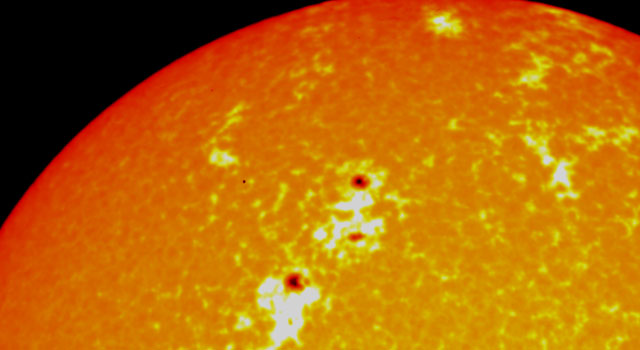
Sunspots may be going into hibernation, a phenomenon unseen since the 17th century that could lead to cooler global temperatures, scientists said Tuesday. It’s not clear how rising temperatures from greenhouse gas emissions may offset global cooling, and scientists are still not totally sure how our star affects Earth’s climate, however. But a forthcoming period of solar quiet will help settle the questions.
Activity in the sun is building toward an expected peak sometime in 2013. Yet, despite a few notable solar flares, things are strangely calm. There are fewer sunspots in this cycle than expected, and they’re fainter than usual, for instance. The east-west plasma jet stream inside the sun is apparently missing, and the magnetic field’s pace of migration toward the poles is slowing down.
Based on these sets of findings, which were presented Tuesday at the annual meeting of the American Astronomical Society's Solar Physics Division in Las Cruces, N.M., heliophysicists believe the current solar cycle, Cycle 24, could be the last one for a while. The sun might be entering a period of hibernation.This was previously observed from 1645 to 1715, a period known as the Maunder Minimum in which there were practically no sunspots. The period coincided with part of the “Little Ice Age,” in which average temperatures in the northern hemisphere dropped by 2 to 4 degrees F.
Scientists said any temperature drops from a new prolonged solar minimum would be very small, however — likely not enough to offset warming from greenhouse gases. Recent 11-year solar cycles have changed global surface temperatures by 0.1 degrees C, said Judith Lean, a solar physicist with the US Naval Research Laboratory, in an AFP story.
Still, a prolonged solar sleep could impact space weather, space travel and even Earth communications. Less sunspot activity means less solar radiation, a slower solar wind and a weaker magnetic field, scientists said.

Given the period of recent quiet, Solar Cycle 25 could be delayed until 2021 or 2022 — or even longer than that, according to Frank Hill, associate director of the National Solar Observatory's Solar Synoptic Network.
“If we are right, this could be the last solar maximum we’ll see for a few decades. That would affect everything from space exploration to Earth’s climate,” Hill said.

Five amazing, clean technologies that will set us free, in this month's energy-focused issue. Also: how to build a better bomb detector, the robotic toys that are raising your children, a human catapult, the world's smallest arcade, and much more.


Online Content Director: Suzanne LaBarre | Email
Senior Editor: Paul Adams | Email
Associate Editor: Dan Nosowitz | Email
Assistant Editor: Colin Lecher | Email
Assistant Editor: Rose Pastore | Email
Contributing Writers:
Rebecca Boyle | Email
Kelsey D. Atherton | Email
Francie Diep | Email
Shaunacy Ferro | Email
they still are not too sure how this will play out, ok, ready set go with all the non scientific comments about greanhouse gases...
this would stick in the crawl of every chicken little climatoligist on earth hahaha. watch this actually erase any side effects from 'glocal warming/change" hahahahahaha
@Lanredneck
Surely if there was a temperature drop, that would still be "climate change", due to it being, y'know, a change of the climate? The general phenomena is rarely called "global warming" nowadays, due to the fact that climate change is a more accurate descriptor.
Unless you actually meant glocal, in which case I'd like to hear more about what the hell glocal actually means :P
calm before the storm?
@joeyjam
haha veryfunny bust me on my grammar, why do people do that on forum i never understand, but you know what i mean, i had an argument with B.V. about how many of these GLOBAL change/GLOBAL warming climatologist say that hell will visit earth if we don't all start living in grass huts, and stop using anything that releases CO2. I stated that the earth will heal itself and none of these prediction will ever happen, i just never thought the sun would help lol. GLOBAL GLOBAL GLOBAL
however, but, for instance, however, likely, still, yet... for real? this is pretty sloppy writing for a website as prestigious as popsci.
just proves the Mayan predictions and galactic alignment even more. we truly are entering a new age.
@Ianredneck,
"haha veryfunny bust me on my grammar, why do people do that on forum"
'Cause it's hard enough to communicate ideas across when using proper grammar--it becomes much harder when using bad grammar.
---
Anyway, these are certainly fascinating developments!
However, I wonder how long the hibernation period will actually last... and what the results will be once it's done hibernating.
We might get fairly steady temperatures as lowered solar output counter-balances the earth's increased ability to trap the solar energy... but whenever the sun wakes up, it's going to start blasting the earth with high levels of energy again.. and the earth will still have the increased ability to capture such energy through the greenhouse effect (assuming steady levels of reflective air-particulate pollution), resulting in much faster rates of average temperature increase...
Seems to me that the more drastic the temp. fluctuations, the more devastating they are to farmers and wildlife.
Also, if the "global warming" is offset by decreased solar energy output, I fear it will just fuel the climate science deniers who will rejoice that, "aha! your models were wrong because they didn't account for decreased solar output! Therefore everything you've ever said or will say is wrong and even if you revise your models you will be wrong!"
@joyjam,
I think it's now called "climate change" because the layperson listening to CNN couldn't comprehend that "global warming" which actually means an increase in the AVERAGE temperature on earth would mean that some parts of the world would get hotter, some colder, some wetter, some drier, some relatively unchanged, etc.
However, I still think typically the term "climate change" really should be called "the human influence on climate" since "climate change" existed before there were every humans (like when the dinosaurs died off likely due to a meteor and dust blocking out the sun).
Today most of the time when people talk about "climate change" they are really talking about what effects human activity has on the climate. Obviously, solar output isn't part of the "human effect" on climate.
Hmm. But it has been shown that solar activity doesn't cause global warming:
http://www.independent.co.uk/environment/climate-change/solar-activity-not-the-cause-of-global-warming-456785.html
Can't have it both ways guys.
I don't really mean to be an ass about this, but (1) that's not what the article you linked says past the headline, as the article only says that solar activity *didn't* cause the warming trend because it wasn't *increasing*, and (2) a .1° non-cumulative shift is irrelevant, anyway.
"scientists are still not totally sure how our star affects Earth’s climate"
Sooo...just out of curiousity...
Could the earth be anticipating the change in the Sun and modifying the climate accordingly?
And I dont mean from an "intelligent" perspective...just a reactionary one that we cannot account for?
quote from National Geographic
July 2004
The Sun: Living With A Stormy Star
by Curt Suplee
Pg 28: "They contained significantly more carbon 14 than trees before and after the period [before and after the Maunder Minumum from 1645 to 1715.] That meant that higher amounts of cosmic radiation had been reaching Earth during that time.[...] A magnetically active sun reduces the cosmic radiation we receive[...]"
Yawn, I'll stick with the scientists, (I have magic powers of prediction).
"scientists are still not totally sure how our star affects Earth’s climate"..........Really? Prior to humans, the earth heated up and froze over thousands of times, more likely tens of thousands of times....If the sun was a little hotter or closer we wouldn't be here....same if the opposite was true.
If the sun simply went out, the earth would freeze solid in days, maybe a week or two on the outside....Earth's climate is affected by a lot of things including placement of the continents, ocean currents, levels of atmospheric gases, and solar radiation...the latter being the most influential!!
you are being a bit simplistic, i believe they are referring to how small changes in the sun's output effect the climate
"Scientists said any temperature drops from a new prolonged solar minimum would be very small, however — likely not enough to offset warming from greenhouse gases."
Really? Pure speculation. First of all no one has any idea how much warming is attributable to greenhouse gases. Could be 0.1 C. Maybe. Maybe not. Sure you can calculate it in a static, closed environment, but earth's atmosphere and its interaction with the oceans, land, ice caps, and every organism in the biosphere is incredibly complex. That's why they need supercomputers to try to model it...and they're still a long way from understanding all the variables involved.
What we do know for a fact is that the earth was unusually cold during the Maunder Minimum. Whether or not we're headed into another one remains to be seen, but based on the historical evidence, if we do enter another one, it could mean harsh winters ahead and global cooling. The idea that it would offset any supposed warming due to greenhouse gases is pure speculation. The earth was warming before the Maunder Minimum and warmed again after the Maunder Minimum; part of a long term trend that started as we entered the current interglacial period thousands of years ago. Despite the warming trend, it still cooled during the Maunder Minimum. Chances are it will cool again if we enter another one.
Couple of things. Global cooling due to less solar activity is not a new discovery (title is misleading) and this upcoming sun cycle minima was predicted in 2005 (and earlier). Second, "likely not enough to offset warming from greenhouse gases" should not follow "scientists are still not totally sure how our star affects Earth’s climate" without at least some real information.
For instance:
During the last solar cooling New York harbor froze solid, but that wont happen this time because ...
or
Recent experiments show that an increase in cosmic rays (which correlate with the suns cycles) suggest an increase in cloud cover, the most significant greenhouse gas, but we are sticking with CO2 as way more influential because...
This isn't really new stuff. I remember being told this not long ago at University by the local climate change professor. 'Saying that we are likely to enter a period of cooling soon and people going crazy making money off controlling carbon emissions might find that it will not be the BIG issue its been made out to be'
Wish governments would take recycling issue as serious as they currently do with CO2 and climate change.
Could this decreasing solar activity have anything to do with the hotter Local Bubble we are entering in about a hundred years?
See SOFTPEDIA.com "Sun to Enter Huge, Hot Cloud of Interstellar Gas"
http://news.softpedia.com/news/Sun-to-Enter-Huge-Hot-Cloud-of-Interstellar-Gas-143100.shtml
or news.sciencemag.org/sciencenow "Sun May Soon Plunge Into Hot Cloud of Interstellar Gas"
http://news.sciencemag.org/sciencenow/2010/05/sun-may-soon-plunge-into-hot-clo.html
ssome science said the sun will expand n burn the earth n now science said that the sun will get cooler....hmmm no conclusion yet.....
Well, I believe that the GHE is really saturated and that additional GHGs will be offset by a decrease in atmospheric water vapor. This meets all my requirements for a stable mental state. Someone did say I was crazy. So I asked the squirrel in the back yard. He said I was not crazy, he knows a nut when he sees one.
All jokes aside. I appreciate all the hard work done by both the warmists and the coolers. It certainly has become a lively show. Will we witness the final chapter in the unraveling of the warmer hoaxsters or will the deniers wind up with egg on their plates. Right now, I am a little reluctant to dismiss the historical cooling record showing significant cooling during Maunder like minimums. But the sun could become bedeviled and spew out more spots just to be ornery.
A Maunder-like solar minimum, a magnetically less active Sun, could result in more cosmic rays, which could increase clouds/atmospheric vapor.