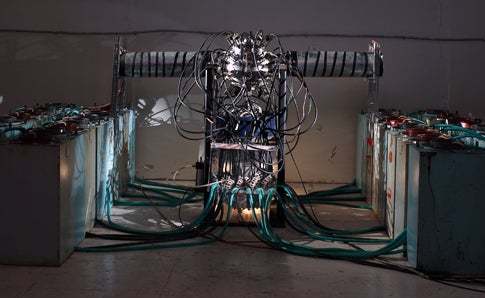
Bring up the prospect of fusion power, and often eyes glaze over. It’s not that it’s not a thrilling prospect--cheap and inexhaustible energy would solve a lot of problems here on planet Earth--but it’s been such a pipe dream for so long that it’s often hard to make people care. But at least one person with a proven track record in recognizing potential when he sees it has taken an interest in a fusion-powered future: Amazon founder and gazillionaire Jeff Bezos has thrown $19.5 million to Canada’s General Fusion to fund further research.
PopSci wrote about General Fusion back in late 2008, when the company was just getting underway in its efforts to completely upend the global energy paradigm in an office park British Colombia. At the time the company said it could provide data that would prove that fusion is indeed possible within three to four years. We haven’t seen that (publicly) yet, but whatever Bezos has seen apparently impressed him.
General Fusion is pursuing what is called Magnetized Target Fusion. In a few words, this technique essentially uses a magnetic field and plasma to break lithium down into helium and tritium, which is then separated and mixed with deuterium, which then fuses into helium (that’s a wild oversimplification, in case you were wondering).That fusion of tritium and deuterium--both forms of hydrogen--into helium releases a huge burst of energy, which can be harvested into electricity. So where you’ve basically started with cheap and plentiful lithium, you end up with a massive amount of energy and harmless gas as a byproduct--no radioactive mess to clean up (or ceaselessly worry about).
We’re nowhere close to being able to do this. But whoever gets there first is pretty much a lock for a Nobel Prize and a massive return on investment. So maybe Jeff Bezos the venture capitalist is taking a gamble on a far-fetched idea. Or maybe he sees a short-term potential that others don’t. Whatever the impetus, this second round of funding is aimed at producing a demonstration of General Fusion’s technology rather than some kind of finished product, so don’t expect your local utility to start fusing isotopes any time soon.
The incredible innovations, like drone swarms and perpetual flight, bringing aviation into the world of tomorrow. Plus: today's greatest sci-fi writers predict the future, the science behind the summer's biggest blockbusters, a Doctor Who-themed DIY 'bot, the organs you can do without, and much more.


Online Content Director: Suzanne LaBarre | Email
Senior Editor: Paul Adams | Email
Associate Editor: Dan Nosowitz | Email
Assistant Editor: Colin Lecher | Email
Assistant Editor: Rose Pastore | Email
Contributing Writers:
Kelsey D. Atherton | Email
Francie Diep | Email
Shaunacy Ferro | Email
TRITIUM is a radioactive isotope that can produce electrical power "directly" in solid state BETAVOLTAIC generators.
Modern 3D BETAVOLTAIC generators are similar to photo-voltaic (PV) cells, except instead of absorbing solar energy to create electricity, they absorb the radiation from the nuclear decay of tritium.
Tritium apparently has a half-life of 12 years, and Canada apparently has stockpiles of tritium, decaying into waste heat...
Why not just put the stockpiles of tritium into BetaVoltaic generators?
yeah i thought of it already. glad he's getting credit for it.
I realize the popsci is an oversimplification but how are they breaking lithium down? it seems that would require quite a bit of energy to do a nuclear breakdown of lithium.
"so don’t expect your local utility to start fusing isotopes any time soon."
This is pure silliness and I expect more from PopSci. Isotopes are only needed for fission due to the need for unstable molecules that separate into fission projects + energy, either spontaneously or with the help of thermal neutrons.
We are of course talking about FUSION here where no isotopes are needed. Fusion has always been possible and been demonstrated countless times. What this article fails to mention is that the process devised has always required MORE energy to create than was produced out of it.
If this company has a process producing net energy output, it will truly be revolutionary
@ajohnson1986: I know you can break down lithium by neutron bombardment. Once they get the reaction going, the tritium reactions would produce neutrons to break down more lithium. They must have some other neutron source to get things started.
"In a few words, this technique essentially uses a magnetic field and plasma to break lithium down into helium and tritium"
Um ... no. A magnetic field isn't goung to break down lithium. It may seperate the tritium created by irradiating lithium with neutrons.
Next time you try oversimplifying, be a tad less wild.
We should all hope this works...
Basically, this has been itching at me for a while...
If you care enough to split hairs over the articles on PopSci, then stop getting your news from a site whose name is POPULAR SCIENCE. Go read the actual research, news article, or other more technical version someone else and argue with the person who knows what they're talking about, so they can smack you down with words. We don't need you here.
Mr. Vladdek,
I disagree that readers should not offer comments as to the clarity in the articles. Feedback such as this allows the author to experience how others understand what he/she has written.
I do find the explanation of the process to be more than a little vague if not incorrect. If a more complete explanation is not in keeping with the length of the Popsci article providing link to an article on another website would be helpful. Such as what can be found on the company’s homepage:
//www.generalfusion.com/energy_capture.html
“Energy Capture
The fusion reaction will release energy in the form of charged helium atoms and free neutrons. The neutrons will pass out of the plasma and will be slowed by the surrounding liquid metal, transferring heat to the lead in the process. The neutrons will eventually be absorbed into the nuclei of the lithium dissolved in the lead, transforming it into tritium and more helium”
That is how the Lithium is broken down and further reading shows that the magnetic fields are used to control the charged particles…the plasma…that is produced.
Constructive criticism would not only help the author improve his/her writing style but also, hopefully, improve the quality of the journalism on the site if the feedback is discussed by the staff.
@matsci1,
Thank you very much for the link and the breakdown.
- Darth Lithicus
dicemaster is wrong anyway. Yes, many different atoms can technically be fused, but some do so more easily than others. Why do you think they're using TRITIUM - if you don't know what tritium is than don't make posts like you're better than the PopSci writers.
didn't they use tritium and deuterium for the H-bomb?
Princeton's Forrestal research center used magnetic fields in its Tokomak reactors to squeeze the plasma enough to cause the reactants to fuse while heat was applied. The approach tried in California (I forget where) used lasers to force the atoms together so fusion could happen.
and Its British Columbia, not British Colombia. No narco subs here thanks.
I've got to agree with vladdek. Some of PopSci's commenters act like they're reading a peer-reviewed journal. That's not what PopSci is. This is a magazine meant to entertain people with gee-whiz information about stuff that they may not have any technical knowledge about. If PopSci spent this article debating the technicalities of how fusion could theoretically work, then most of their readers wouldn't even make it through the entire article and they would be left with a readership consisting of a few techno-geeks that would have been better off reading something else to begin with.
"whoever gets there first is pretty much a lock for a Nobel Prize and a massive return on investment" you forgot, and a bullet to the head. i cant see the petrol industry giving up its insane profits any time soon without a big fight
So its electrolysis to break down lithium using a magnet field to hold the gas or plasm inside the container, maybe instead of using direct electricity they should try a chemical reaction from the start, like the atom bomb :O
@matsci1
Thank you for the piece by piece break down.
@Everyone Else
Negative criticism helps nothing, Pop Sci readers, simply educate do not bash, it drives people away from what it is we are trying to do here.
@matsci1,
I do appreciate CONSTRUCTIVE criticism, but that's not what we're seeing at all. Most articles aren't adding anything useful, but are attack the authors over grammatical errors, spelling errors or over information that only a TRAINED scientist knows. That isn't what they do here and it isn't who they are. No one is gaining a deep understanding of nuclear physics by someone attack the author or the article. In addition, if we wanted that knowledge or were interested in the article enough to actually care beyond a passing interest, then we would read the source material. Thank you, however, for your source links. They will be well appreciated.
@vladdek
I agree with matsci1, the article is poorly written and edited. Doesn't matter that Popsci is a popular magazine, the basic statements ought to make sense.
The phrase " In a few words, this technique essentially uses a magnetic field and plasma to break lithium down into helium and tritium..." is flat out wrong. That reaction would be as difficult as unburning a candle.
The paragraph should have read:
"General Fusion is proposing to fuse tritium and deuterium using a combination of magnetic fields and sound waves to produce helium and neutrons. The fusion products will hit the fusion chamber walls which in General Fusion's case, are made of an alloy of molten lead and lithium. When fusion-produced neutrons hit the lithium, they'll chip off more tritium which is fed back into the fusion chamber as fuel. The molten alloy heats up as it captures the neutron's energy and that heat is used to produce steam for power. If their process works, General Fusion figures their process will generate 100 Megawatts per day burning a 3 inch cube of lithium."
The revised paragraph doesn't get into the details of how the molten lead is configured, the vortex chamber details, GF's solution to neutron embrittlement of the chamber walls, the sound generation mechanism, Rayleigh–Taylor instability issues, etc but does give a more accurate picture of what GF is trying to do that's different than previous attempts and has a gee-whiz factor as well.
Since Bezos has poured some money into the venture, this story could have legs. A follow-up article could go into the elided details in layman's terms and give decent insight into what the chances of GF succeeding are and why the money may be well spent even if GF fails.
i agree with both matsi and vladdek, however, most criticism on here is just plain bashing from trolls, (the next post will be a troll accusing me of trolling)
@dicemaster
Actually, the fusion of certain isotopes (particularly He-3 and He-3) when fused produce no additional neutrons, hence making this a reaction that produces a vast amount of energy and at the same time does not produce any neutron radiation, which is very good in terms of radiation safety when you compare it to fission. Protons can be contained quiet easily, while we know neutrons not so much.
I actually work at the plant that removes tritium from moderator water and we are hoping that one day we can make a sale on this bloody tritium as it just sits in a vault and decays. But that isn't too bad. I mean, it decays to our precious He-3 which is far more valuable (and rarer) than tritium.
On the other hand, I for one don't think fusion will fly and would much more be interested in thorium fission reactors. I know it is far from perfect, but a very interesting and plausible alternative to other energy producers.
-Suffer, learn and change.
Using neutrons from common reactors to fission 6Li & 7Li has been one way of generating Tritium for decades.
However, D-T fusion, even if achieved with power gain, produces 100x the neutron flux of a conventional fission reactor of the same power output. This has great consequences for damage and transmutation of vessel materials, as well as great demands on shielding.
Since they also cannot run at high vessel temps, but intend to just make steam, their efficiency will be lower than a coal/gas plant's, wasting >60% of thermal energy available. And, waste heat adds directly to global warming as well as requiring cooling at the last stage to condense the water -- this wastes 628 watt-hours per lb of water used to make steam.
An alternate fusion collides Hydrogen and 11Boron,
yielding two Alpha particles (4He) with high exit energies, plus one slower Alpha. This produces a positive electric current directly, with no emitted fast neutrons to cause transmutations of elements in chamber walls.
Thermal efficiency is one reason why modern reactor designs pursue liquid fuels and salt coolants, gaining back efficiencies & matching the best thermal plants. This is especially true if inert gas cycles, such as the Brayton Cycle are the output stages of turbine generators.
The fellow who mentioned Thorium is quite right, which when combined with molten salt and Brayton Cycle turbines, yields 1000 years of US power from just the Th lying around as waste in one small, rare-earth mine. Lithium has many important uses, so burning it isn't wise. Th has little present use...
http colon slash slash tinyurl dot com/25mgqkd
Dr. A. Cannara
650-400-3071
Thorium will be the next big thing, not fusion. It's just not there yet. The energy density of thorium alone demands that it will indeed power our reactors in the last half of this century, if for no other reason than the owners of our current nuclear stations understand it, and understand exactly how much raw wealth they have been throwing away so far. Paying to throw away.
A chief executive!
I can repeat the reactor Rossi!
I can make the reactor - http://nt.ru/tp/ie/ts.htm and at http://thermonuclear.ucoz.com/.! Over a year!
I'll give almost nothing!
Главному руководителю!
Могу повторить реактор Росси!
Могу сделать свой реактор - http://n-t.ru/tp/ie/ts.htm and at http://thermonuclear.ucoz.com/.! За 1 год!
Отдам почти даром!
It is expensive, dull and inefficient technology.
but as at CERN well raises funds.
Jeff Bezos has to wait for power from them.