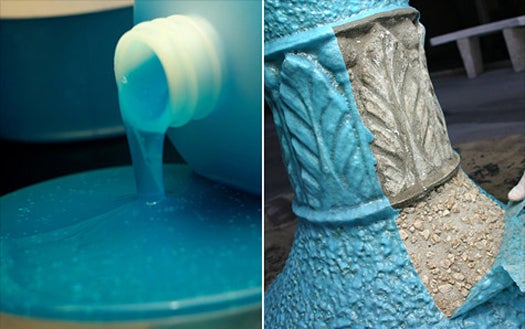
A clever technology is helping hazmat crews in Japan contain and clean up the contamination caused by the ongoing nuclear disaster there: a blue liquid that hardens into a gel that peels off of surfaces, taking microscopic particles like radiation and other contaminants with it. Known as DeconGel, Japanese authorities are using it inside and outside the exclusion zone on everything from pavement to buildings.
DeconGel was stumbled upon by accident at Hawaiian venture capital firm and technology incubator Skai Ventures. A researcher conducting an experiment got a bit of solution from an experiment on the floor; when it was cleaned up the next morning, the solution came off the floor taking everything foreign with it. Underneath, the floor was so clean they couldn’t make the rest of the surface look the same with any amount of scrubbing.
Now commercialized, the blue goo hasn’t seen much publicity. But after donating 100 five-gallon buckets of the stuff to Japanese cleanup efforts, the orders are rolling in.When DeconGel goes onto a surface, it encapsulates absolutely everything that isn’t native to the material itself--including microscopic bits of contamination, like radiation or other pollutants. That in itself is a huge innovation. Conventionally, radiation is literally scrubbed from surfaces, essentially with soap and water. In doing so cleanup crews essentially mobilize the dangerous waste, increasing the chances that it might escape into water supplies or into the soil, while also increasing the hazard to workers themselves. The byproduct is contaminated water that is heavy and difficult to contain.
DeconGel captures contaminants first, then hardens around them, neutralizing the threats. Workers can then remove the contaminants safely, without worrying about pollutants escaping into the air or seeping into surrounding soil.
It sounds like, a pretty remarkable improvement in the way environments are remediated, and one that is likely to keep hazmat workers safer while they do their jobs. Those who do that unenviable work seem to think so. DeconGel’s maker has doubled its business every year since 2008, and with the Fukushima disaster elevating nuclear awareness around the globe, the company’s CEO told CNN Money he predicts 20 times more business over the next few years.

140 years of Popular Science at your fingertips.
Each issue has been completely reimagined for your iPad. See our amazing new vision for magazines that goes far beyond the printed page
Stay up to date on the latest news of the future of science and technology from your iPhone or Android phone with full articles, images and offline viewing
Featuring every article from the magazine and website, plus links from around the Web. Also see our PopSci DIY feed
The 6th annual Invention Awards are here, from an inflatable tourniquet to a better lobster trap to spring-loaded hocket skates. This issue is all about the celebration of invention.
Plus: Making synthetic biology breakthroughs in a garage, building a constantly-moving ping-pong table, and a ridiculously overpowered barbecue.
No, it can't be blue! It's supposed to be amber!
#Fringe
-IMP ;) :)
My prayers goes out to the people of Japan! I am glad to see this type of technology come their way in the clean up!
My only questions are
What do they do with the now radioactive blue substance that they collect?
Does it bio degrade?
How long will it be radio active for?
I suspect it just becomes a radio-active tangable thing they can collect and store in safe containers.
BubbaGump is correct. It can simply be rolled up and stored like other waste--unfortunately, there's no real way to eliminate the waste, you can only contain it. But it's easier to safely store than water because the dangerous stuff is already encapsulated and fixed in place. And unlike contaminated water, it isn't inherently corrosive to its container. So safe storage of this solid is greatly simplified relative to water.
is it available commercially I wonder...I have a tile floor that needs some cleaning
This isn't the "Japanese miracle" per say but it is real good news. I hope this help stop things from getting to bad to start with in the future from things like this.
i didn't know that Cave Johnson was Japanese!
duct tape is like the force, it has a light side, a dark side, and it binds the universe together.
why dont they just throw all radioactive wast into outer space? there is so much SPACE in space.
@JediMindset
Sure, we'll throw the waste into sapce as long as you pay for it. I'm sure it doesn't cost that much for you right? ^^
"...microscopic bits of contamination, like radiation or other pollutants."
Radiation can not be described as "microscopic bits", but microscopic bits can emit radiation.
Wow, picks up radiation, does it? That's great. I can now soak a stocking cap with it and I won't need a source of tinfoil for my anti-government snooping hats. I must admit that since it is blue it must soak up red and green. Think of the security uses.
Too bad the author and editor don't understand the difference between radiation and radioactive particles.
I would love to perceive the original, agenda for blue goo?
Holy crap. The potential of this stuff for cleaning things is obviously unparalleled! Hey, how about cleaning medical instruments by dipping them in this stuff?
I can definitely see how this is a good alternative to the scrubbing method. This gets more of the contaminants off the surface of materials (100%) and it's much less labor intensive.
@JediMindSet: First, because last time I checked, we haven't built a railgun that can achieve terminal velocity. Why would we need a railgun? Because sending so many tons of radioactive waste into orbit via rocket propulsion would probably make our atmosphere look like Venus.
Second, rocket propulsion is essentially controlling explosive ingredients to produce a force in one direction. If this controlled explosion goes OUT of control, the payload ends up in countless tiny particles spread across an enormous area. No one is going to take the risk because a rocket loaded with radioactive material could at any moment become a giant "dirty bomb."
Third, radioactive material by its very nature could still have some potential use that we simply haven't found yet. There are reactors today that can generate electricity using fuel that older nuclear reactors consider "waste." (which is actually more than 95% good fuel) At any rate, this blue goo will certainly make it easier to obtain and contain radioactive contaminants.
Super funny to read this on Popsci. My good friend is heading up this project. He's been working at this place for a while now. Got the job with this company when he came to my wedding. Funny how things turn out.
re: Space - yes there is a thought to transport it up into space and then ship it to the sun so to speak. That's one of the ideas of the new rockets being created where the cost is super low.
re: solid waste - there was an article about a new laser that is hotter than the sun. So in theory, we could burn this with that laser.
re: Amber - good one.
Am I the only one who's concerned that business is going to...increase?
@Onihikage
yeah it is dangerous but why not just create a space elevator and transport it that way? or just send it to the center of the earth where it would not cause us any danger. at least i think it wouldn't. and as for the cost im sure the government could get rid of the radiation for cheap.
Serendipity... love that word.
If you are concerned about radioactivity here is a link on how to turn your computer into a radiation testing machine. It does require the purchase of third party hardware, but still fairly reasonable.
http://www.chimac.net/2011/03/13/want-to-test-for-nuclear-radiation-with-your-computer/
The Ghostbusters used green slime (or "good" ectoplasm) to counteract evil ectoplasm. That must be where they got the idea from. (kidding)
Store in safe containers? That's not the way of the samurai. They will burn it and throw the ashes into the sea.
@JediMindset: They can't throw the stuff into space. It costs more to launch it into space than it would to simply store it away for a few decades/centuries/millenia until it decays into harmlessness.
As for a space elevator. You DO realize that materials science doesn't currently have a viable solution for materials necessary to actually BUILD a space elevator right?
And again, there's the cost factor. They still have to build the darn thing. Which would likely take years/decades. In the mean time they STILL have to have a more or less permanent storage facility to keep the stuff in.
Also, just dumping the stuff into space is a really rotten solution. What if that stuff becomes useful at a later date? What if one of our later forays into space run into the stuff? Maybe you're okay with pooping where you live, but others are more responsible.
@quasimod: Radiation can be described as energy or particles. Alpha decay, Beta decay, and Neutron radiation all describe the release of particles. In alpha decay, you're releasing alpha particles (two protons and two neutrons). In beta decay, you're releasing beta particles (electrons or positrons (antimatter)). In neutron radiation, you're releasing *GASP!* neutrons.
In short, I'm glad this substance has been discovered. It's especially cool that it was discovered by accident. Some of the most interesting things in technology have been things literally stumbled upon. Keeps us humble I suppose.
@Hawking
you are right. i hadn't thought about it that way. it might become useful for us in the near future. thanks for the enlightenment. everyone poops where they live. lol. the poop is transferred by way of piping.
How does it work in glossy surface any clue?
@JediMindset
I think that the main concern with launching radioactive waste into space is that the possibility of the rocket exploding, releasing the radioactive waste, is too devastating of a possibilty. If this were to happen, all life on earth may be destroyed (Or atleast all life that can't adapt to it- I think that would include humans). Interesting substance though.
Nice, but can you bounce of this stuff?
@ Hawking Radiation: I wouldn't say "microscopic" if I meant "subatomic". I think the author misspoke, is all. Pretty neat stuff: I'll take 5 gallons, please.