Bodies In Motion: Exploring the Human Limits of Future Travel
The limits of travel are defined not by what vehicles can do, but by what vehicles can do to us. So how much can we take?
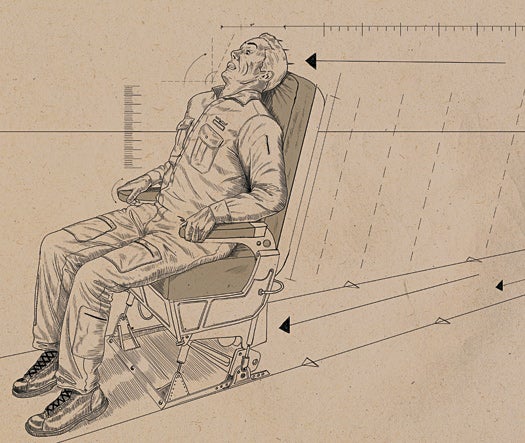
Lateral Acceleration
On the morning of October 25, 1999, captain Michael Kling and his first officer, Stephanie Bellegarrigue, piloted a Learjet Model 35 out of Orlando and set a heading for Dallas, where their passengers—the professional golfer Payne Stewart, Stewart’s agents Robert Fraley and Van Ardan, and golf-course architect Bruce Borland—were planning to build a new course. The Learjet, a plane often used for such trips, was a marvel of engineering: It could climb 4,340 feet in a minute and cruise at up to 530 mph. In 1976 a similar Lear, the Model 36, set a round-the-world speed record.
As the crew headed north, they received instructions from a Jacksonville controller, first to climb to 26,000 feet, then 39,000. “Three nine zero bravo alpha,” the first officer acknowledged. It was her last transmission. A few minutes later, the Learjet leveled out and the controller issued another routine instruction. No one radioed back. The controller tried to reach the crew five more times in the next four and a half minutes.
When a flight crew is unresponsive, the FAA asks that the nearest military jet make a visual assessment—in this case, it was an F-16 pilot on a test run out of nearby Eglin Air Force Base. Coming even with the Learjet, the test pilot reported that both of the plane’s engines were running. By all indications, the Learjet was in perfect working order. But the test pilot also reported a disturbing detail: The Learjet’s windows were opaque, as if covered from the inside with condensation or ice.
“You can create a system to do whatever you need it to do. But can you keep a person conscious and alive inside it?”It was becoming clear that in the minutes after Bellegarrigue’s last transmission, the cabin had lost pressure and all its oxygen began to escape. Within as little as eight seconds, the crew and their passengers most likely began to experience hypoxia—lack of oxygen in the bloodstream—that impaired their most basic motor and cognitive functions. They may not have even been aware that there was a problem, but within a few minutes of the breach, they were probably dead.
Yet the plane continued on, because a plane does not need its occupants to be comfortable in order to operate. It does not even need them to be breathing.
Corporeal Limits
Humans are flimsy. Our bones snap after a fall of only a few feet. Our flesh ignites at the operating temperature of the average wood-burning stove. The highest human settlements are no more than 19,520 feet up, and none of us can stay alive long past 26,000.
Machines, meanwhile, can take a lot. The wings of a Boeing 777, for instance, can bend as much as 24 feet from their resting position, and any turbulence powerful enough to bend them that far will damage the passengers long before it damages the airplane. In 1997, United Airlines Flight 826, en route from Tokyo to Honolulu, encountered a sudden gust of “clear air turbulence” that crushed passengers into their seats and flung them at the ceiling. The turbulence killed one passenger and injured 70 others. But the pilot was able to return the plane itself safely to Tokyo.
Capacity
This is the fundamental limit of all forms of travel. “You can create a system to do whatever you need it to do,” says Michael Planey, a former U.S. Air Force engineer and now a consultant for commercial airlines. “But can you keep a person conscious and alive inside it? That’s the challenge.”
How we’ll move from place to place in the future will be determined by what passengers can withstand. How fast can the body accelerate? How long can it sit in one place? How many can we pack into a vehicle? Right now we have only a rough sense of these corporeal limits.
Scarce Data
Much of what we know is drawn anecdotally from the violent, often accidental experiences of airmen and astronauts. In 1966 a test pilot named Bill Weaver managed to eject when his SR-71 Blackbird broke apart at Mach 3.18. His systems officer was killed, but at 78,000 feet Weaver survived more than 2,000 mph of air resistance, revealing that a human can in fact withstand incredible shock at a very high altitude, at least when protected by a pressurized suit.
“Comfort is difficult to quantify. We look primarily at safety.”In 1960, Air Force captain Joseph Kittinger established as-yet-unbroken records for the highest parachute jump (102,800 feet) and the fastest human free-fall through the atmosphere (614 mph). And between 1947 and 1954, Air Force colonel John Stapp, part of the Aero Medical Laboratory of the Wright Air Development Center, subjected himself to repeated tests on a rocket sled that zipped across what is now Edwards Air Force Base. During one run on his “human decelerator,” Stapp went from 630 mph to a complete halt in just a few hundred feet, experiencing 46 Gs of deceleration.
But standardized data about human tolerances is hard to come by. J.D. Polk, NASA’s chief of space medicine, knows a great deal about the strain of space travel—his astronauts have endured hours of waiting at the launch pad and lived for months in a weightless environment—but even he can’t quite name the breaking point of a human being. That’s because engineers can’t test humans the way they can other components of a spaceship. In designing a space shuttle, “you can stress a part until it breaks,” Polk says. “The human body is the only system in engineering that you can’t take to failure.”
Jerk
Military and NASA researchers don’t really investigate human comfort, at least not in the way that a commercial traveler might hope. They aren’t attempting to engineer conditions that will convince the traveler to fly a particular airline or buy a particular car. That distinction was highlighted during the Iraq war, when Baghdad International Airport became one of the few places in the world where civilians regularly encountered the discomfort of military efficiency. Rather than the usual long, low approach to the runway, commercial pilots instead had to drop from as high as 35,000 feet in a hard spiral “corkscrew descent,” the better to avoid rockets and small-arms fire. It’s a standard military approach path. But for a civilian, it’s terrifying. “It’s pretty amazing what airplanes can do,” says Tom A. Peter, a freelance reporter who has flown into Baghdad several times. “I’ve never been in a plane crash, but I have to imagine that a corkscrew landing is about as close as you can come without actually wrecking a plane.”
NASA engineer Dustin Gohmert, who designed seat systems for the crew module of the Orion spacecraft, explains the military-civilian distinction in straightforward terms. “Comfort itself is difficult to quantify,” he says. “We look primarily at the safety of the crew.”
Designing for Safety
“The human body is the only system in engineering that you can’t take to failure.”The standards are very high for NASA vehicles. Because a spacecraft can crash hours or days from help, “we have to make it such that the crew can self-rescue,” Gohmert says. And sometimes that means doing away with conventional amenities. In the Orion capsule plan, for instance, Gohmert’s team dispensed with seat cushions altogether. Cushions may separate the body from the hard seat underneath by just a few millimeters, but in a sudden deceleration, the body can close even that small distance with enough force to cause injury. The Orion seats fit each astronaut fairly closely, and the weight distribution makes for a more or less tolerable experience. But comfort isn’t the goal. The seats keeps the astronauts alive.
Of course, NASA also gets to be picky about who comes on board, a degree of selectivity that further limits what the agency can teach us about our own comfort. The Federal Aviation Administration requires commercial airlines to safely accommodate nearly the entire spectrum of humanity, from a 5th-percentile woman (about 5 feet tall) to a 95th-percentile man (over 6’3″). Not so at NASA. To make sure each astronaut fits the operating environment of the spacecraft, the agency assesses not just height and weight, but every measurement of every extremity. If you don’t fit, you can’t fly. “We do three-dimensional body scans of the astronauts as part of the screening,” Gohmert says. “If your femur is too long, it might disqualify you.” Air Force pilots must also properly fit their plane—legs longer than the engineered standard could break when the pilot ejects in an emergency.
Civilian passengers, no matter how tall or wide, expect gentle treatment. As a result, engineers must set extremely conservative tolerances. Rail system designers, for instance, consider the acceptable limit of linear and lateral acceleration (the force exerted on passengers by starting, stopping, and rocking from side to side) to be no more than 0.15 G—roughly what you’d feel on the moon. That limit allows passengers to dispense with seatbelts and walk around freely inside.
Bank Angle
But design constraints also act as speed constraints. In 1990, engineers for a federal program called the National Maglev Initiative began to investigate the domestic potential for high-speed magnetic-levitation (maglev) trains—the fastest, a Shanghai airport shuttle, reaches 268 miles an hour. Daniel Patrick Moynihan, then the chair of the Senate subcommittee responsible for the U.S. highway system, had suggested that maglev trains be placed along the median of U.S. highways, so in July 1992, to better understand what it would be like to travel an interstate at maglev speeds, four engineers set out from National Airport in a private jet. “We did 180 mph and began banking as if we were obeying the turns you’d have to make on the New York State Thruway,” recalls Laurence Blow, now a maglev consultant. As the pilot cranked the plane back and forth, simulating the thruway, the engineers began to heave and retch. “It wasn’t the speed or acceleration that made us all sick,” Blow says. “It was the banking.”
Avoiding Nausea
Motion sickness is one of the few areas where civilian desires overlap with military requirements; no commander wants his soldiers or astronauts puking when they need to fight or fly. A lot of data has been generated. In 1995, for example, British naval doctors subjected participants to repeated vertical and horizontal motions while the participants were either seated upright or lying on their backs, and determined that the subjects found horizontal movement while prone to be the most tolerable, and seated horizontal movement to be least tolerable. And a 2006 study established that low-frequency movement (a camel’s gait) is more nauseating than high-frequency movement (a horse’s gait).
The accepted notion, proposed by the English physician J.A. Irwin in 1881 and largely confirmed by NASA in 1970, is that we get sick when our visual input contradicts our vestibular, inner-ear input—when what we see (an unmoving bulkhead) is in conflict with what we feel (sudden acceleration). This is why passengers get sick before drivers or pilots do. “It’s the lack of sightlines that are the problem in the backseat,” says Gary Strumolo, the manager of vehicle design and infotronics at Ford Motor Company. This helps to explain, he says, why even those people who are highly susceptible to motion sickness can often avoid it by driving.
The same goes for air travel. “Pilots on the controls have a foreknowledge of the aircraft motion,” says Catherine Webb, a psychologist who studies motion sickness at the U.S. Army Aeromedical Research Laboratory at Fort Rucker, Alabama. For passengers, she explains, “expectations of aircraft motion often conflict with actual motion, and sickness often results.”
Linear Acceleration
The drug dimenhydrinate, sold under the brand name Dramamine, can help, but it also causes drowsiness and can sometimes even act as a hallucinogen. NASA, eager for a substitute, is studying the use of LCD shutter glasses, like those worn at 3-D movies. The vestibular system, when disturbed, may prevent the retina from holding images steady, thereby inducing nausea. Shutter glasses create a strobe effect that breaks the view into discrete images, fixing each one in one place, which helps the brain coordinate the vestibular with the visual.
For now, a good view is the best way to ease motion sickness. But showing passengers the true movement of the plane can also create problems. In turbulence, a passenger seated at the rear of the plane is moving around in very different ways from the people seated up front. “If you have a clear view,” Planey says, “you can see the fuselage twisting, which is what it’s supposed to do.” But the sight tends to alarm passengers, so designers have learned to interrupt the view through the interiors of most modern jets with restrooms and curtains.
How Much Speed?
What are the real limits for commercial transit on Earth? Assume for a moment that vehicles can travel any route at any speed without tearing apart or running out of gas. Onboard, what can our bodies take?
The longest commercial nonstop flight in the world is Newark to Singapore—a 9,535-mile haul that takes just under 19 hours. Imagine the trip on a maglev train. On a smooth, straight, point-to-point track between the two cities, a commercial maglev operator wanting to avoid passenger complaints would still have to obey conservative, 0.15G limits on acceleration and deceleration. Within those confines, the train would accelerate continuously until, at a halfway point somewhere in the Arctic Circle, it very briefly reached a peak speed of 11,000 mph. Then it would immediately begin a comfortable 0.15G deceleration, for a total trip of just under two hours. If we allowed our theoretical supertrain to follow the more permissive standards of commercial flight, however—1.5 Gs of acceleration, 1 G of deceleration—the journey would be much faster. The train would use the first third of the trip to accelerate to 30,000 mph. Then it would use the remaining two thirds of the trip to (somewhat) gently decelerate. Total time: 46 minutes. All other considerations aside—such as the sonic booms that would deafen the towns along the way—these are the fastest trips any paying, conscious passenger will ever take on this planet.
How close are we to such a trip? In March 2001, Boeing announced its concept for a so-called Sonic Cruiser, capable of flights at just short of the speed of sound—as much as 20 percent faster than the Boeing 747-400, one of the fastest commercial jets in service. The new wide-body plane would, Boeing promised, shave nearly an hour off every 3,000 miles traveled.
Comfort Comes First
But airlines for the most part are finding that it’s easier and cheaper to distract passengers from the experience of travel than it is to make the trip faster and shorter. Passengers are happy to spend a bit of time on the plane, it turns out, if they have a sense of control over their surroundings. “Watching the moving-map display, inflight Internet, television—all of that helps,” Planey says.
Egress
Boeing, for its part, is betting that passengers will choose comfort over speed. The company shelved the Sonic Cruiser program in 2002 to focus on the 787 Dreamliner, due to make its first commercial flights next year. The new plane borrows much of the Sonic Cruiser’s structural design; composite materials make up 50 percent of the plane, as compared with 20 percent on the 777.
The flights will be no shorter. But a lighter plane requires less fuel, and, more important, Boeing claims that the composites will make for a more comfortable environment. In a conventional aluminum-fuselage plane, the metal can be corroded by humidity in the cabin, so engineers need to keep the environment extremely dry.
Endurance
On a pressurized 747, passengers are sitting at the equivalent of 8,000 feet of altitude. In the 787, that perceived altitude can instead be 6,000 feet, and the air will be moister and more pleasant, because the composite materials don’t corrode as quickly. In a Boeing-sponsored Oklahoma State University study, 500 people took a simulated 20-hour flight in the cabin. Passengers reported feeling less achy and more relaxed in the new perceived altitude. Combined with in-flight entertainment and the right lighting, comfort seems to do away with the need for extra speed. If time seems to pass faster, why bother designing a faster plane?
That pilotless Learjet crossed most of the country on its own, and except for the one system needed to keep everyone breathing, the rest of the plane appeared to be functioning flawlessly. The flight couldn’t have been more comfortable, perhaps even for the passengers and crew. The progression of hypoxia—disorientation, sedation, unconsciousness—is often imperceptible to the victim. With a drink or a half-finished latte in their hands, the passengers probably remained in their seats throughout the flight.
The experience of travel gives us the illusion that motion comes at no cost. But vehicles are essentially cocoons, and the systems that cradle us inside them have one fundamental purpose: to keep us from feeling how fast and how far we’ve come.