
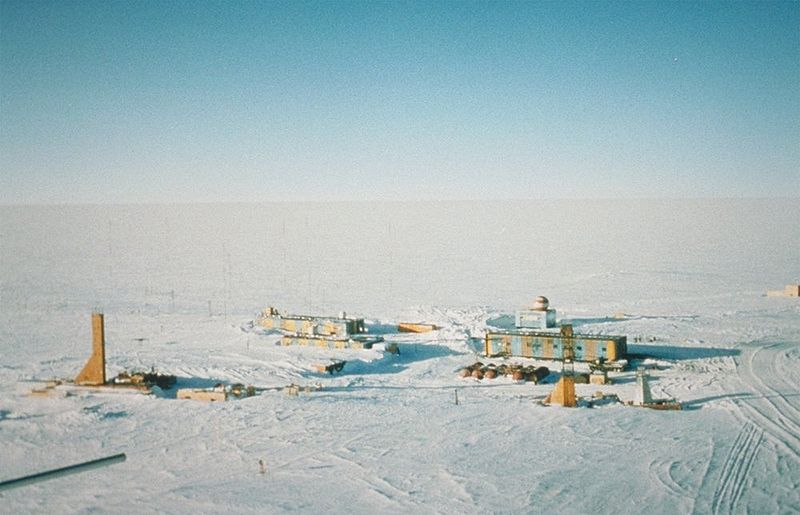
Winter has stymied a Russian-led effort to drill into an Antarctic lake that has been buried for 14 million years, scientists said this week. Just 96 feet short of their goal, scientists had to put their tools away and wait out the rapidly approaching Antarctic winter. But they don’t want to lose the progress they’ve made so far, so they’re pouring kerosene down the borehole to keep it from freezing.
Meanwhile, the scientific community is worried the kerosene will taint the pristine, untouched lake and harm any strange life forms that might call it home.
The Russian team evacuated just in time — had they waited much longer, their airplane’s hydraulic systems would have frozen, stranding them until spring, according to Science Insider. They left behind a 12,300-foot-deep borehole, just 29 meters (about 96 feet) from the lake. Teams had been working 24 hours a day in an attempt to reach the water-ice boundary.Lake Vostok is interesting for its similarity to Europa and Enceladus, frozen satellites of Jupiter and Saturn, respectively. Astrobiologists are among those eager to uncover Lake Vostok’s Miocene-era secrets.
Vostok Station, just above the lake, holds the distinction of experiencing the coldest recorded temperatures on Earth: -129 degrees F on July 21, 1983. If it makes you feel any better, that's the middle of winter on the continent. Incidentally, that is also much colder than the freezing point of kerosene, which is -54 degrees.
Efforts to reach the lake, which remains liquid because of the pressure of a more than 12,000-foot-thick ice cap, have been controversial since it was first discovered in 1993. Russian scientists drilled into it before but had to stop several times to satisfy international bodies tasked with protecting the lake. But the Antarctic Treaty Secretariat, set up to protect the continent, approved the team’s drilling methods last month, giving them the green light to keep drilling. If all goes according to plan, once the drill breaches the ice boundary, the lake’s water pressure will push the drilling fluid up into the borehole, where it will freeze. Another year after that, researchers will return to extract that ancient water and analyze its contents.
But some groups are not convinced the kerosene plug is safe. The Antarctic and Southern Ocean Coalition says contamination could destroy the very attributes that make Lake Vostok unique.
“If Russia continues to drill the lubricants and anti-freeze present in their borehole may taint the microorganisms they are trying to discover,” the coalition argues on its website.
Now everyone will have to wait until at least next December, when the Antarctic summer allows scientists to return and switch on the drills once again.


Five amazing, clean technologies that will set us free, in this month's energy-focused issue. Also: how to build a better bomb detector, the robotic toys that are raising your children, a human catapult, the world's smallest arcade, and much more.


Online Content Director: Suzanne LaBarre | Email
Senior Editor: Paul Adams | Email
Associate Editor: Dan Nosowitz | Email
Assistant Editor: Colin Lecher | Email
Assistant Editor: Rose Pastore | Email
Contributing Writers:
Rebecca Boyle | Email
Kelsey D. Atherton | Email
Francie Diep | Email
Shaunacy Ferro | Email
This has to be the dumbest thing anyone has ever done.
Screw your progress if saving it means destroying what you intend to discover.
This has to be the dumbest thing anyone has ever done...
Leave it to the Russians to screw up something this big.
I agree with both of the comments above, I have been watching this for a few months now...The REAL reason they left wasn't because of winter, it was the lack of their vodka supplies!
Seriously...
There are much safer alternatives for the plug. And some are just as cheap as kerosene. Oleic acid is a hyper dispersant. It only takes a couple of grams to spread over the surface of an entire lake. Hell you could even use a halogen gas pumped down to keep things from totally freezing over.
I am going to play devils advocate. "Leave it to the Russians to screw up something this big." the usa has had their fair share of FUBAR moments in science.
There may be better solutions to this problem, but also remember where they are. They cant drive to the local super science and chemical and machine store to pick up what they need. I would guess they had very little time. They were not expecting this winter to come on to quickly and so strong. I would assume they have plenty of kerosene laying around. for the drill, heating, generators, etc.
I really dont see how they could have pumped a halogen gas down into the hole. They need to plug the hole, but if it was that simple. then i am sure that is all they would have done. Do you mean Halogen or Nobel gasses. Halogen gases are the most reactive gases. Very bad stuff. Not sure they want some iodine or chlorine compound leaking into the lake any more than kerosene.
but agian. they hardely had time to leave, they didnt have time to fly in massive tanks of gas. and water would displace ANY gas, making the gas pointless as the water and ice would simply move it out of the way.
MY question to the Russian or anyone who has an idea is where is the kerosene going to go? my guess it would go down. seep through the ice. or pool at the bottom and leak into the lake when they break through. Do you think all the kerosene would evaporate? I am really not up to date on the physical and thermodynamic properties of kerosene.
my bad. Iodine is solid at room temp. So replace iodine in my previous post with Florine gas. excuse my error.
I think the logical choice would be to leave an anchored building over the bore site. There will have to be re-drilling in any event, and the leaving of a hydrocarbon like kerosene would never have been permitted had any responsible organization known what was going to take place. They should return and pump it out immediately. It was an act of idiocy, and if this is the team chosen to lead this now polluted effort of discovery; then the effort is already doomed. This will not be the only time that the risk of contamination will present it's challenge. If they are not up to it, get someone else. I'm sure that Russia can provide a team with more capability than this pathetic excuse of ruination.
umm vodka doesn't freeze...didn't they think of that? humans really suck!
@quasi44 I agree. it was probably just panic last minute bad decision making. I don't know about an anchored building. again they where stuck out in the middle of nowhere running out of time. I would assume they have some kind of bore cover like most drilling operations. but this is a unique situation so who knows how prepared they were. no very it seems.
EDIT: They should return and pump it out, fill the borehole; and begin planning for a new bore project some reasonable distance away.
@ inaka_rob ; Well these people didn't just have tents, did they? And the McMurdo Station hab was just rebuilt, correct? There is no shortage of material that can be used.
@drinny26 ummm I am sorry. but you are 100% wrong. EVERYTHING freezes my friend. EVERYTHING!!!!
40% vodka freezes at (about) -27c or -16.5f
and 50% freezes at (about) -40c or -40f (where C and F meet!!!)
PURE ethanol at (about) -114c
coldest temp around there is -130f
The vodka would be VERY VERY frozen.
Kerosene is still slightly better (in terms of not freezing)
@quasi44 i dont know. look at the pic at the top of pop sci. They dont seem to have much.
Also, they can say winter this and frozen hydraulics that, but we have re-supplied Antarctica in the dead of winter with C-130's.
from air. We have AIR dropped supplies in. but landing and taking off is certain temp is simply impossible. I would assume they also cant drill in that weather and would rather not chance staying there for months. do you really want to go out in -100f blizzard to look for supplies a c130 dropped and haul them back? and those missions were considers emergency high risk missions.
@ inaka_rob ; There are in fact plenty of materials right in that picture that could have been used, but their desire to scrape off more money from the exploration fund wouldn't permit that. This is worse than bad science protocol, this is something more approaching criminal malfeasance. Whatever the stated reasons of this mismanagement team, the fact is that they do not own the project, nor the equipment, nor the results of the project. Nor does Russia, nor does the Secretariat. This citizen of planet Earth wants this obvious deliberate damage fixed NOW. The pristine environment is supposed to be CONSERVED for the future. This is a method of exploitation, not conservation.
If they are too damm scared to go into -100 F to fix their harm done, then I submit that we have unemployed Eskimos that are up to the challenge.
@ inaka_rob You do realize that fluorine gas will react to almost anything very violently, so pumping the hole full of it would not be a good idea at all.
It does sound like a dumb idea at first, but the risks are very minimal. Kerosene is less dense then water, so any melting that might occur will actually create a barrier of liquid water and even in a scenario where a breach occurs the weight of the ice is going to force fresh water up the breach minimizing the chance kerosene is introduced into the system. Kerosene would not be my first choice, but under the circumstances it makes reasonable sense to use it.
@ inaka_rob, Anarian:
Fluorine gas is both very hard to come by and incredibly dangerous. Just isolating fluorine for the first time cost the lives of some 39 chemists. A tiny amount of it will kill a person horribly over the course of several days. In addition, fluorine is the most powerful oxidizer in existence, capable of setting quartz and glass on fire. It reacts with water (and ice) to make HF, an extremely toxic acid. DEFINITELY not the right thing to use here. Argon would be much safer.
Or, if they're worried about water seeping in from fractures in the walls of the borehole, why not case harden the sides? Melt the ice and allow it refreeze in a slow, controlled way, a few feet at a time while drilling, thus making a solid, impermeable shell of ice around the inside and keeping liquid water out. IIRC this is a fairly common trick when drilling for ice core samples.
In any case, kerosene seems like a poor choice. If you can't plan ahead you have no business doing science.
inaka_rob is a moron.
uhhh.. why dont they cover their hole with a structure so stuff wont fall into and freeze in the hole?
Or am i missing something about hole physics here?
also.. if pressure is hwat has kept the lake liquid.. wont drilla a hole into the lake alieviate that pressure, ultimately allowing this historical gem to freeze?
@Kickstand27 Well they would have gotten what they wanted so whats the big deal if the whole picture is ruined right? on a more serious note, the pressure from below would push the water through the whole freezing it as it rises but once the hole seals up there would still be plenty of pressure to prevent freezing underneath the ice.
The should fill it inert silica... Halogen gases are pretty bad for the atmosphere because they make a ton of free radicals.
From what experience i have in the oil industry, you need to have some type of fluid, pipe, or casing to keep the "hole" from collapsing in on itself. At 12,300 feet the pressure will be extremely high. Kerosene may not be the best choice, but it is probably the most abundant fluid source on the job sight. I am sure they have engineers and scientists working on this that know more than me or most others commenting on this article, or at least I hope so.
My worry is how the hell they plan on getting the kerosene out of the hole. It could take months to pump it out with conventional methods, and leaving it in there is a no-go as well, seeing as it would just leak in when they reach the lake or be ignited by the heat of the friction generated by the drill. And when they do reach it, what might happen? I mean, you leave a sealed bowl of water containing some sort of living microorganisms in the fridge for a year (experiment I helped my cousin do. Don't ask), and not only will you get some funky stuff inside, that thing will sort of 'explode' when you open it; a forceful blast of air and water. So what happens when you have a bowl the size of the Great Lakes that's been covered for millions of years, and you force that pressure through the comparitvely tiny-ass hole their putting in the ice?
On another note, what might they find down there? Have these assholes ever seen John Carpenter's THE THING? i mean, the poor SOB's who dug the monster out of the ice were Norwegian as opposed to Russian, but I don't think the beast is going to care when it starts assimilating their biomass. Do you see what I'm saying? They're playing Russian-Roulet (pun not intended) with a doomsday-deice-revolver, only this one has five bullets instead of one.
they wouldn't need to pump it out, since the when they break through the water pressure gonna, make a geyser. and expell the kerosene, and its less dense than water so its not really going to contaminate much. thats if they do it right.
The big problem with putting kerosene down the hole is that every bit of water coming up the bore will be contaminated in the rise to surface. Considering that biologicals tend to live at different depths, all of their samples of biological origin will be contaminated til the pressure equalizes. Their action was childishly destructive. It would have been less work overall; and much better science, if they had just left.
@Anarian and @aliusdragonfly
I wish people would read posts before they comment on them. I never said to pump florine gas. If you read my post I was pointing out it would be a bad idea.
@lajoey are you f%%%ing kidding you are the moron because you didnt read my "#$"#"#$"#ing posts. what a d%%% fart. I said that putting halogen gasses would be a bad idea if not at the very least. impractical. how does that make me a moron?